
The Fed Is Holding Steady. The Market Is Already Asking What Comes Next.
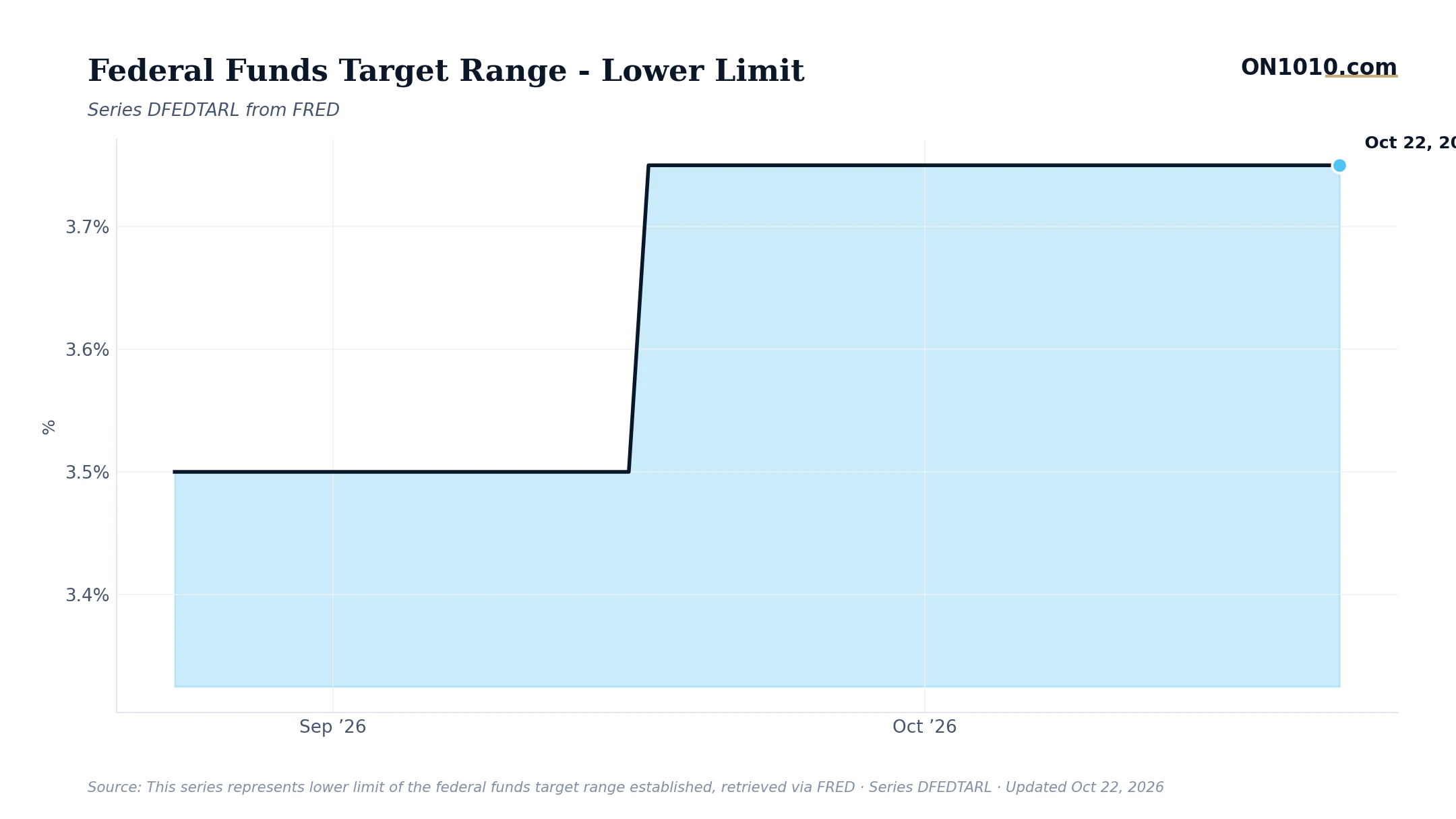
The federal funds rate target (lower bound) sits at 3.75%, unchanged for at least the past week. On the surface, that’s a non-event. Underneath, the tension is building.
Here’s what makes that number interesting right now: monetary policy is running restrictive by historical standards, inflation is still running hot versus its own history, and the bond market is keeping long-term rates in the upper range of their historical record. The Fed is holding its position while the economy around it is shifting.
That combination has a specific economic logic. When the policy rate stays elevated while inflation slowly cools, the real policy rate (the fed funds rate minus inflation) actually rises without the Fed doing anything at all. Restrictive policy gets more restrictive by standing still. That’s the mechanism worth watching here, and it applies real pressure to business borrowing costs, capital project decisions, and anything financed at variable rates. Meanwhile, credit spreads have moved wider recently, a sign that lenders are quietly demanding more compensation for risk, even before the Fed makes another move.
Historically, when monetary policy has been this restrictive relative to its own history, a new recession has begun within the following 12 months about 18% of the time. That’s worth knowing as a base rate, not as a forecast, because most of the time (about 82%) the outcome has been different. What’s notable is the cluster of signals: consumer sentiment near historic lows, credit conditions tightening, and money rotating out of technology and growth sectors into staples, healthcare, and utilities.
In past cycles, business operators and capital allocators have used periods of Fed-on-hold to reassess the refinancing timeline on any floating-rate exposure and to map out which planned investments depend on rates eventually coming down.
Bottom Line: The Fed isn’t moving. But with real policy rates rising quietly in the background and credit conditions tightening at the edges, the real question is whether the current rate level has finished doing its work, or whether the pressure is still building.
Source: Federal Reserve Economic Data (FRED)
ON1010 Research is an independent publisher of economic education and is not a registered investment adviser, broker-dealer, or investment company. This content is for educational and informational purposes only and is not investment advice or a recommendation to buy, sell, or hold any security. Published under the publisher exemption recognized by Section 202(a)(11)(D) of the Investment Advisers Act of 1940 (Lowe v. SEC). Always consult a qualified financial professional before making any financial decision.
Free Research
The economy moves fast. We make sure you move faster.
Economic data, policy shifts, and market signals — delivered to your inbox.
Subscribe Free