
The 2-Year Yield Is Creeping Back Up. The Market Is Telling a Different Story.
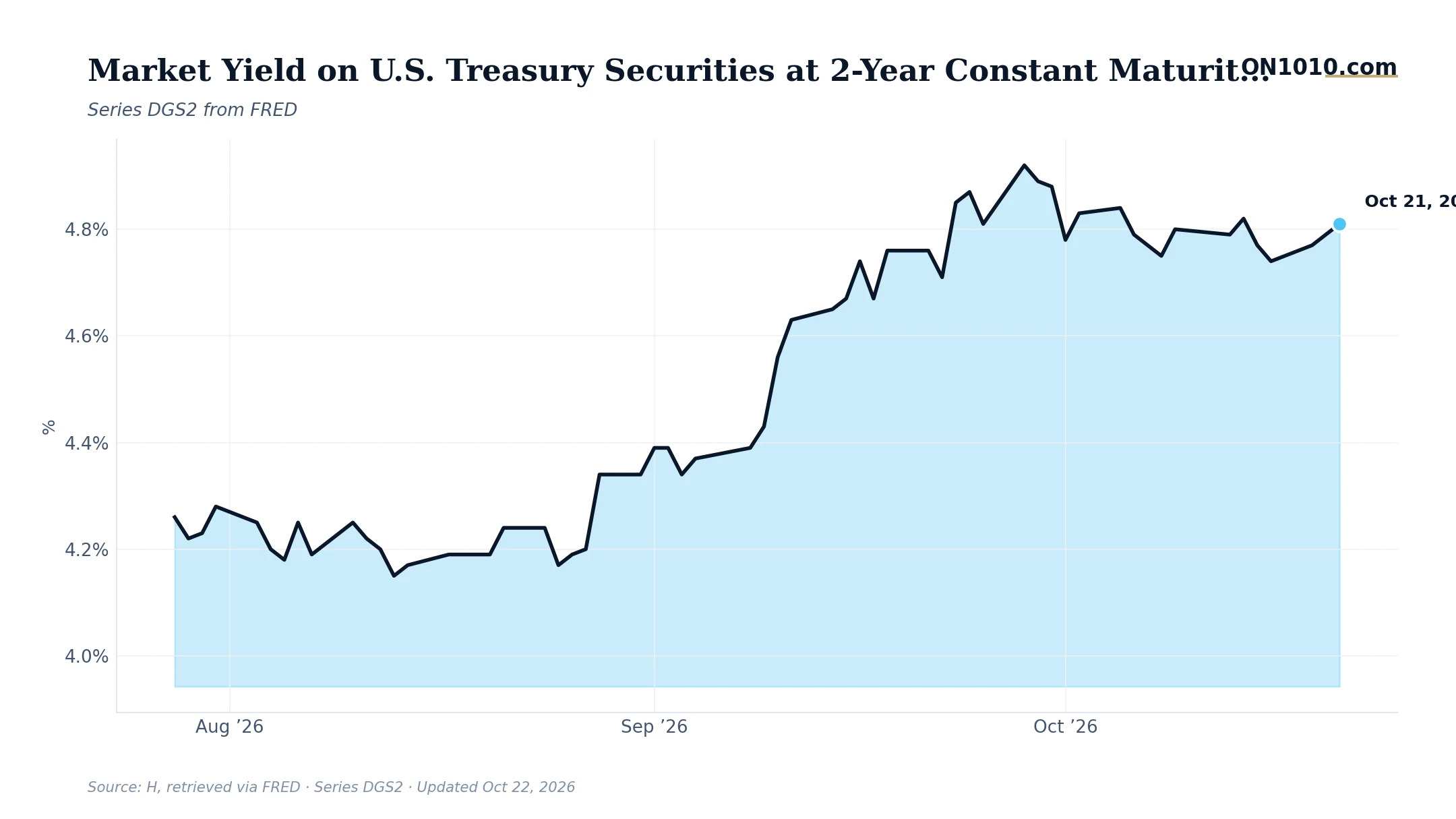
The 2-year Treasury yield has climbed to 4.81%, up from 4.74% just a week ago. That’s a quiet but steady move higher, and it runs directly against what defensive sector rotation and widening credit spreads are usually whispering about the economy’s direction.
Here’s the puzzle. When investors get nervous, they typically flock to safety, and short-term Treasuries are about as safe as it gets. Falling yields usually follow. Instead, the 2-year yield is rising, which signals that bond markets are pricing in fewer rate cuts ahead, or possibly none at all. Meanwhile, consumer staples and healthcare are outperforming tech and communications services by roughly 5 percentage points over the past month. Credit spreads are widening too, a sign that lenders are demanding more compensation for risk. These two things can coexist for a while, but the tension between “yields rising” and “defensive sectors winning” is exactly the kind of signal worth watching.
The backdrop makes this harder to read cleanly. Inflation is still running hot relative to its historical range. The real policy rate (the Fed’s rate minus inflation) is high by historical standards, and historically, monetary policy this restrictive has preceded a recession within 12 months about 18% of the time. That’s not a prediction; it’s a base rate worth knowing.
Historically, when the 2-year yield holds stubbornly high even as credit stress builds, it has reflected a market that hasn’t yet decided whether the economy will soften enough to force the Fed’s hand. In past cycles, capital allocators have watched the spread between short rates and credit conditions as a clue about how long businesses can finance growth before costs become prohibitive.
Bottom Line: The 2-year yield sitting at 4.81% means the bond market still believes the Fed stays higher for longer. The question is whether credit spreads and defensive rotation are early warnings that this tightness is finally starting to bite.
Source: Federal Reserve Economic Data (FRED)
ON1010 Research is an independent publisher of economic education and is not a registered investment adviser, broker-dealer, or investment company. This content is for educational and informational purposes only and is not investment advice or a recommendation to buy, sell, or hold any security. Published under the publisher exemption recognized by Section 202(a)(11)(D) of the Investment Advisers Act of 1940 (Lowe v. SEC). Always consult a qualified financial professional before making any financial decision.
Free Research
The economy moves fast. We make sure you move faster.
Economic data, policy shifts, and market signals — delivered to your inbox.
Subscribe Free