
The Stock Market Just Had Its Worst Day in Months. The Bond Market Saw It Coming.
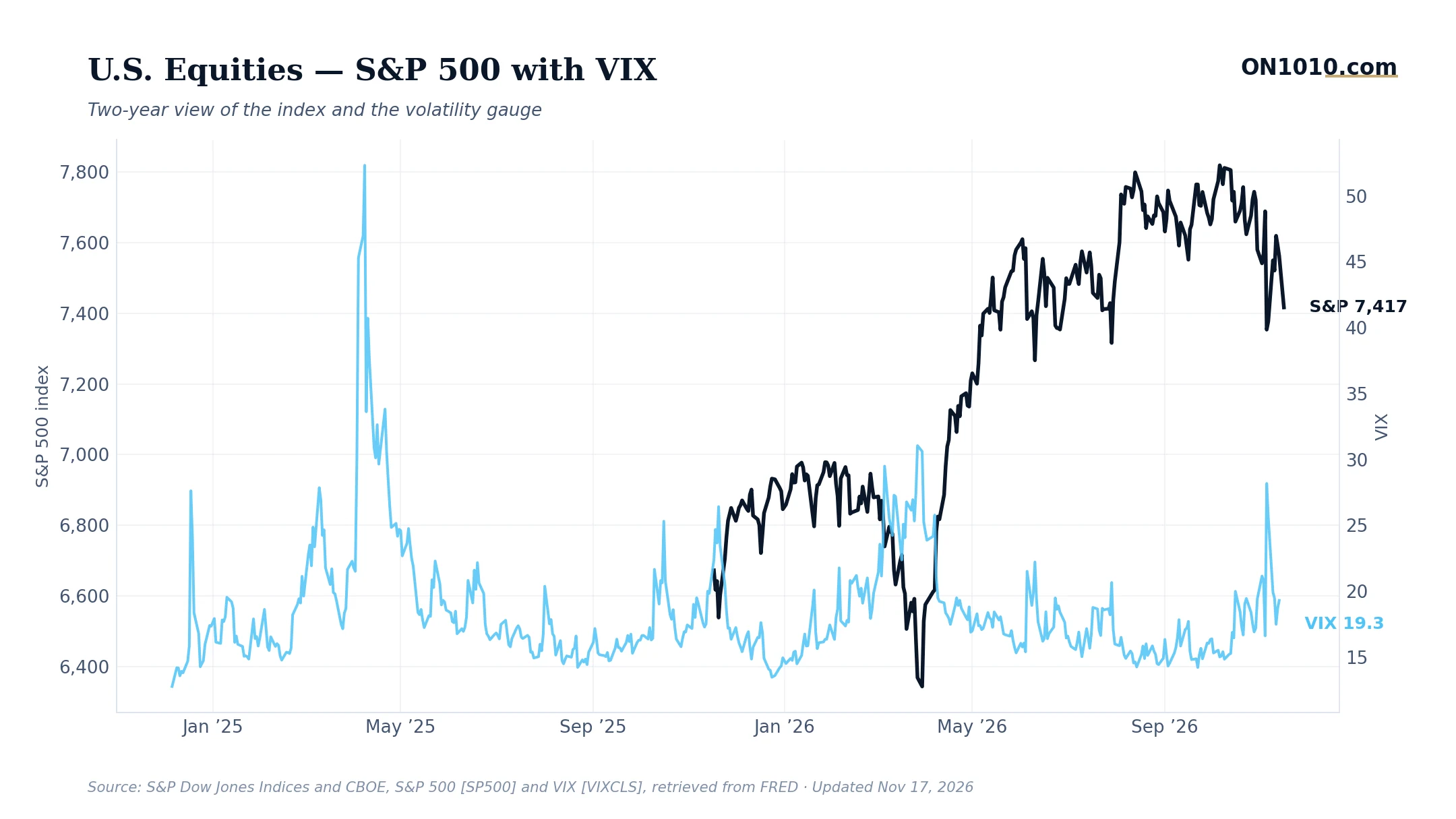
Monday’s selloff was sharp, broad, and hard to wave away. The question is whether it was a warning or just noise, and the bond market has an opinion.
The S&P 500 dropped 1.92% to 7,416, the Nasdaq shed 2.49%, and the Russell 2000 fell 1.70%. Every major index moved lower in unison. The VIX climbed to 23.52, up from 20.03 the session before. Meanwhile, the 10-year Treasury yield sits at 5.15% while the Fed’s target rate is 3.75% to 4.0%. That gap is not typical. When long-term borrowing costs run more than a full percentage point above the policy rate, the bond market is essentially saying it does not trust that inflation stays tamed, or that the government’s borrowing appetite will ever ease.
The harder-to-miss detail is in sector rotation. Over the past month, defensive sectors (consumer staples, health care, real estate, utilities) have outrun the broader market by nearly 8 percentage points. Technology is down 7.2% against the S&P over that stretch. Institutional money has been rotating out of growth and into safety well before Monday’s headline drop.
On deck today: Housing starts and building permits print this morning. With the 10-year at 5.15%, mortgage rates are punishing, so any softness in starts would fit the pattern.
Why it matters: Long-term rates this high, running well above historical norms, raise the cost of every business investment and consumer purchase financed with debt. When credit conditions tighten at the same time sentiment weakens, the margin pressure cycle tends to follow.
Today’s story connects directly to what Sunday’s Long View is already digging into: the full picture on high long rates, wide credit spreads, and what defensive rotation means for the cycle ahead. It’s free, and it lands Sunday.
ON1010 Research is an independent publisher of economic education and is not a registered investment adviser, broker-dealer, or investment company. This content is for educational and informational purposes only and is not investment advice or a recommendation to buy, sell, or hold any security. Published under the publisher exemption recognized by Section 202(a)(11)(D) of the Investment Advisers Act of 1940 (Lowe v. SEC). Always consult a qualified financial professional before making any financial decision.
Free Research
The economy moves fast. We make sure you move faster.
Economic data, policy shifts, and market signals — delivered to your inbox.
Subscribe Free