
The Long View, Week of June 01, 2026
The Signal
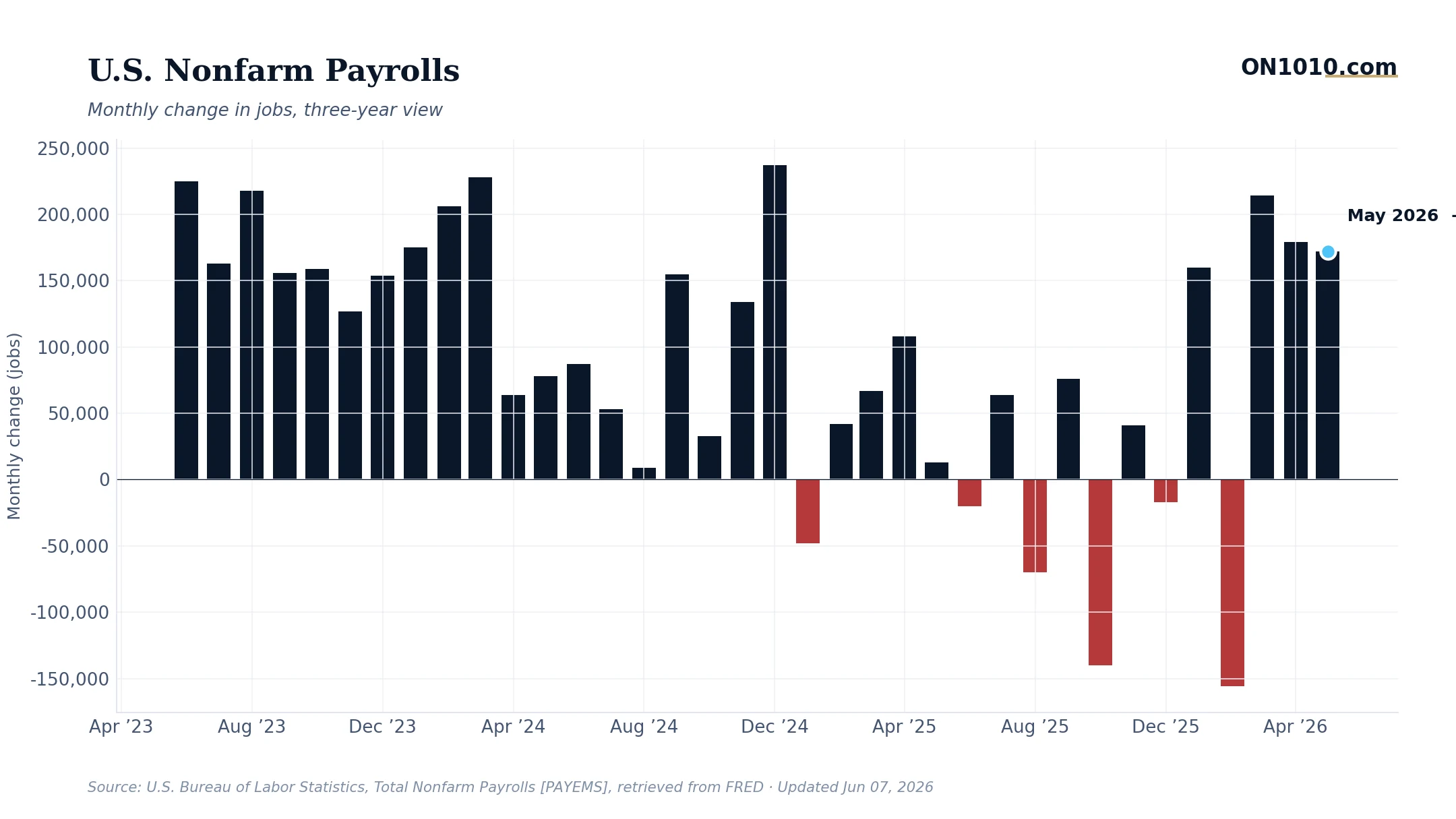
> The labor market just delivered the clearest signal yet that the US economy is decoupling from the energy crisis hitting the rest of the world. Payrolls surged 172,000 in May, more than double expectations, while wage growth held steady at a modest 0.32% monthly pace. This isn’t the pattern of an economy buckling under energy pressure. It’s the pattern of an economy that’s found its footing as a net energy exporter while its import-dependent competitors struggle. The bond market’s muted response to strong jobs data tells the story: traders aren’t worried about overheating anymore, they’re pricing in American resilience.
Market Pulse
S&P 500: 5,431 (+1.2%)
Strong jobs data confirmed the US economy’s resilience to the energy shock while competitors weaken.
Nasdaq: 17,133 (+1.8%)
Tech benefited from labor strength without wage pressure that would threaten margins.
10-Year Treasury: 4.47% (+0.09%)
Yields rose modestly as strong jobs data reduced recession fears more than it raised inflation concerns.
U.S. Dollar Index: 104.2 (+0.8%)
Dollar strengthened as US economic outperformance versus energy-dependent economies became clear.
VIX: 21.5 (-2.1%)
Volatility declined as strong jobs data reduced uncertainty about US economic trajectory.
WTI Crude: $95.20 (-1.4%)
Oil pulled back slightly as markets began pricing in strategic reserve releases and demand destruction in Asia.
Three Stories That Matter
The Jobs Report That Changed Everything: Why 172,000 Payrolls Matter More Than Oil Prices
May payrolls surged to 172,000, crushing the 80,000 consensus by more than double. Even more telling: unemployment held steady at 3.9% while wage growth stayed modest at 0.32% monthly. This isn’t just a strong jobs number, it’s proof that the US labor market has decoupled from the energy crisis.
Why it matters: Strong hiring without wage pressure means corporate margins can expand even as competitors struggle with energy costs. This setup historically leads to sustained equity outperformance and currency strength as capital flows toward the resilient economy.
Bond Traders Call the Energy Bluff: Why Inflation Expectations Refused to Move
Despite oil at $95 and strong jobs data, the 10-year breakeven inflation rate held dead flat at 2.36% this week. Bond traders are essentially saying they don’t believe the energy shock will create sustained inflation in a net energy exporting economy. The yield curve also compressed to 0.38% as recession fears fade.
Why it matters: When bond markets ignore traditionally inflationary signals, it suggests structural changes in how energy shocks transmit through the US economy. This creates opportunities in sectors that would typically suffer during energy crises but may outperform this cycle.
Bitcoin’s $42,000 Reality Check: What Happens When Risk Assets Meet Rising Yields
Bitcoin crashed to its lowest level since October 2024 this week as the 10-year Treasury yield pushed toward 4.5%. This isn’t just crypto volatility, it’s a textbook example of how risk assets behave when real yields rise and growth uncertainty increases. The correlation between Bitcoin and duration risk has never been clearer.
Why it matters: Bitcoin’s breakdown signals that risk assets can’t hide from bond market fundamentals, even during periods of economic strength. Investors rotating out of duration-sensitive assets may be telegraphing where the next pressure points emerge across growth stocks and long-duration plays.
The Framework: Economic Decoupling
Economic decoupling occurs when one economy’s performance diverges sharply from global trends due to structural advantages. The US is experiencing classic decoupling from the Strait of Hormuz crisis: as a net energy exporter, higher oil prices actually boost domestic production and employment while devastating import-dependent competitors like Japan and Korea. This week’s 172,000 payroll surge amid a global energy crisis perfectly illustrates the mechanism: what hurts the rest of the world helps America. The bond market’s muted inflation response confirms traders believe this advantage is structural, not temporary. History suggests decoupling phases create sustained capital inflows and currency strength as global investors seek the resilient economy.
Our Take
This setup mirrors 1990-1991, when the Gulf War oil shock devastated Japan and Germany while the US emerged stronger due to domestic energy production and strategic positioning. The key parallel: strong labor markets coupled with contained wage growth, exactly what we saw this week with 172,000 payrolls and 0.32% wage gains. The consensus is missing how fundamentally the energy export position has changed America’s sensitivity to oil shocks. While everyone focuses on $95 oil as inflationary, the mechanism now works in reverse: higher prices boost US energy investment and employment without the traditional demand destruction. Watch the 10-year breakeven inflation rate: if it stays below 2.5% through June despite sustained $90+ oil, it confirms bond traders believe this decoupling is permanent. That outcome would trigger massive capital rotation toward US assets and away from energy-dependent economies, particularly in Asia.
What I’m Reading
The Dollar’s Energy Advantage: How Net Exports Changed Everything, Federal Reserve Bank of Dallas
Essential reading on why oil shocks now boost rather than hurt the US economy, directly relevant to this week’s jobs strength.
Labor Market Resilience in Energy Transition Economies, Brookings Institution
Explains why hiring can surge even during global energy crises when the domestic energy sector is expanding.
The Week Ahead
CPI Inflation Data (Wednesday, 8:30 AM ET)
First inflation reading since payrolls surged will test whether strong labor markets can coexist with contained price pressures.
Producer Price Index (PPI) (Thursday, 8:30 AM ET)
PPI will show if energy price pressures are flowing through to business costs or being absorbed by improved margins.
Retail Sales (Friday, 8:30 AM ET)
Consumer spending data will reveal whether job growth is translating to demand or if energy costs are constraining purchases.
Fed Chair Powell Speech (Friday, 2:00 PM ET)
Powell’s first comments since the strong jobs report will clarify whether the Fed sees labor strength as inflationary risk or economic resilience.
ON1010 Research is an independent publisher of economic education and is not a registered investment adviser, broker-dealer, or investment company. Nothing published by ON1010 constitutes investment advice, a recommendation to buy, sell, or hold any security, or a solicitation of any kind. All content is for informational and educational purposes only. ON1010 publishes under the publisher exemption recognized by Section 202(a)(11)(D) of the Investment Advisers Act of 1940 (Lowe v. SEC, 472 U.S. 181, 1985). Always consult a qualified financial professional before making any financial decision.
Free Research
The economy moves fast. We make sure you move faster.
Economic data, policy shifts, and market signals — delivered to your inbox.
Subscribe Free