
The 2-Year Treasury Is Creeping Higher. The Market Is Sending a Message.
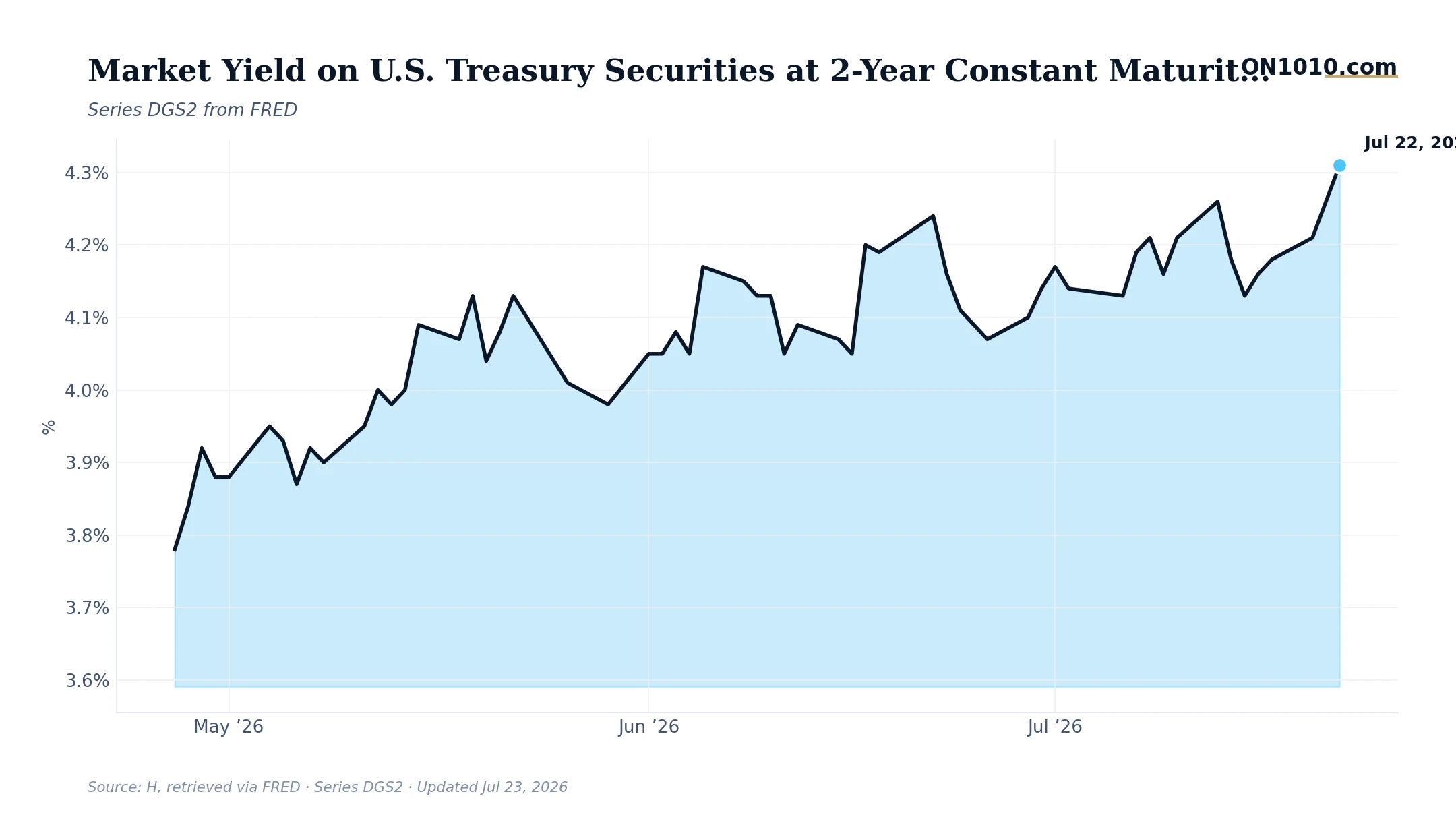
The 2-year Treasury yield has risen for seven straight trading days, climbing from 4.13% on July 15 to 4.31% on July 22. That’s an 18-basis-point move in less than two weeks, and in bond market terms, that’s not noise. That’s a signal.
The 2-year yield is the bond market’s best real-time read on where traders think the Fed will take interest rates over the next 24 months. When it rises, it means the market is pushing back its expectations for rate cuts. Right now, the drift upward is telling you that traders are repricing a “higher for longer” scenario, either because inflation isn’t cooling fast enough, the economy is holding up better than expected, or both.
What makes this interesting is the contradiction sitting right next to it. Sector rotation data shows a clear flight to safety over the past month, with defensive sectors (health care, consumer staples, utilities) beating the broad market by meaningful margins while technology has lagged. Usually, a rising 2-year yield signals confidence in the economy. But defensive sector outperformance signals caution. These two signals are pointing in different directions, which is exactly the kind of tension worth paying attention to.
Historically, a sustained move higher in the 2-year yield has compressed valuations in long-duration assets like growth stocks, since higher near-term rates raise the discount rate applied to future earnings. In past cycles, businesses have also found that rising short-term rates increase the cost of floating-rate debt and short-term borrowing, which squeezes cash flow for capital-intensive operations.
Bottom Line: The 2-year yield is quietly telling you that rate cut hopes are fading, even as defensive positioning suggests investors aren’t fully comfortable with the growth picture. The question worth sitting with: what happens to valuations if the Fed stays on hold longer than the consensus expected heading into the summer?
Source: Federal Reserve Economic Data (FRED)
ON1010 Research is an independent publisher of economic education and is not a registered investment adviser, broker-dealer, or investment company. This content is for educational and informational purposes only and is not investment advice or a recommendation to buy, sell, or hold any security. Published under the publisher exemption recognized by Section 202(a)(11)(D) of the Investment Advisers Act of 1940 (Lowe v. SEC). Always consult a qualified financial professional before making any financial decision.
Free Research
The economy moves fast. We make sure you move faster.
Economic data, policy shifts, and market signals — delivered to your inbox.
Subscribe Free