
The Job Market’s Quiet Signal Everyone Is Sleeping On
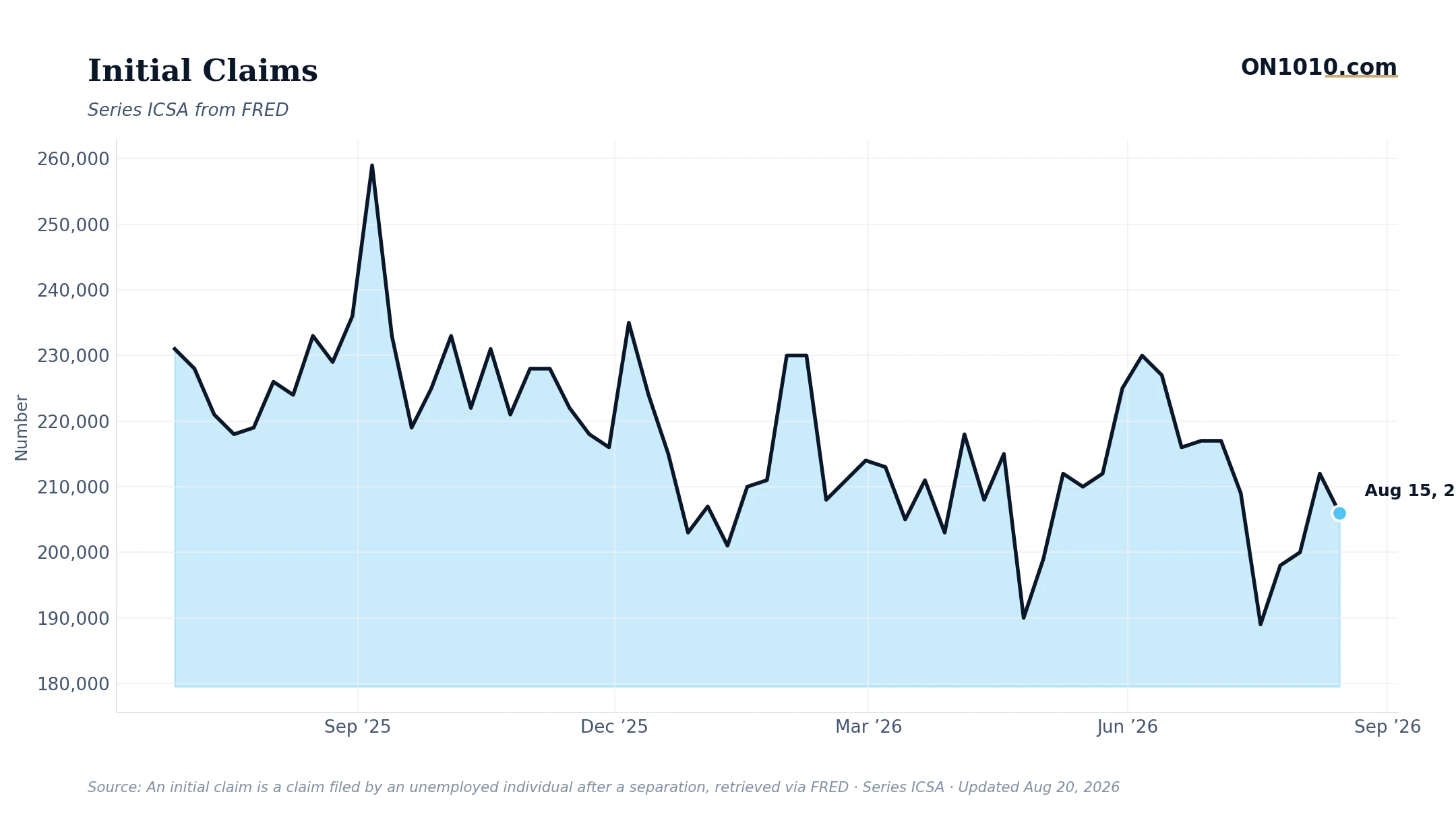
Initial jobless claims fell to 206,000 for the week ending August 15, down 6,000 from the prior week. That sounds fine. Here’s the interesting part: zoom out six weeks and the picture gets more complicated.
Claims have now bounced between 189,000 and 212,000 since mid-July. That’s not a trend. That’s choppiness. And in a data series this important, choppiness deserves more attention than the weekly headline number does.
The six-week average sits right around 202,000 to 203,000, which by any historical standard is a remarkably low level. Layoffs aren’t accelerating. Employers are holding onto workers. But here’s the tension the current setup creates: consumer sentiment is near historic lows, long-term interest rates are running above their historical norm, and yet businesses aren’t cutting. That combination, firms maintaining payrolls while consumers feel terrible, is either a sign of remarkable corporate confidence or a lag that hasn’t closed yet.
Credit spreads are tight and tightening further, which suggests credit markets see no systemic stress on the near-term horizon. But the market’s participation and trend indicators have been weakening, and defensive sectors like health care have pulled ahead of cyclicals recently. The economy and the market are telling slightly different stories right now, which is exactly when you want to be paying close attention.
Historically, when layoffs hold this low, the labor market has been a genuine buffer against broader slowdowns. Employed people spend. Spending supports margins. Margins support hiring. The virtuous cycle stays intact as long as the first link holds. The question worth sitting with is what breaks that chain. High rates are the candidate most worth watching, because they affect business investment decisions with a delay. The hiring you see today reflects confidence that was formed months ago.
Bottom Line: Claims this low say the labor market is still a source of strength, but the gap between how businesses are acting and how consumers are feeling is unusually wide. Which one blinks first matters a great deal for what comes next.
Source: Federal Reserve Economic Data (FRED)
ON1010 Research is an independent publisher of economic education and is not a registered investment adviser, broker-dealer, or investment company. This content is for educational and informational purposes only and is not investment advice or a recommendation to buy, sell, or hold any security. Published under the publisher exemption recognized by Section 202(a)(11)(D) of the Investment Advisers Act of 1940 (Lowe v. SEC). Always consult a qualified financial professional before making any financial decision.
Free Research
The economy moves fast. We make sure you move faster.
Economic data, policy shifts, and market signals — delivered to your inbox.
Subscribe Free