
The Bond Market’s Inflation Forecast Has Barely Moved in a Week. That Calm Deserves Attention.
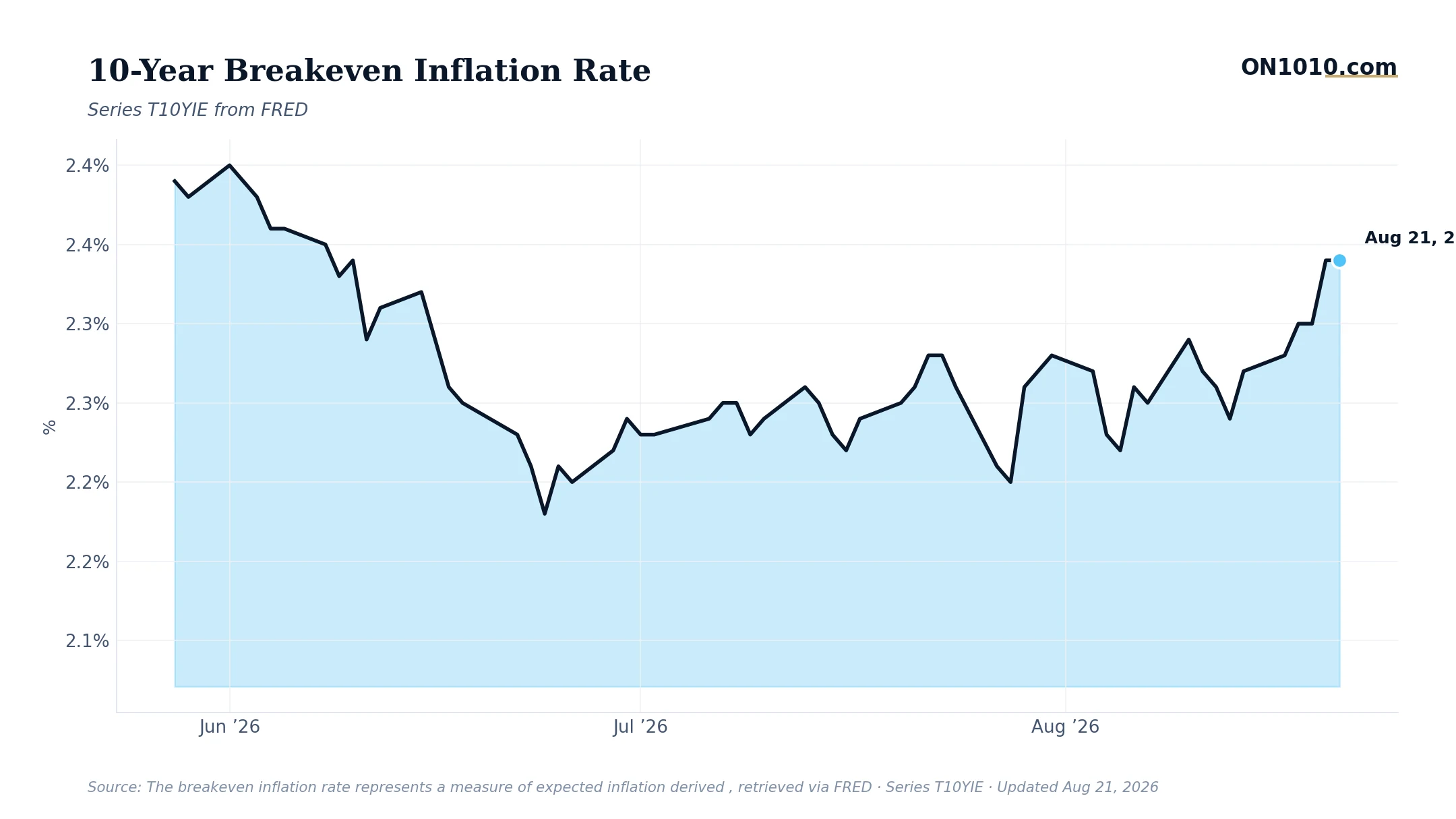
The 10-year breakeven inflation rate has sat at 2.30% to 2.34% for the past six trading days, barely twitching. Markets are pricing in about 2.34% average annual inflation over the next decade, and that number refuses to budge.
In a week when plenty else is moving, that stillness is the story.
The breakeven rate is what you get when you subtract the yield on inflation-protected Treasuries (TIPS) from the yield on regular 10-year Treasuries. Whatever gap remains is what bond traders collectively believe inflation will average over the next decade. Right now, they’re settled on a number just above the Fed’s 2% target, calm, orderly, unimpressed by the noise. That’s notable because our core inflation gauge is running very hot against its own history. Bond traders are essentially saying: we see elevated inflation now, and we believe it normalizes. The question worth asking is whether that confidence is well-placed or complacent.
Historically, when breakeven rates have held in the 2.25% to 2.50% range during periods of above-average actual inflation, it has often reflected genuine trust in central bank credibility, the belief that the Fed will do whatever it takes to bring prices back down. In past cycles, that kind of anchored expectation has given businesses and capital allocators a more stable planning environment, even when the present was messy. But it has also, at times, reflected a market that was slow to price in inflation’s persistence. Both possibilities live inside the same calm number.
Long-term interest rates are elevated against their own history, and our monetary policy gauge sits near its historical midpoint, not tight, not loose. Credit spreads are tight, which speaks to confidence in corporate balance sheets. The pieces form a picture of a market that believes the current discomfort is temporary.
Bottom Line: The bond market’s 10-year inflation forecast hasn’t flinched all week, even as actual inflation runs hot, and the real question for anyone with a long-horizon decision in front of them is whether that confidence in the Fed reflects clear-eyed credibility or a market that hasn’t fully updated yet.
Source: Federal Reserve Economic Data (FRED)
ON1010 Research is an independent publisher of economic education and is not a registered investment adviser, broker-dealer, or investment company. This content is for educational and informational purposes only and is not investment advice or a recommendation to buy, sell, or hold any security. Published under the publisher exemption recognized by Section 202(a)(11)(D) of the Investment Advisers Act of 1940 (Lowe v. SEC). Always consult a qualified financial professional before making any financial decision.
Free Research
The economy moves fast. We make sure you move faster.
Economic data, policy shifts, and market signals — delivered to your inbox.
Subscribe Free