
The Yield Curve Just Sent a Quiet Signal. Here’s What It’s Saying.
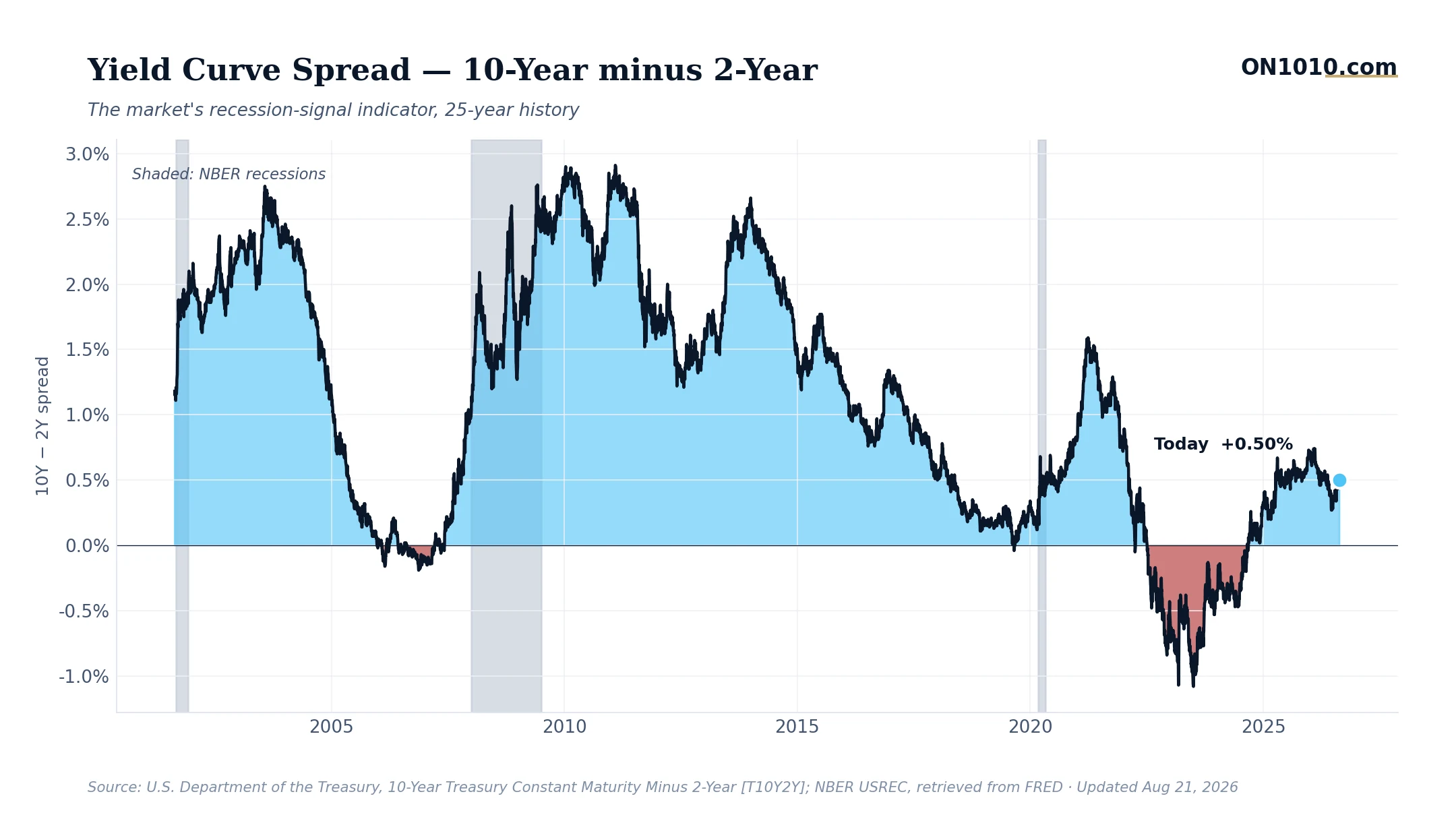
The 10-year/2-year Treasury spread held at 0.5% this week, sitting in a narrow band between 0.46% and 0.53% for the past six trading days. No drama, no swing. But the stillness itself is worth paying attention to.
Think of the yield curve as the bond market’s opinion on where the economy is going. When long-term rates are meaningfully higher than short-term rates, lenders expect growth and, often, inflation ahead. When the gap collapses or inverts, the market is saying the opposite: that the Fed’s short-term rates are too high relative to where growth is headed. Right now, the spread is positive but thin, parked well below the historical average of around 1.0% to 1.5%. The curve has re-steepened from the deep inversion of 2022 to 2024, but it has not fully normalized.
That re-steepening matters because of how it happened. Long-term rates remain high by historical standards, credit spreads are tight (a sign of calm in private lending markets), and VIX sits in a comfortable range. The bond market is not flashing red. But core inflation is running hot relative to history, and the curve still has room to climb before it signals the kind of broad credit easing that typically fuels a full business cycle expansion.
Historically, when the curve has re-steepened into positive territory after a prolonged inversion, it has marked a reset point for capital allocation decisions. In past cycles, business operators and capital allocators have used that window to reassess borrowing costs, refinancing timelines, and investment horizons, since the cost of duration was shifting. How fast the curve steepens, and what drives it (falling short rates vs. rising long rates), has tended to tell very different stories about what comes next.
Bottom Line: The yield curve is no longer predicting a recession, but it is also not yet pricing a boom. The question worth sitting with: is the curve stuck here because the economy has found equilibrium, or because something is still unresolved between the Fed and long-term lenders?
Source: Federal Reserve Economic Data (FRED)
ON1010 Research is an independent publisher of economic education and is not a registered investment adviser, broker-dealer, or investment company. This content is for educational and informational purposes only and is not investment advice or a recommendation to buy, sell, or hold any security. Published under the publisher exemption recognized by Section 202(a)(11)(D) of the Investment Advisers Act of 1940 (Lowe v. SEC). Always consult a qualified financial professional before making any financial decision.
Free Research
The economy moves fast. We make sure you move faster.
Economic data, policy shifts, and market signals — delivered to your inbox.
Subscribe Free