
The 10-Year Yield Is Holding Near Its Highest Levels in Over a Decade. That Tension Is Worth Understanding.
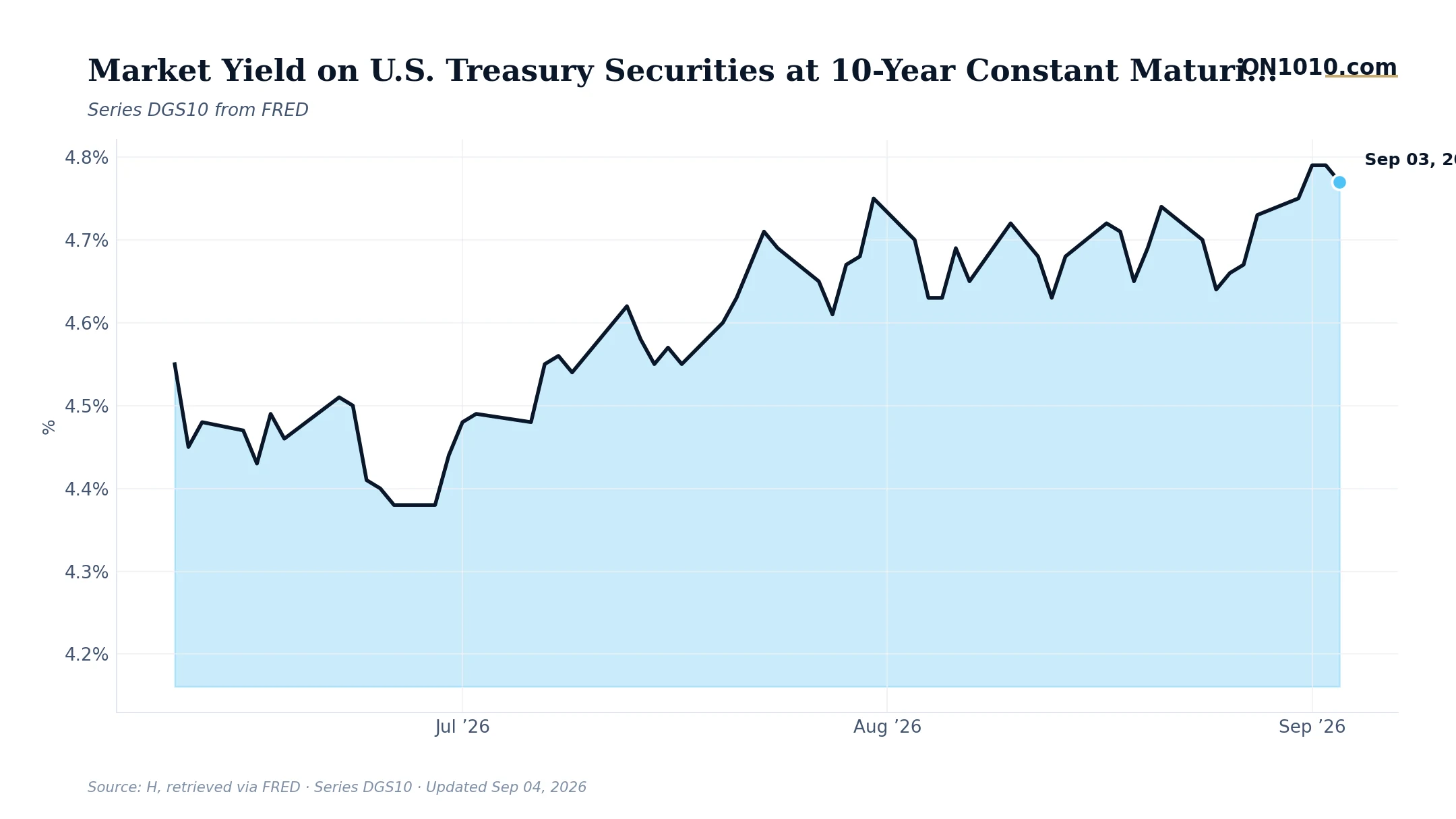
The 10-year Treasury yield edged down to 4.77% on September 3, after sitting at 4.79% for two straight days. A two-basis-point move barely registers on its own. What does register: this yield has crept up from 4.67% just a week ago, and it remains in the upper quarter of every reading in modern history.
The bigger story here is the contradiction the bond market is spelling out. Credit spreads are historically tight, meaning corporate bond investors are barely asking for extra compensation to hold riskier debt. That’s the calm side of the ledger. Meanwhile, the 10-year yield itself is historically elevated, meaning the floor cost of borrowing across the entire economy is high. You can have both at once when growth expectations are solid and inflation remains sticky, but it creates a quiet tension. When the base rate is this high and core inflation is running hotter than roughly nine out of every ten months on record, the math of capital allocation changes for almost everyone: businesses borrowing to expand, homebuyers financing a purchase, and companies issuing new debt all face a structurally higher hurdle rate than they did two or three years ago.
Historically, when long-term rates have held at levels like these, a new recession began within the following 12 months roughly 19% of the time. That is not a forecast, it is a base rate worth knowing. In past cycles, investors and business operators have used elevated long-term rates as a prompt to examine refinancing timelines, duration exposure, and whether projected returns on capital investment still clear the bar when borrowing costs are this elevated.
The offsetting data point is also real: market volatility just dropped below its historical midpoint, and the major equity index sits comfortably above both its 50-day and 200-day moving averages. That’s not the posture of a market pricing in serious damage.
Bottom Line: The 10-year yield holding near 4.77% in a world of tight credit spreads and calm equity markets tells a complicated story. The question worth sitting with: if the cost of money stays this high for this long, which business models built on cheap capital start to feel the friction first?
Source: Federal Reserve Economic Data (FRED)
ON1010 Research is an independent publisher of economic education and is not a registered investment adviser, broker-dealer, or investment company. This content is for educational and informational purposes only and is not investment advice or a recommendation to buy, sell, or hold any security. Published under the publisher exemption recognized by Section 202(a)(11)(D) of the Investment Advisers Act of 1940 (Lowe v. SEC). Always consult a qualified financial professional before making any financial decision.
Free Research
The economy moves fast. We make sure you move faster.
Economic data, policy shifts, and market signals — delivered to your inbox.
Subscribe Free