
The Yield Curve Is Back in Positive Territory. That’s Worth Pausing On.
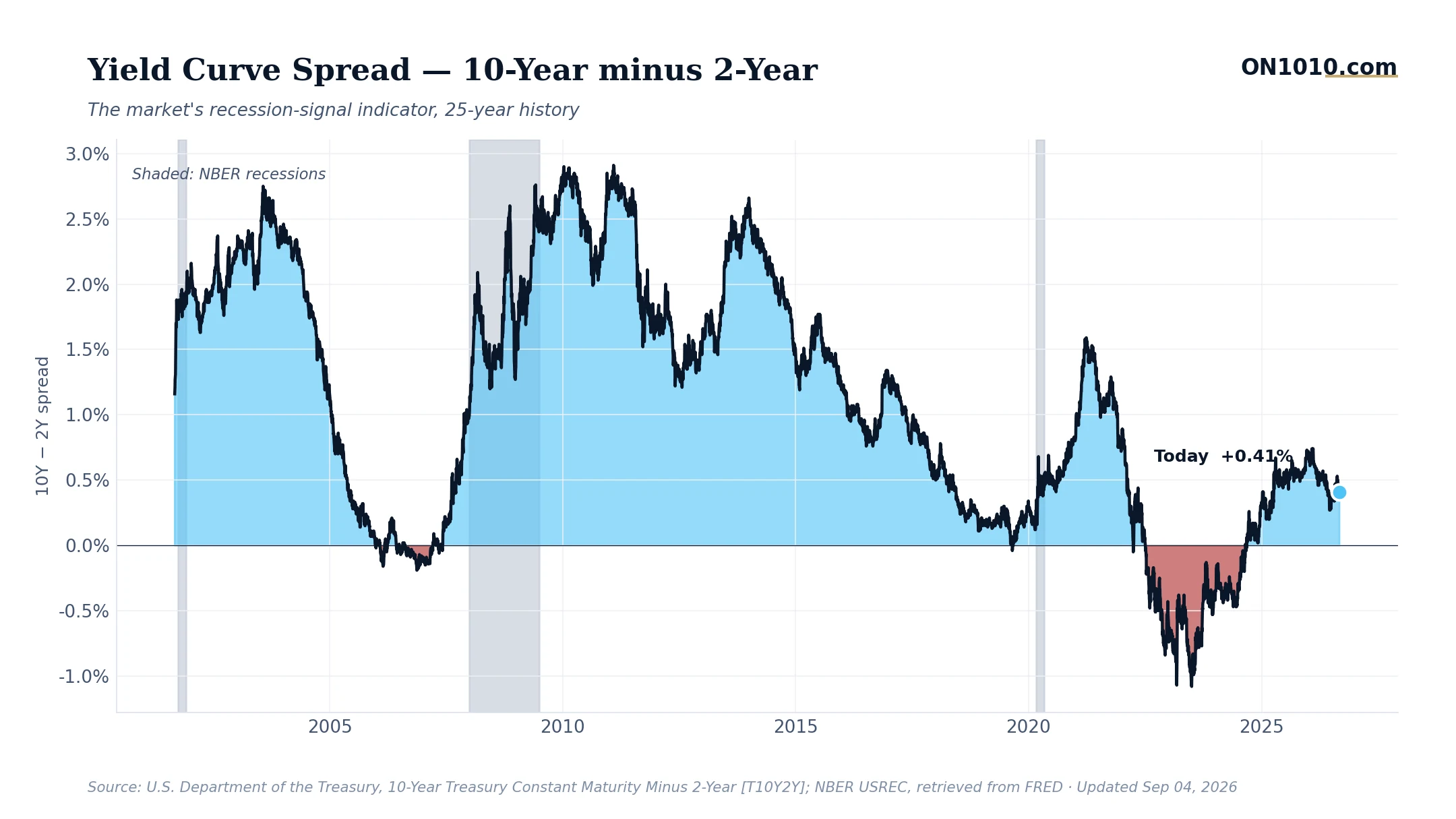
The 10-year/2-year Treasury spread sits at 0.41% as of September 4, down a tick from 0.43% the day before. The small daily move is noise. The bigger story is where we are: the curve has been comfortably positive for several weeks now, holding in a tight range between 0.39% and 0.43%, after one of the deepest and longest inversions in modern history.
That normalization matters. For roughly two years, the inverted curve was the dominant recession signal that nearly every economist cited. The inversion is gone. The curve is re-steepening. And so far, the recession the textbooks promised has not arrived on schedule.
Here is the tension worth sitting with. Long-term rates are sitting in the upper quarter of their historical range, meaning they are elevated by any historical standard. Credit spreads, on the other hand, are near the tightest levels on record, which is credit markets saying corporate balance sheets look fine and default risk is low. Those two things can coexist for a while, but they represent competing narratives about where the economy is headed. Tight credit spreads are the bond market’s vote of confidence in business health. Elevated long-term rates are a reminder that capital remains expensive.
Historically, when the yield curve has re-steepened after a prolonged inversion, there have been two very different stories. Sometimes it meant the coast was clear and growth was returning. Other times, it meant the Fed was cutting rates because conditions were deteriorating fast. The spread itself does not tell you which story you are in. What you watch next is whether the curve steepens because short rates fall (the Fed easing) or because long rates rise (growth and inflation expectations picking up). The mechanism behind the move is everything.
From similar interest-rate environments in the historical record, a new recession began within the following 12 months about 19% of the time. That is not a prediction. It is a base rate worth knowing before drawing conclusions from a normalizing curve.
Bottom Line: A positive yield curve after a historic inversion is a milestone, but the curve’s direction matters less than the reason behind it. Watch whether it is short rates falling or long rates rising that does the work from here.
Source: Federal Reserve Economic Data (FRED)
ON1010 Research is an independent publisher of economic education and is not a registered investment adviser, broker-dealer, or investment company. This content is for educational and informational purposes only and is not investment advice or a recommendation to buy, sell, or hold any security. Published under the publisher exemption recognized by Section 202(a)(11)(D) of the Investment Advisers Act of 1940 (Lowe v. SEC). Always consult a qualified financial professional before making any financial decision.
Free Research
The economy moves fast. We make sure you move faster.
Economic data, policy shifts, and market signals — delivered to your inbox.
Subscribe Free