
Bond Market Sends a Quiet Signal: Inflation Expectations Are Anchored, and Holding
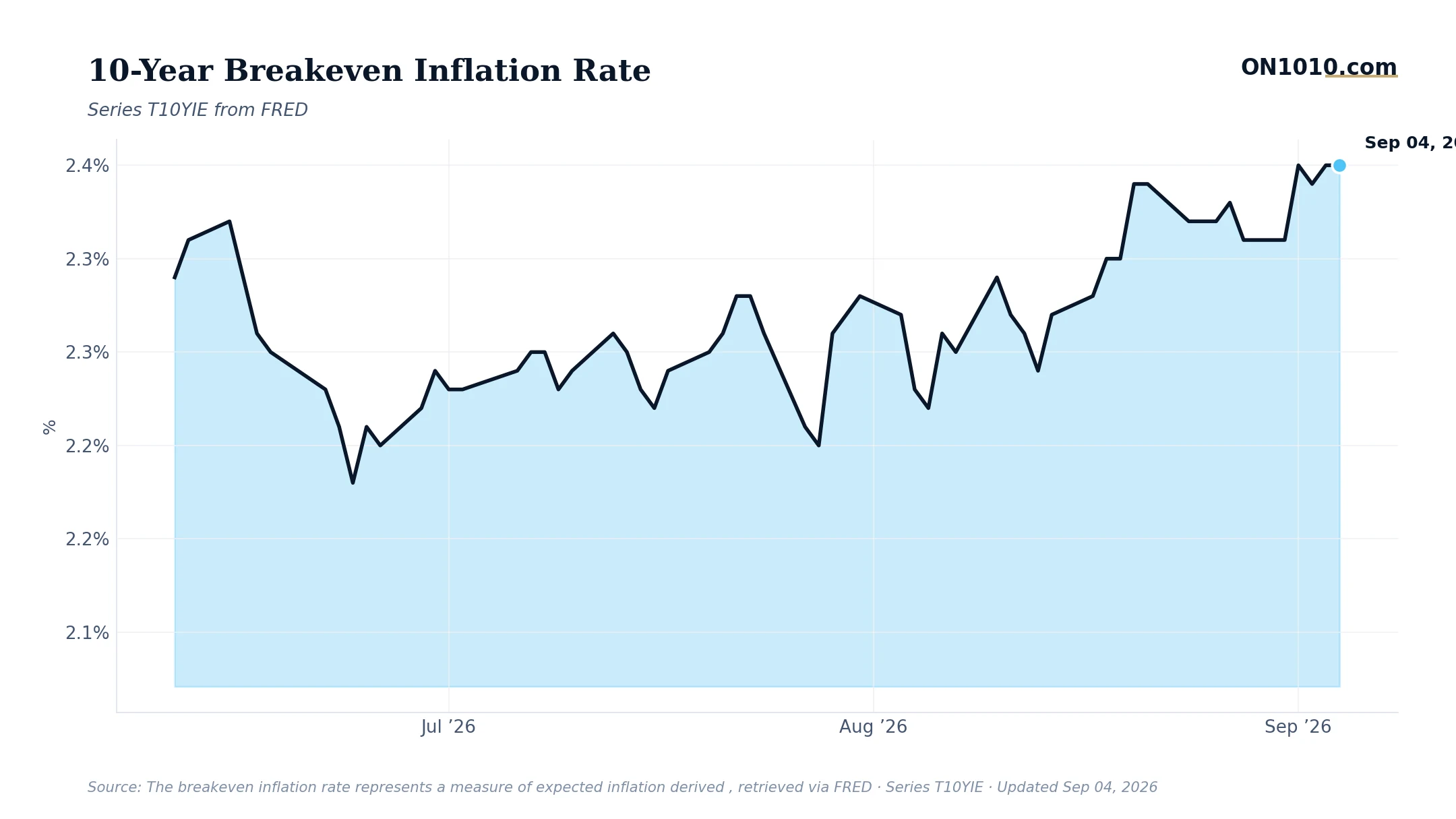
The bond market’s inflation forecast has barely moved in a week. The 10-year breakeven rate held at 2.35% on September 4, up just slightly from 2.31% at the end of August. That steadiness, in a week where plenty of noise surrounded trade, the labor market, and Fed expectations, is worth pausing on.
Here’s why it’s interesting: the breakeven rate is what you get when you subtract the yield on inflation-protected Treasuries from regular Treasury yields. The gap between them represents what the collective bond market thinks inflation will average over the next decade. Right now, that number is 2.35%. Call it the bond market’s best guess, priced in real dollars, with real money on the line.
The broader context makes this reading more meaningful. Core inflation still sits hot against its historical range. Long-term interest rates are elevated. Consumer sentiment remains weak. And yet the market’s long-run inflation expectation is sitting about 35 basis points above the Fed’s 2% target, not surging, not collapsing, just quietly anchored. That’s the bond market saying: we believe this inflation episode eventually resolves, but probably not all the way back to 2%.
In past cycles, a 10-year breakeven in the 2.2% to 2.5% range has generally been associated with environments where the Fed has some room to manage rates without sparking a panic about long-run price stability. Historically, it’s when this number drifts toward 2.7% or higher that bond markets have started pricing in a more aggressive Fed response, and that’s when borrowing costs for businesses and homeowners tend to rise more sharply. Operators planning long-duration investments often watch this number closely alongside the nominal 10-year yield, because together they describe the real rate environment that new projects have to clear.
Bottom Line: The bond market is holding a view that inflation won’t spiral, but it isn’t fully bought into a return to the old 2% world either. The question worth sitting with: if breakevens start drifting higher from here, what would that signal about the durability of current margin conditions?
Source: Federal Reserve Economic Data (FRED)
ON1010 Research is an independent publisher of economic education and is not a registered investment adviser, broker-dealer, or investment company. This content is for educational and informational purposes only and is not investment advice or a recommendation to buy, sell, or hold any security. Published under the publisher exemption recognized by Section 202(a)(11)(D) of the Investment Advisers Act of 1940 (Lowe v. SEC). Always consult a qualified financial professional before making any financial decision.
Free Research
The economy moves fast. We make sure you move faster.
Economic data, policy shifts, and market signals — delivered to your inbox.
Subscribe Free