
Bond Markets Are Telling a Quiet Story About Inflation. Listen Carefully.
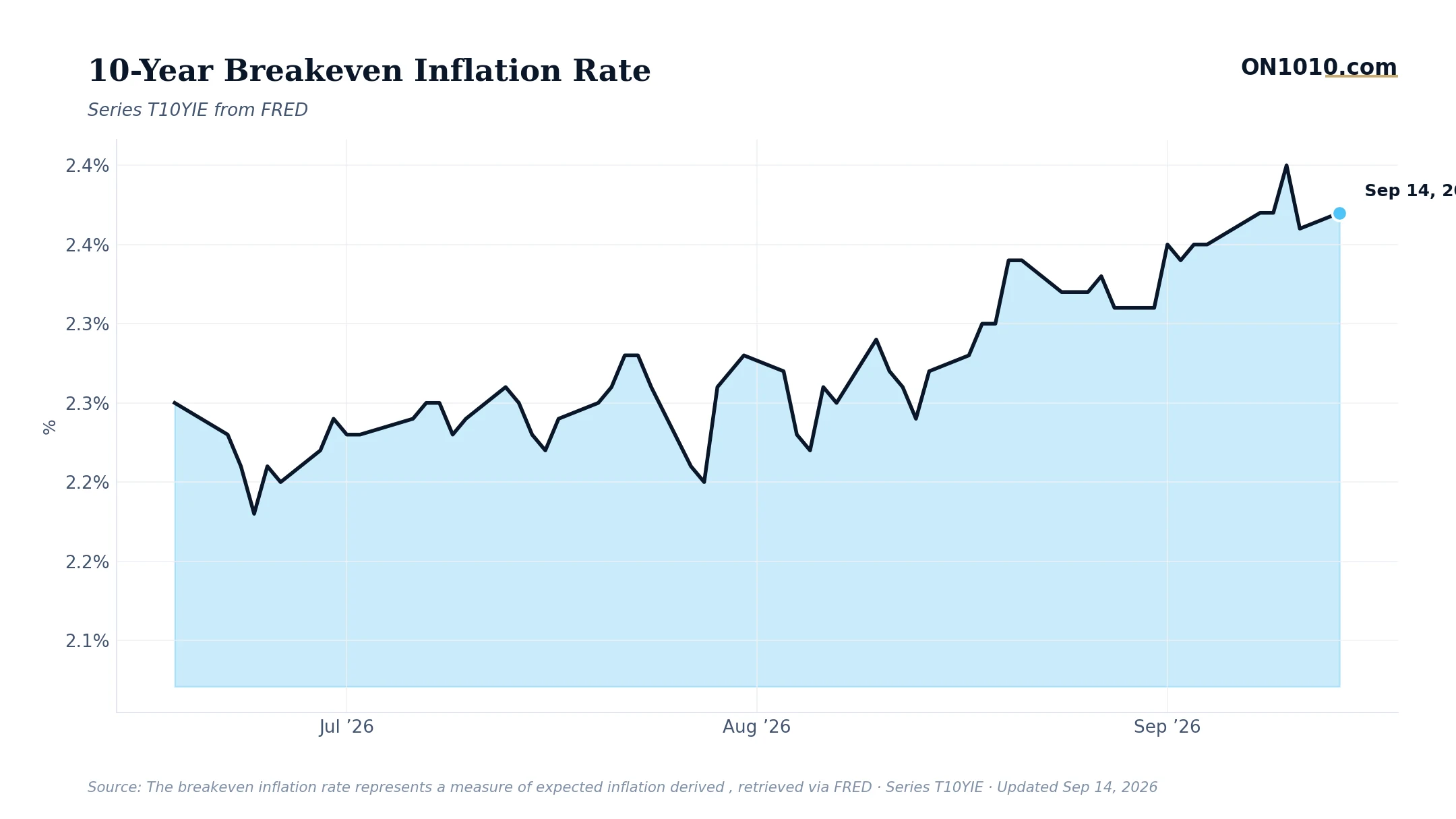
The 10-year breakeven inflation rate ticked up to 2.37% on September 14, from 2.36% the session before. That move is tiny. The range over the past two weeks, between 2.35% and 2.40%, is even tighter. What’s worth your attention isn’t the daily move. It’s the stubborn stability of where this number has parked itself.
Bond investors embed their best collective guess about future inflation into the spread between regular Treasuries and inflation-protected securities (TIPS). Right now, that guess is 2.37% average inflation per year for the next decade. That sits above the Fed’s 2% target, and it has been sitting there. The consistency signals something: markets aren’t panicking about inflation running away, but they aren’t fully convinced it’s solved either.
Pair that with the bigger dashboard and a tension emerges. Core inflation readings remain historically hot relative to their long-run range, yet credit spreads are near the tightest readings on record, meaning corporate bond investors are pricing in almost no financial stress. Long-term interest rates are elevated relative to history. Those three facts can coexist, but they create a narrow path: the economy needs to keep growing fast enough to justify tight credit spreads, while inflation stays contained enough to keep the Fed from tightening further.
Historically, when breakeven inflation has held above the Fed’s target for an extended stretch, it has complicated rate-cut decisions even when growth appeared to be slowing. In past cycles, business operators and capital allocators have treated the breakeven rate as one of the early signals about the real cost of long-duration commitments, since any investment priced today will be repaid in future dollars that inflation steadily erodes. A rate stuck at 2.37% is not alarming, but it is a persistent reminder that inflation expectations haven’t fully returned to their pre-2020 anchoring.
Bottom Line: The bond market is saying inflation won’t disappear quietly over the next decade. The question is whether the Fed’s current posture is tight enough to push that number back toward 2%, or whether we’ve quietly accepted a new normal somewhere between the old target and the post-pandemic highs.
Source: Federal Reserve Economic Data (FRED)
ON1010 Research is an independent publisher of economic education and is not a registered investment adviser, broker-dealer, or investment company. This content is for educational and informational purposes only and is not investment advice or a recommendation to buy, sell, or hold any security. Published under the publisher exemption recognized by Section 202(a)(11)(D) of the Investment Advisers Act of 1940 (Lowe v. SEC). Always consult a qualified financial professional before making any financial decision.
Free Research
The economy moves fast. We make sure you move faster.
Economic data, policy shifts, and market signals — delivered to your inbox.
Subscribe Free