
Bond Markets Say Inflation Is Behaving. The Rest of the Dashboard Isn’t So Sure.
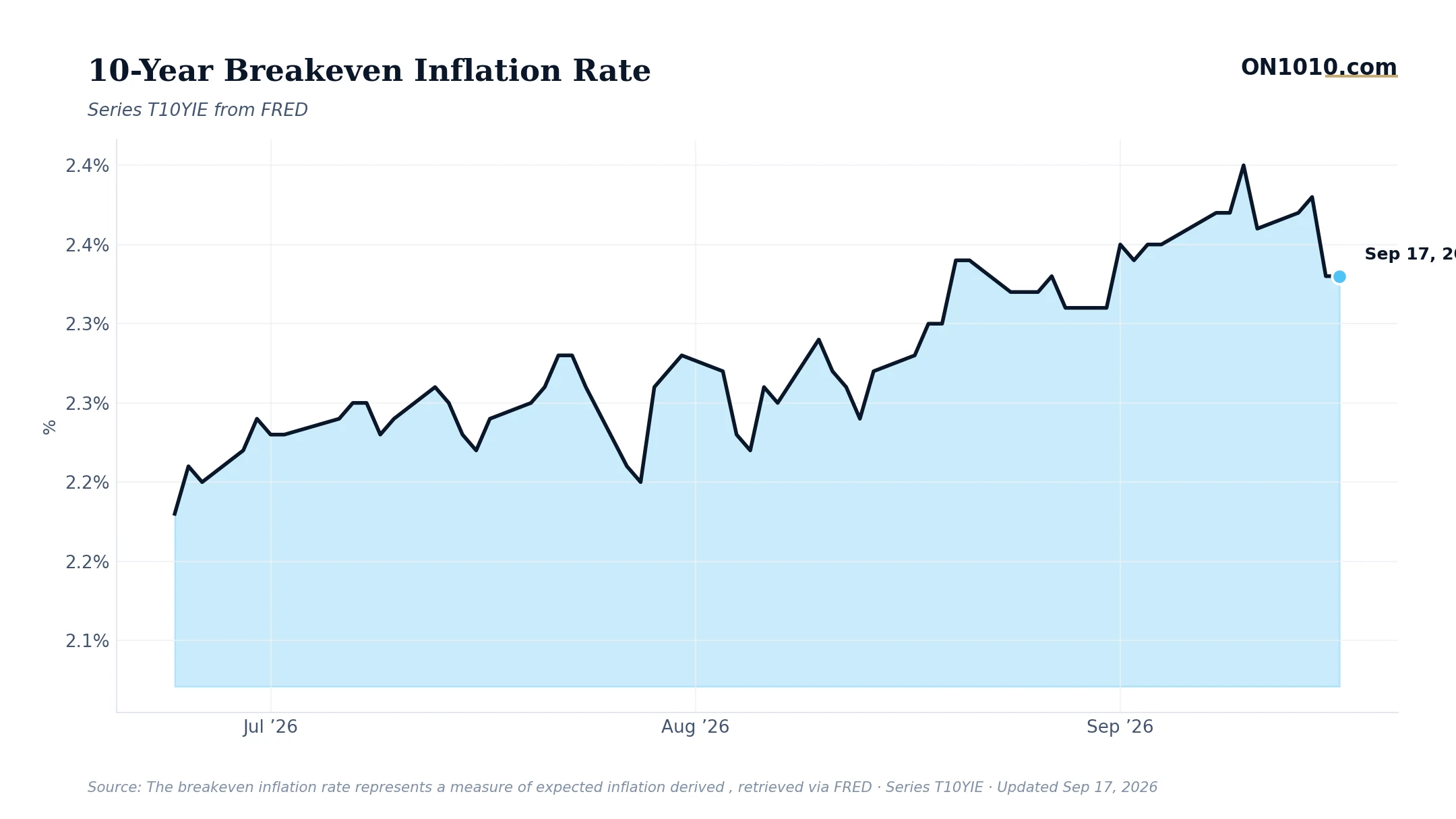
The 10-year breakeven inflation rate held at 2.33% on September 17, flat for two straight days after a gentle slide from 2.40% earlier this month. Bond investors are pricing in inflation that is close to the Fed’s 2% target, comfortably anchored, and not accelerating. On the surface, that sounds like good news.
But here’s the tension worth examining. Core inflation, measured against its own long history, is running hotter than roughly nine of every ten months on record. Bond markets say inflation expectations are tame. The actual inflation gauge says we’re still burning hot. Those two readings don’t fully agree, and understanding why is worth the effort.
The breakeven rate is what you get when you subtract the TIPS yield from the nominal Treasury yield. When it’s steady around 2.33%, it means investors in the $25 trillion Treasury market collectively believe the Fed has the inflation problem more or less contained over the next decade. That’s a meaningful vote of confidence. Historically, when breakevens have been anchored below 2.5% while actual inflation remained elevated, it suggested the market believed the disinflationary trend was already underway, even if the data hadn’t fully confirmed it yet.
In past cycles, when breakevens and actual inflation diverged like this, the question businesses and capital allocators tended to ask was whether bond markets were early or wrong. Long-term rates sit in the upper quarter of their historical range right now, credit spreads are tight, and consumer sentiment is near its weakest on record. That combination historically raises real questions about where demand is heading.
Bottom Line: Bond markets are telling you inflation gets solved. Everything else is asking: at what cost to growth?
Source: Federal Reserve Economic Data (FRED)
ON1010 Research is an independent publisher of economic education and is not a registered investment adviser, broker-dealer, or investment company. This content is for educational and informational purposes only and is not investment advice or a recommendation to buy, sell, or hold any security. Published under the publisher exemption recognized by Section 202(a)(11)(D) of the Investment Advisers Act of 1940 (Lowe v. SEC). Always consult a qualified financial professional before making any financial decision.
Free Research
The economy moves fast. We make sure you move faster.
Economic data, policy shifts, and market signals — delivered to your inbox.
Subscribe Free