
Consumer Sentiment Slips Again. The Bond Market Doesn’t Seem to Care.
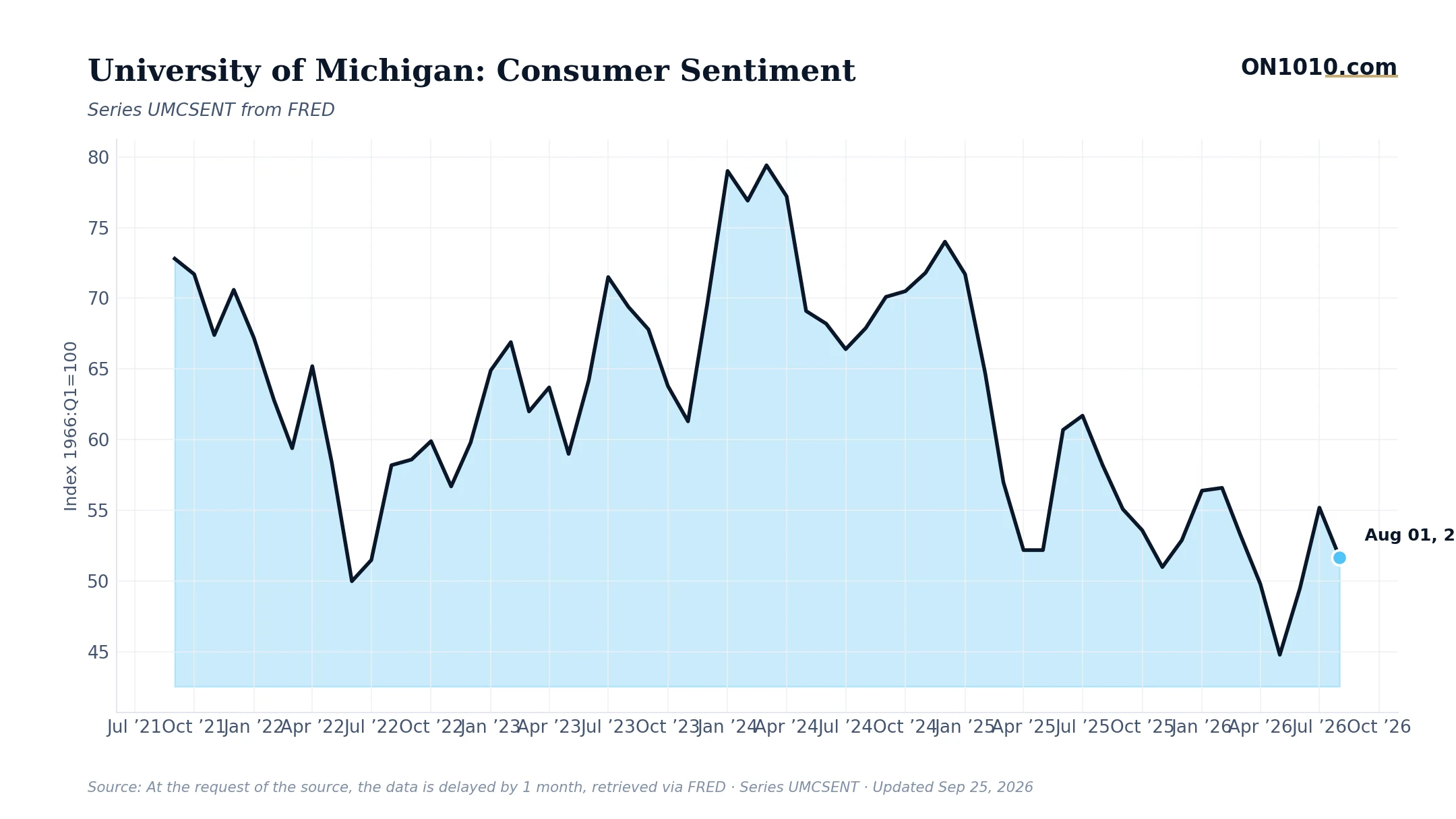
Consumer sentiment fell to 51.7 in August, down 3.5 points from July’s 55.2. That puts it back near its recent lows, and it places the mood of the American consumer in territory weaker than roughly nine of every ten months on record since the 1960s.
Here’s the puzzle: the bond market and credit markets aren’t behaving like something is seriously wrong. Credit spreads remain historically tight, suggesting lenders see low risk of widespread default. Long-term rates are high by historical standards but rising gradually, not spiking. Those are signals that institutional money is not pricing in an economic breakdown, even as everyday consumers say they feel terrible.
That gap deserves attention. Sentiment surveys measure how people feel, which can diverge sharply from what they actually do. Spending is ultimately driven by income, employment, and credit access, not mood surveys alone. The recent trend here is also worth noting: sentiment crashed to 44.8 in May, bounced to 55.2 in July, and now retreated to 51.7. That’s a volatile, choppy pattern rather than a straight-line collapse, suggesting consumers are reacting to headlines and uncertainty rather than deteriorating fundamentals.
Historically, when sentiment sits this far below its long-run average, a recession beginning within the following 12 months has occurred roughly 0% of the time in the data, and a year later this indicator has typically drifted higher. That is the base rate, not a promise. In past cycles, business operators have used extended periods of low sentiment as a lens for pricing strategy, inventory positioning, and demand forecasting, particularly for discretionary spending categories where mood tracks closely with purchase decisions.
The real tension here is between soft data (how people feel) and hard data (what credit markets and employment are showing). When those two diverge for long, one of them eventually proves correct.
Bottom Line: Consumer sentiment is historically depressed, but credit markets are calm and recession base rates at this sentiment level are surprisingly low. The question worth tracking is whether this soft-data weakness eventually bleeds into hard-data spending, or whether the mood lifts as headline uncertainty fades.
Source: Federal Reserve Economic Data (FRED)
ON1010 Research is an independent publisher of economic education and is not a registered investment adviser, broker-dealer, or investment company. This content is for educational and informational purposes only and is not investment advice or a recommendation to buy, sell, or hold any security. Published under the publisher exemption recognized by Section 202(a)(11)(D) of the Investment Advisers Act of 1940 (Lowe v. SEC). Always consult a qualified financial professional before making any financial decision.
Free Research
The economy moves fast. We make sure you move faster.
Economic data, policy shifts, and market signals — delivered to your inbox.
Subscribe Free