
Core Inflation Is Cooling. But “Cool” Is Doing a Lot of Work Here.
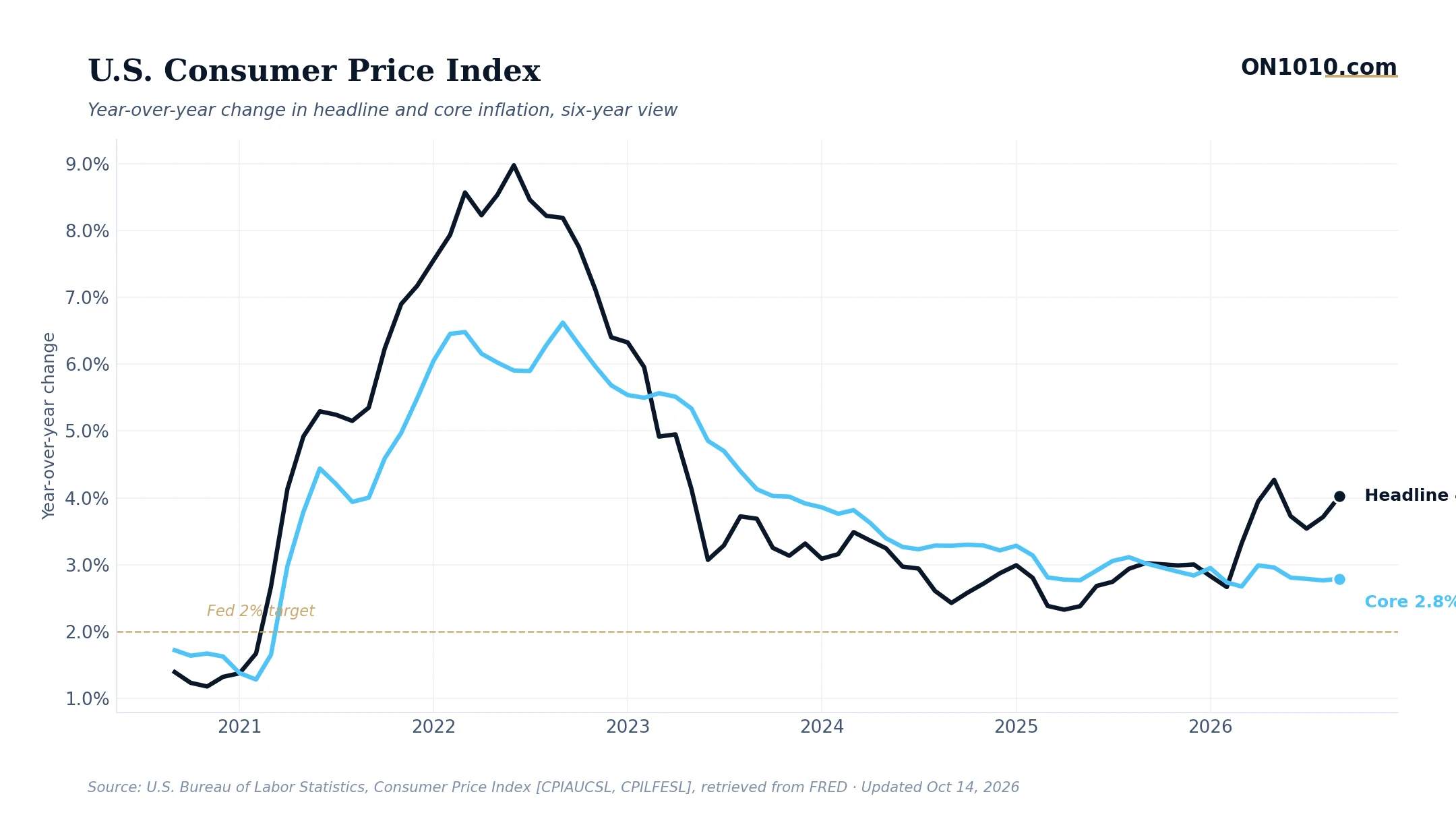
Core CPI rose 0.33% in September, putting the year-over-year rate at 2.37%. On its face, that sounds like a win. The Fed’s target is 2%. We’re close.
Look at the trend, though, and the story gets more complicated. After a brief pause in May, monthly price increases have accelerated for four straight months. The index has climbed from 335.423 in April to 338.896 in September. The direction of travel matters as much as the level.
This is the central tension in the inflation picture right now. The year-over-year number is converging toward target, which reflects how hot prices were a year ago being compared against today’s more modest increases. But the monthly momentum has quietly shifted back upward. Monetary policy remains restrictive by historical standards, which typically creates pressure on business margins. And consumer sentiment sits near the weakest levels in decades, even as VIX signals calm in financial markets. These don’t usually point in the same direction at once.
Historically, when core inflation has run above 2% with restrictive monetary policy in place, the question for businesses has been: who absorbs the remaining price pressure? If companies can pass costs to consumers, margins hold. If demand softens too much to allow it, margins compress. In past cycles, that margin squeeze has led the employment picture by several months.
The further question worth tracking: is the recent monthly acceleration a seasonal blip or something stickier? One or two months can be noise. A fifth consecutive monthly increase would start to look like a signal.
Bottom Line: Core inflation is close to target on an annual basis, but the monthly trend is moving in the wrong direction. The Fed doesn’t get to declare victory on one number alone, and neither should anyone else watching this data.
Source: Federal Reserve Economic Data (FRED)
ON1010 Research is an independent publisher of economic education and is not a registered investment adviser, broker-dealer, or investment company. This content is for educational and informational purposes only and is not investment advice or a recommendation to buy, sell, or hold any security. Published under the publisher exemption recognized by Section 202(a)(11)(D) of the Investment Advisers Act of 1940 (Lowe v. SEC). Always consult a qualified financial professional before making any financial decision.
Free Research
The economy moves fast. We make sure you move faster.
Economic data, policy shifts, and market signals — delivered to your inbox.
Subscribe Free