
Economic Wire: Surging Treasury yields don’t signal a U.S. ‘fiscal apocalyp
The 5% Yield Is a Warning, Not a Crisis. The Difference Matters.
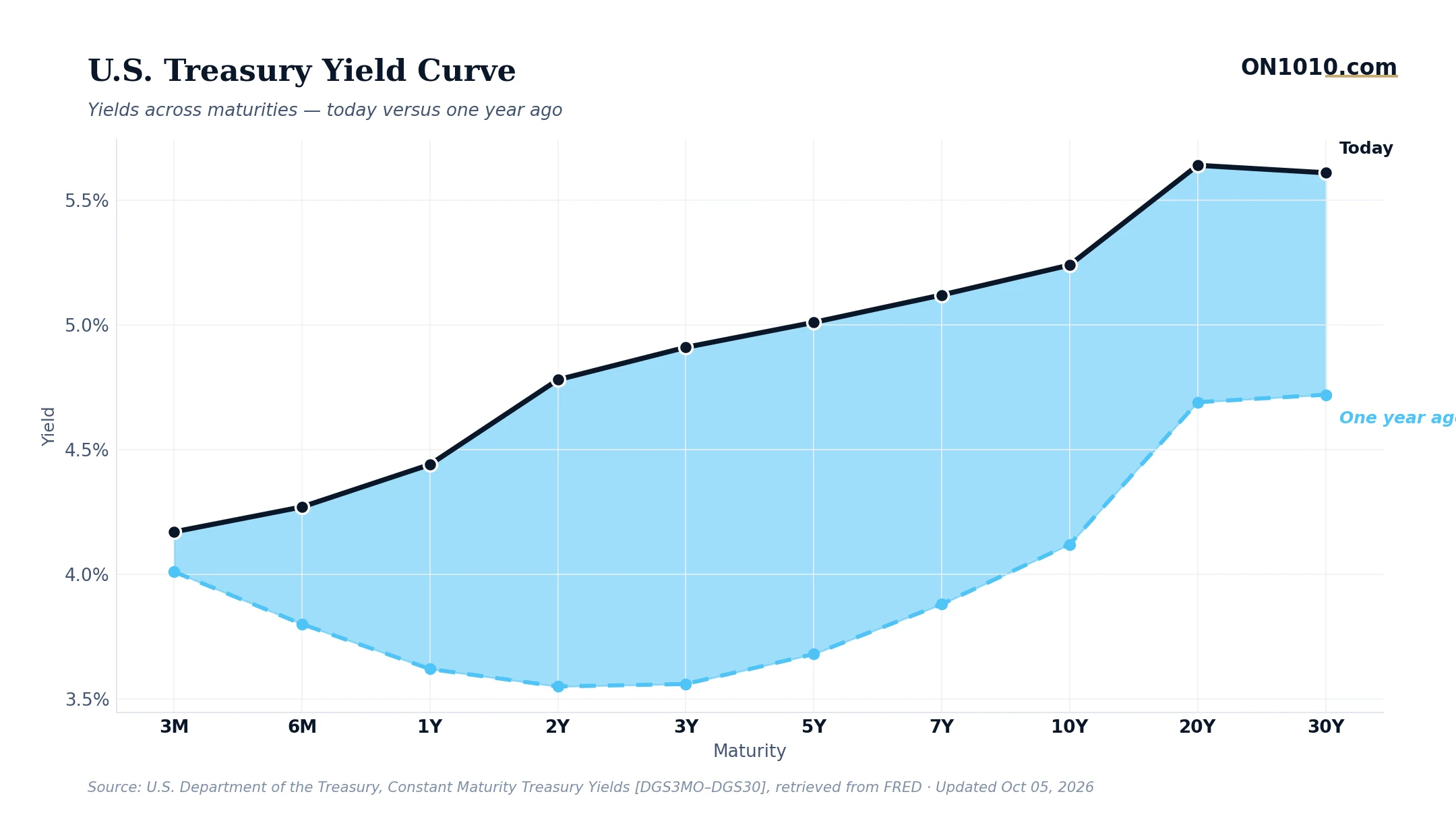
According to CNBC, the 10-year Treasury yield has climbed to 5.24%, reigniting fears that rising borrowing costs could send U.S. debt into a self-reinforcing spiral. Most of the coverage has treated this as either catastrophic or ignorable. Neither read is quite right.
Here is the more useful framing. The federal government is the world’s largest borrower. When its borrowing costs rise, the interest expense on existing debt grows every time a bond matures and must be refinanced at a higher rate. That is a slow-moving force, not a sudden cliff. The U.S. still has deep, liquid capital markets and a reserve currency. A debt crisis, historically, requires creditors to lose confidence and demand a risk premium on top of already-high yields. That premium is real but nowhere near crisis levels today. The word “spiral” implies acceleration. The data shows elevation, which is a different problem.
What makes the current setup worth watching closely is the combination of signals, not any single one. Inflation remains hot against its own history. Monetary policy is restrictive, with the Fed holding a high real policy rate. Long-term interest rates sit near their highest readings in decades. Credit spreads have been widening. Consumer sentiment is deeply depressed. Growth, by contrast, is holding near its historical midpoint. That is a lot of pressure building on one side of the ledger while the growth engine stays neutral, not strong.
Historically, investors have treated a sustained 5%+ 10-year yield as a meaningful headwind for equity valuations, real estate, and any business model that depends on cheap refinancing. The mechanism is straightforward: higher risk-free rates raise the bar every investment must clear to be worth making. The question investors have asked in past similar environments is whether corporate margins are strong enough to absorb higher interest costs without cutting investment or employment.
Bottom Line: A 5% yield is pressure, not apocalypse. But pressure that persists long enough reshapes the economy quietly, one refinancing at a time.
Read more: CNBC Top News
ON1010 Research is an independent publisher of economic education and is not a registered investment adviser, broker-dealer, or investment company. This content is for educational and informational purposes only and is not investment advice or a recommendation to buy, sell, or hold any security. Published under the publisher exemption recognized by Section 202(a)(11)(D) of the Investment Advisers Act of 1940 (Lowe v. SEC). Always consult a qualified financial professional before making any financial decision.
Free Research
The economy moves fast. We make sure you move faster.
Economic data, policy shifts, and market signals — delivered to your inbox.
Subscribe Free