
Housing Starts Drop to a Three-Month Low, and the Rate Story Is Getting Harder to Ignore
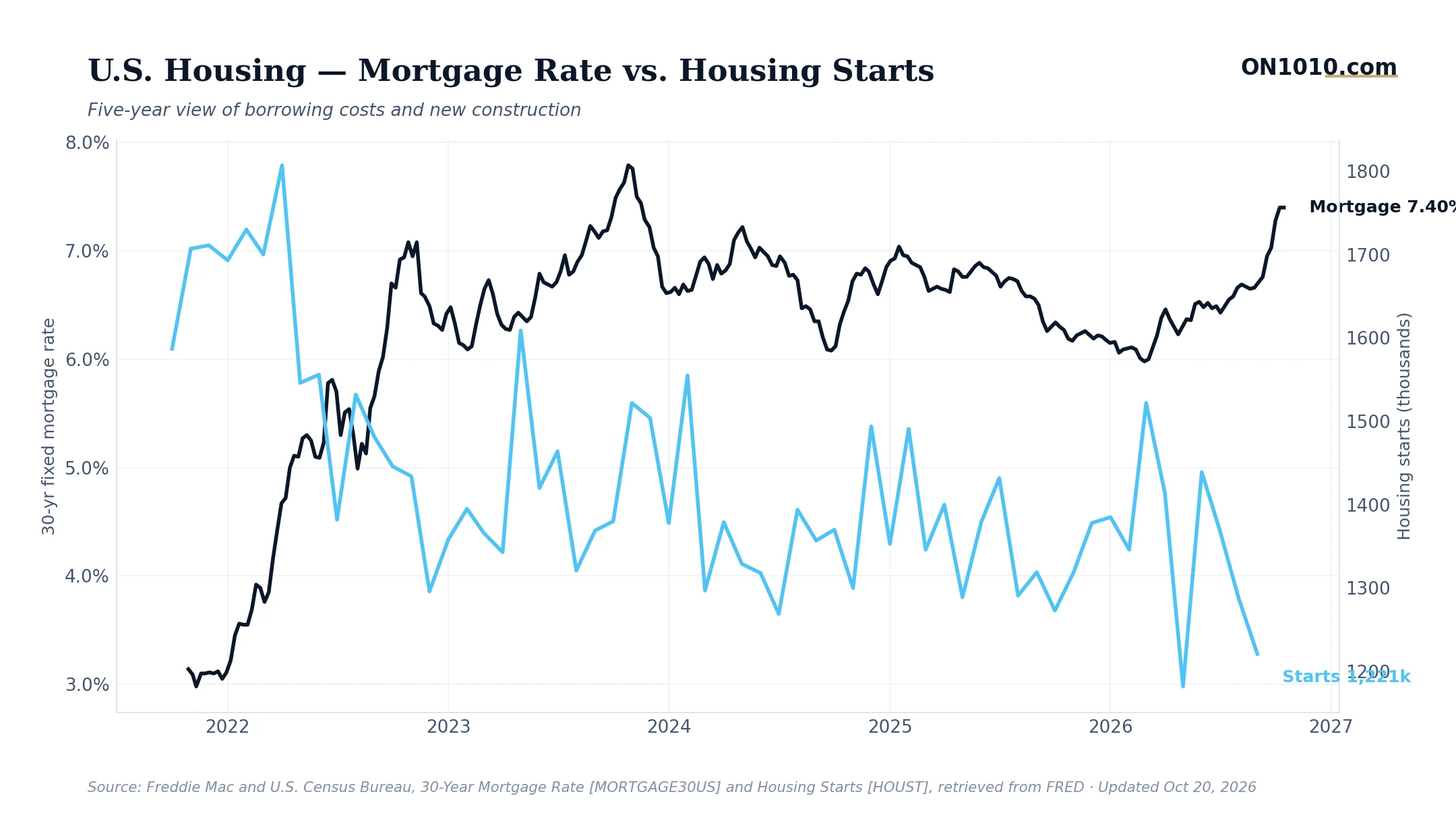
Housing starts fell 5.2% in September to a seasonally adjusted annual rate of 1,221,000 units, the lowest reading in three months and 7.4% below where they were a year ago. The number that stands out is the trend: starts have now fallen in three of the last four months, sliding from 1,439,000 in June to where they sit today.
One volatile month is noise. A staircase lower over four months is a signal.
The macro backdrop explains most of this. Long-term interest rates remain historically elevated, meaning mortgage rates are staying stubbornly high. For a homebuilder, that math is simple: higher mortgage rates shrink the pool of buyers who can afford the finished product. When demand looks uncertain, the rational move is to pull back on new ground-breakings. The incentive structure is doing exactly what you’d expect it to do. Separately, credit spreads have widened recently, moving from elevated to very elevated territory, which raises financing costs for developers themselves and adds another layer of friction to new projects.
Historically, this type of sustained decline in starts has mattered beyond just the construction site. Housing is deeply woven into the broader economy through lumber, appliances, real estate services, and employment. In past cycles, multi-month contractions in starts have foreshadowed softness in those adjacent industries within six to twelve months. The current combination of restrictive monetary policy, high long-term rates, and tightening credit conditions has appeared roughly 64 months in the historical record, and from similar setups, the indicators have typically drifted lower before recovering. That is the base rate, not a forecast.
For anyone watching capital allocation in rate-sensitive sectors, the question worth tracking is whether lower long-term rates (which the gauges suggest have been falling recently) eventually reach the mortgage market fast enough to reverse this trend before builder confidence breaks further.
Bottom Line: Housing starts are sending a consistent message over the past four months: the rate environment is squeezing new construction. The key question is whether mortgage rates ease enough, fast enough, to restart the cycle before the pullback deepens.
Source: Federal Reserve Economic Data (FRED)
ON1010 Research is an independent publisher of economic education and is not a registered investment adviser, broker-dealer, or investment company. This content is for educational and informational purposes only and is not investment advice or a recommendation to buy, sell, or hold any security. Published under the publisher exemption recognized by Section 202(a)(11)(D) of the Investment Advisers Act of 1940 (Lowe v. SEC). Always consult a qualified financial professional before making any financial decision.
Free Research
The economy moves fast. We make sure you move faster.
Economic data, policy shifts, and market signals — delivered to your inbox.
Subscribe Free