
Mortgage Rates Are Creeping Higher Again. The Housing Market Is Watching Closely.
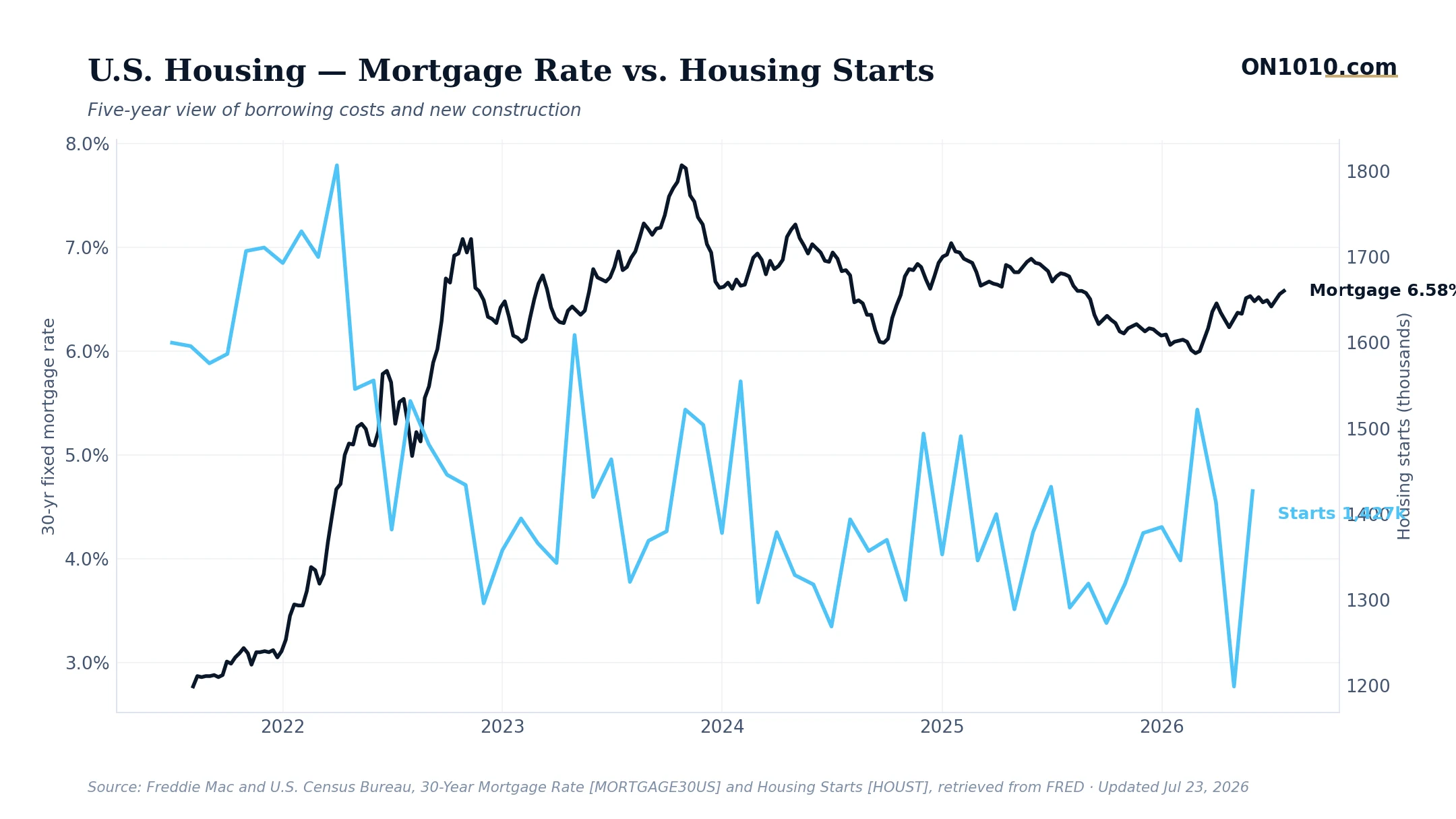
The 30-year mortgage rate ticked up to 6.58% this week, the fourth consecutive weekly increase and the highest reading since late June. It’s a small move, just 3 basis points from last week, but the direction matters as much as the magnitude.
Look at the trend: rates have climbed from 6.43% on July 2nd to 6.58% today, a move of 15 basis points in three weeks. That may sound modest, but on a $400,000 home loan, it translates to roughly $40 more per month in payments. Multiply that across millions of would-be buyers, and you have a meaningful drag on affordability that compounds quietly.
This creep higher is happening against an interesting backdrop. Broader market signals show institutional money rotating into defensive sectors, including Real Estate (XLRE), which has outperformed the S&P 500 by 1.8% over the past month. That’s a bit of a contradiction: REITs doing well while mortgage rates rise. Part of the explanation is that REIT strength often reflects lower long-term rate expectations, not current affordability conditions. The equity market may be pricing in relief that hasn’t shown up in the weekly rate data yet.
Historically, periods where mortgage rates hold stubbornly in the 6.5% to 7% range have tended to freeze existing homeowners in place. Sellers who locked in 3% mortgages in 2021 have little incentive to trade up, which keeps inventory thin and prices stickier than you might expect for a market with high rates. That “lock-in effect” has been one of the defining structural features of housing since 2022, and it shows no sign of breaking.
The question worth sitting with: if rates stay rangebound here rather than falling, does housing activity stay frozen through the back half of 2026, or does buyer demand eventually return out of necessity?
Bottom Line: Mortgage rates are grinding higher, not falling, and in a market already starved of inventory, even a slow drift upward keeps the affordability math hard for new buyers.
Source: Federal Reserve Economic Data (FRED)
ON1010 Research is an independent publisher of economic education and is not a registered investment adviser, broker-dealer, or investment company. This content is for educational and informational purposes only and is not investment advice or a recommendation to buy, sell, or hold any security. Published under the publisher exemption recognized by Section 202(a)(11)(D) of the Investment Advisers Act of 1940 (Lowe v. SEC). Always consult a qualified financial professional before making any financial decision.
Free Research
The economy moves fast. We make sure you move faster.
Economic data, policy shifts, and market signals — delivered to your inbox.
Subscribe Free