
The 10-Year Treasury Just Crossed 5%. Here’s Why That Number Has Weight.
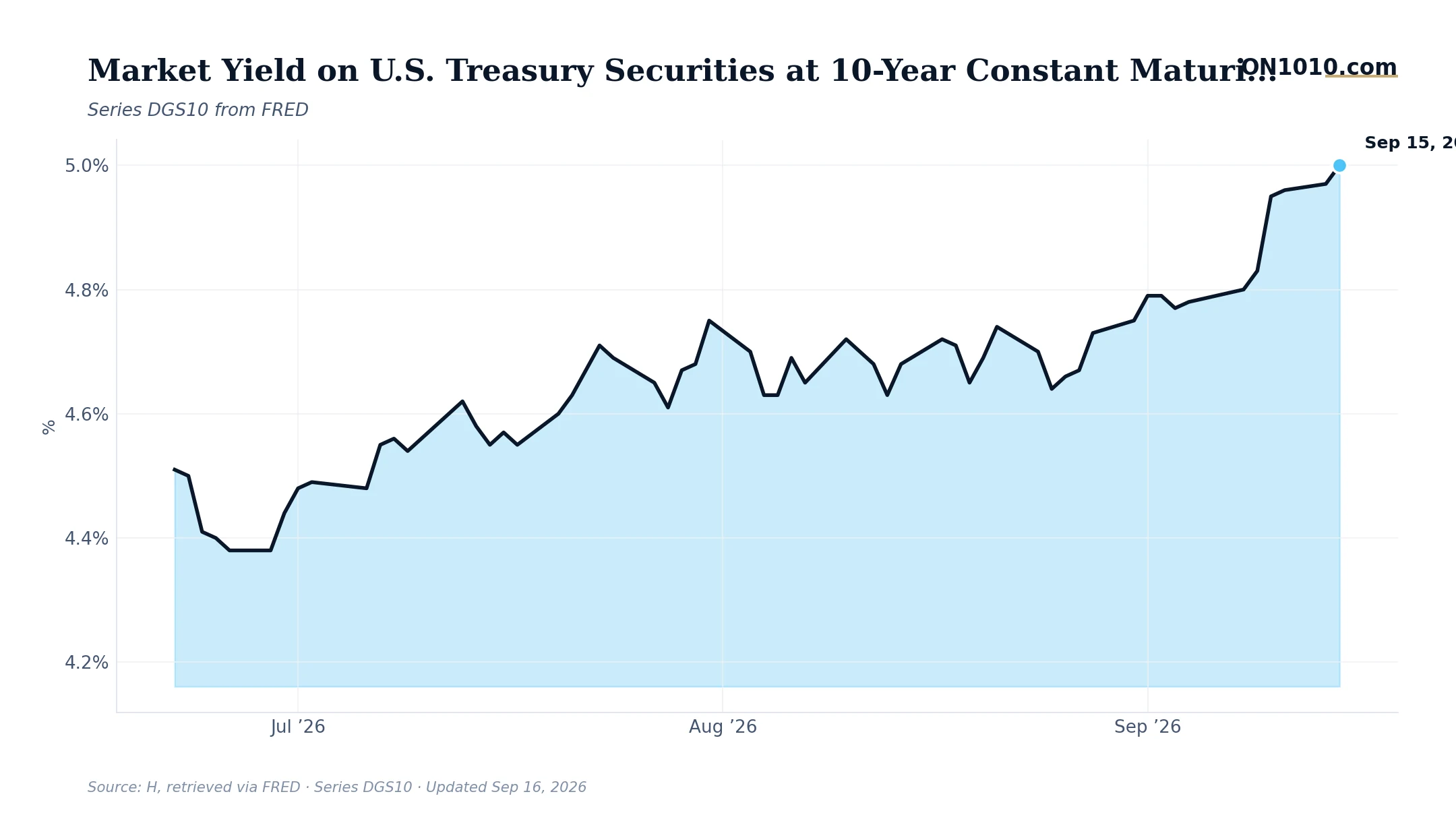
The 10-year Treasury yield hit 5.0% on September 15, crossing a psychologically significant threshold after climbing steadily from 4.80% just one week ago. That 20-basis-point move in five trading sessions is quick by bond market standards, and the direction is unmistakable.
The broader backdrop makes this more than a round number worth noting. Core inflation is running hotter than roughly nine of every ten months in the historical record. Monetary policy sits near its historical midpoint. Growth is roughly in line with its long-run norm. Put those three together, and you get an economy that does not obviously need lower rates anytime soon, which means bond investors are not waiting for the Fed to blink. They are pricing a “higher for longer” reality into the long end of the curve on their own.
The economy is a balance sheet story as much as an income story, and the 10-year yield is the rate against which almost everything gets priced: 30-year mortgages, corporate bond coupons, the discount rate used to value future earnings. When that benchmark rises, the cost of carrying leverage goes up across the entire economy. Historically, when long-term rates have sat in the upper quarter of their range, a new recession has begun within 12 months roughly 19% of the time. That is one in five. Worth knowing, though past patterns do not predict what comes next.
Credit spreads remain very tight by historical standards, meaning the corporate bond market is not flashing distress. The stress, for now, is in the rate level itself, not in credit quality. In past cycles, investors and business operators have paid close attention to whether rising long-term yields reflected stronger growth expectations or stubborn inflation. The answer to that question shapes the downstream effects on margins, investment decisions, and refinancing costs.
Bottom Line: The 5% yield is a line in the sand for borrowing costs across the economy. The real question is whether the economy can keep absorbing this cost without something in the credit stack starting to crack.
Source: Federal Reserve Economic Data (FRED)
ON1010 Research is an independent publisher of economic education and is not a registered investment adviser, broker-dealer, or investment company. This content is for educational and informational purposes only and is not investment advice or a recommendation to buy, sell, or hold any security. Published under the publisher exemption recognized by Section 202(a)(11)(D) of the Investment Advisers Act of 1940 (Lowe v. SEC). Always consult a qualified financial professional before making any financial decision.
Free Research
The economy moves fast. We make sure you move faster.
Economic data, policy shifts, and market signals — delivered to your inbox.
Subscribe Free