
The 10-Year Yield Is Pulling Back. The Bigger Story Is Where It’s Coming From.
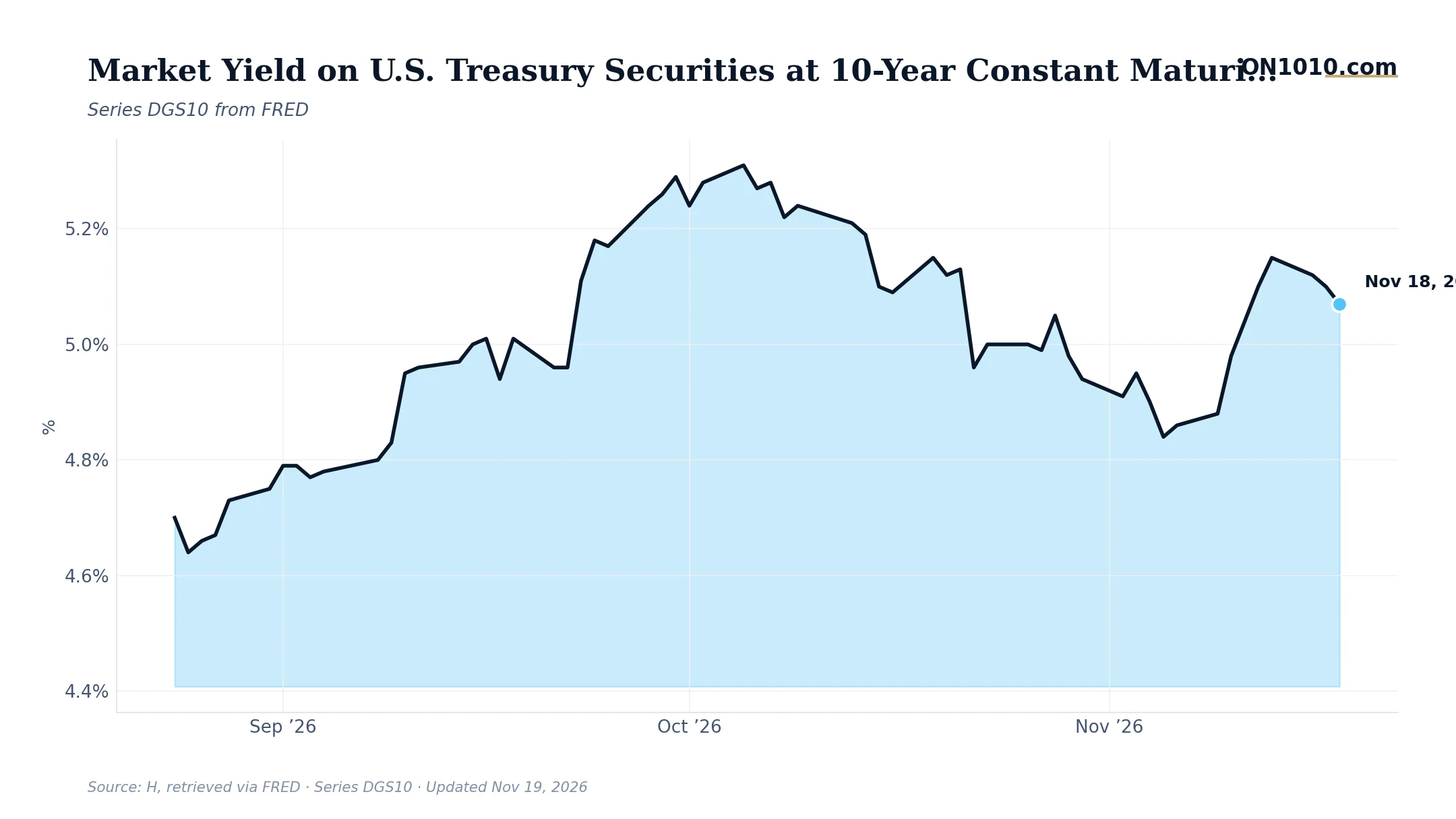
The 10-year Treasury yield slipped to 5.07% on November 18, down from 5.10% the day before and from a recent peak of 5.15% earlier in the month. Three basis points on any given day is noise. But the level itself is the story: the benchmark rate for the entire economy has spent the past week hovering above 5%, a threshold it rarely crossed for two full decades before 2023.
Long-term rates in this range sit in the upper quarter of their entire recorded history. The economy is running with a constraint that most borrowers, business planners, and financial models built after 2008 were never really designed to handle. Every mortgage, corporate bond, leveraged buyout, and commercial real estate refinancing gets priced off this number. When it stays elevated, the pressure doesn’t announce itself all at once. It arrives gradually, as old cheap debt matures and gets replaced at current rates.
The backdrop makes this harder to read as a simple “rates are easing” story. Credit spreads are wide and rising, which means bond investors are demanding extra compensation for risk on top of an already-high base rate. Market volatility has moved up into elevated territory. Defensive sectors, including utilities, consumer staples, and real estate, have significantly outperformed offensive sectors over the past month. The market is behaving like something is quietly tightening beneath the surface.
Historically, when long-term rates have held in this range, a new recession began within the following 12 months about 20% of the time. One-in-five is not a forecast. It is a base rate worth carrying into every capital decision. In past cycles, businesses and investors have paid close attention to whether rates at this level are reflecting genuine growth expectations or a fiscal premium, because the two have very different implications for what comes next. A qualified financial professional can help connect that distinction to your specific situation.
Bottom Line: The 10-year yield pulling back a few basis points from 5.15% is a footnote. The question that matters is whether the economy can sustain the refinancing math that 5%+ rates require, and how long it takes for the answer to show up in earnings.
Source: Federal Reserve Economic Data (FRED)
ON1010 Research is an independent publisher of economic education and is not a registered investment adviser, broker-dealer, or investment company. This content is for educational and informational purposes only and is not investment advice or a recommendation to buy, sell, or hold any security. Published under the publisher exemption recognized by Section 202(a)(11)(D) of the Investment Advisers Act of 1940 (Lowe v. SEC). Always consult a qualified financial professional before making any financial decision.
Free Research
The economy moves fast. We make sure you move faster.
Economic data, policy shifts, and market signals — delivered to your inbox.
Subscribe Free