
The 10-Year Yield Is Sitting at 5.24%. History Says Pay Attention.
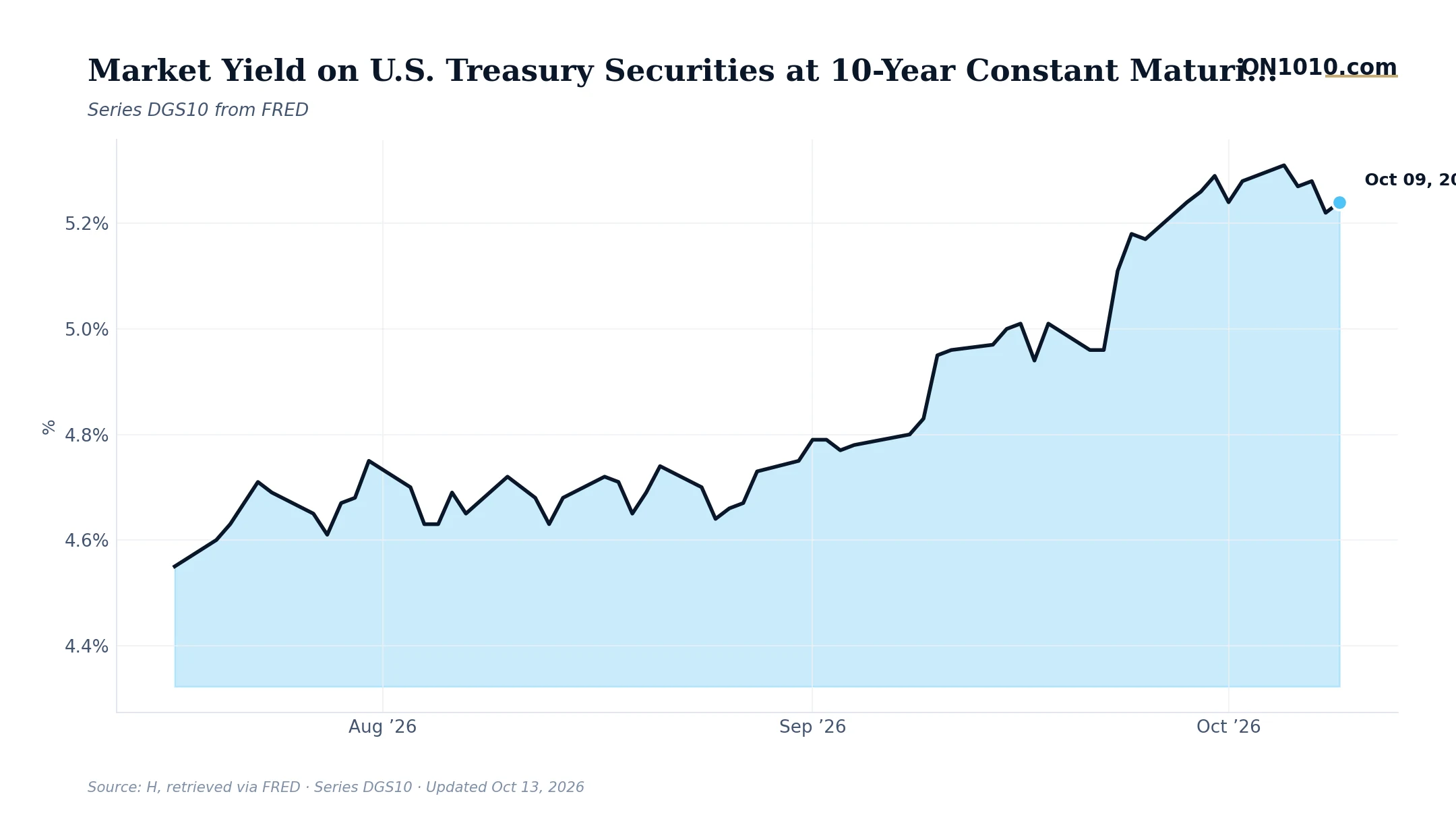
The 10-year Treasury yield edged up to 5.24% on October 9, ticking 0.02 points higher from the day before. That small move buries the more important story: the benchmark rate has been locked in a tight band between 5.22% and 5.31% for the past two weeks, refusing to fall. At these levels, long-term rates sit in the upper quarter of their entire recorded history.
The bigger picture here is a collision of forces. Inflation is still running hot relative to history, the real policy rate is restrictive, and now the long end of the curve is staying elevated on its own, without the Fed pushing it there. Normally, the 10-year yield drifts down when the economy cools. When it stays stubbornly high, bond investors are sending a message: either they expect inflation to persist, or they are demanding more compensation for the risk of holding long-dated government debt, or both. Credit spreads are also wide relative to their historical range, which means stress is building quietly in corners of the credit market that don’t make front-page news.
Historically, when long-term rates sit this high for an extended stretch, the pressure lands hardest on balance sheets carrying variable-rate debt and on businesses with refinancing needs on the horizon. In past cycles, capital allocation decisions, particularly around commercial real estate, leveraged buyouts, and long-duration infrastructure projects, have shifted noticeably when the 10-year held above 5% for more than a few months. The question businesses and capital allocators have historically asked is straightforward: does the expected return on a new investment clear a 5.24% risk-free hurdle?
Historically, when rates sat this high, they drifted lower over the following year in most comparable periods. That is the base rate. It is worth knowing, not predicting from.
Bottom Line: A 10-year yield anchored above 5% is not just a borrowing cost. It is the benchmark every investment, project, and acquisition has to beat. The question worth tracking now is whether corporate margins can hold up if that bar stays this high.
Source: Federal Reserve Economic Data (FRED)
ON1010 Research is an independent publisher of economic education and is not a registered investment adviser, broker-dealer, or investment company. This content is for educational and informational purposes only and is not investment advice or a recommendation to buy, sell, or hold any security. Published under the publisher exemption recognized by Section 202(a)(11)(D) of the Investment Advisers Act of 1940 (Lowe v. SEC). Always consult a qualified financial professional before making any financial decision.
Free Research
The economy moves fast. We make sure you move faster.
Economic data, policy shifts, and market signals — delivered to your inbox.
Subscribe Free