
THE 10-Year Yield Is Still Above 5%.
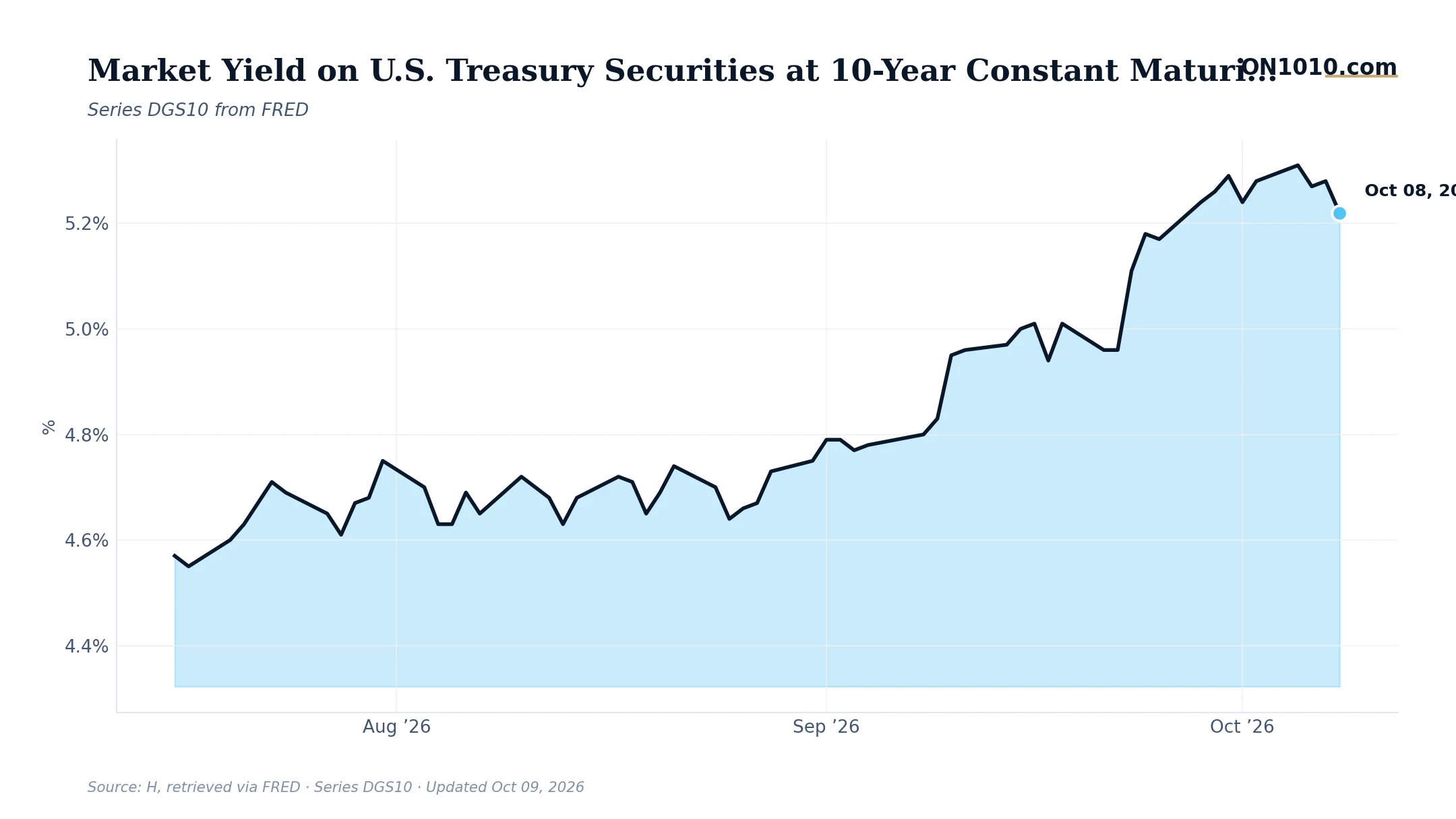
Thursday’s one-day dip in the 10-year Treasury yield from 5.28% to 5.22% will get attention. The more important fact is where it’s sitting: above 5%, where it has been all week, in a range the U.S. economy hasn’t regularly dealt with in nearly two decades.
One day’s move of 0.06 percentage points is noise. The trend is not. The 10-year has held between 5.22% and 5.31% across every trading session this week, refusing to retreat in any meaningful way. That’s not a blip. That’s the bond market telling you something about how it sees inflation, growth, and the risk of holding U.S. debt at current prices.
The broader backdrop makes this yield level particularly worth watching. Core inflation remains historically elevated. The real policy rate (the Fed’s benchmark minus actual inflation) is restrictive by the standards of most post-2000 cycles. Consumer sentiment is near historically weak readings. And yet the economy’s growth gauge sits near its historical midpoint, with recession base rates from similar setups running around 14% over the following 12 months. Not alarming, but not nothing.
Historically, when long-term rates have held this high for extended stretches, the pressure tends to land unevenly. Businesses carrying floating-rate debt or facing refinancing deadlines feel it first. Commercial real estate, which shows up in the sector data as real estate underperforming the broader market by 6.9 percentage points this year, carries some of the clearest fingerprints. In past high-rate cycles, the question that mattered most was duration: how long rates stay elevated, not how high they peak.
A yield that dips one day and holds above 5% the next raises a practical question for anyone making a long-term capital commitment right now: what does your business plan look like if this is the borrowing environment for another 12 to 18 months?
Bottom Line: Thursday’s dip in the 10-year yield is a one-session move against a week-long wall above 5%. The bond market is still demanding a premium to lend long, and until that changes, the cost of capital stays a headwind for anything rate-sensitive.
Source: Federal Reserve Economic Data (FRED)
ON1010 Research is an independent publisher of economic education and is not a registered investment adviser, broker-dealer, or investment company. This content is for educational and informational purposes only and is not investment advice or a recommendation to buy, sell, or hold any security. Published under the publisher exemption recognized by Section 202(a)(11)(D) of the Investment Advisers Act of 1940 (Lowe v. SEC). Always consult a qualified financial professional before making any financial decision.
Free Research
The economy moves fast. We make sure you move faster.
Economic data, policy shifts, and market signals — delivered to your inbox.
Subscribe Free