
The 10-Year Yield Just Crossed 5.25%. The Last Time It Stayed Here, Something Had to Break.
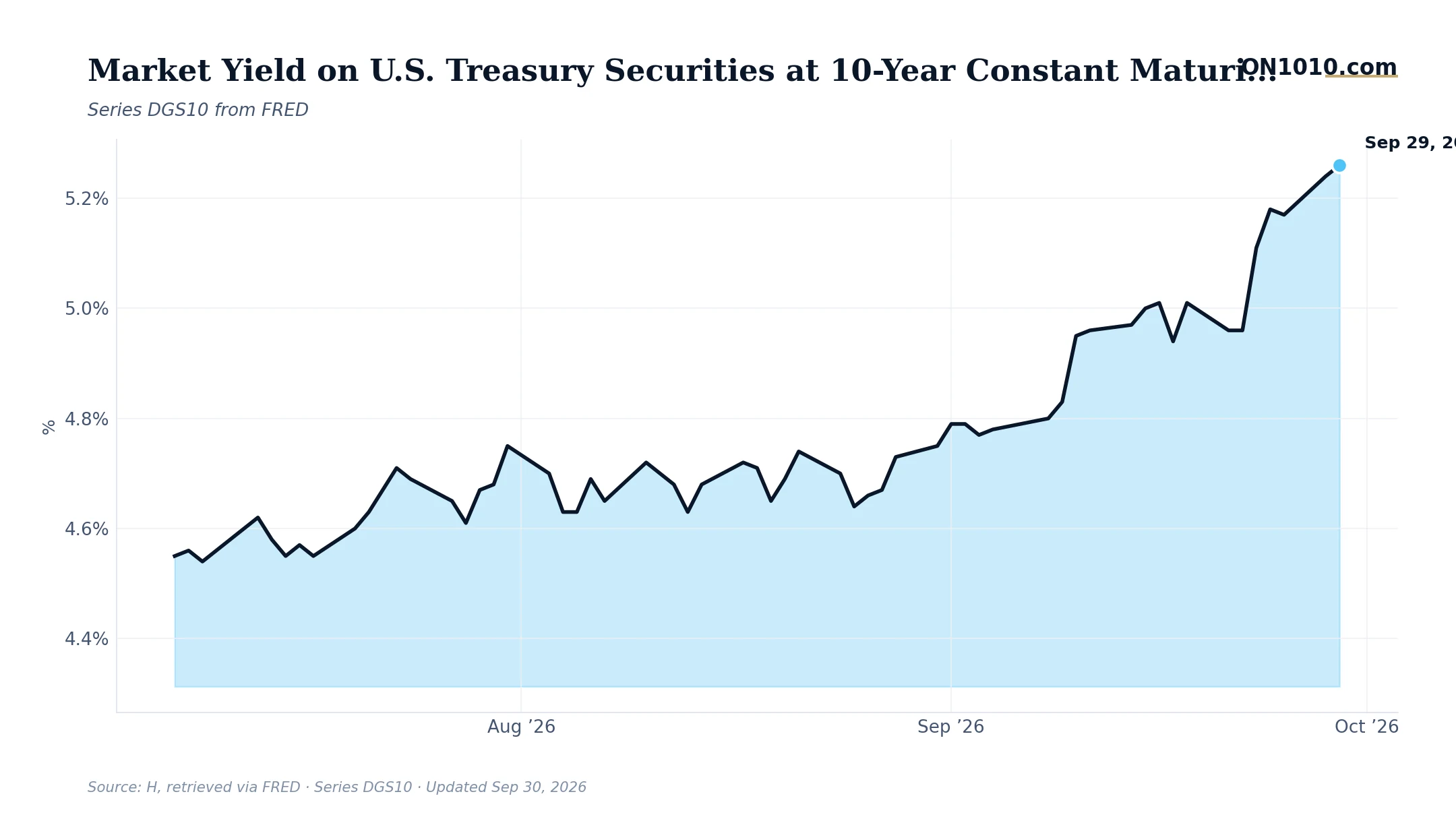
The 10-year Treasury yield closed at 5.26% on September 29, up from 4.96% just one week earlier. That’s a 30-basis-point move in five trading sessions. Weekly moves of that size don’t happen in calm markets. They happen when something is repricing.
The broader context makes this harder to dismiss. Long-term rates are now in the upper range of their entire modern history. Inflation remains hotter than nine of every ten months on record. Monetary policy sits near its historical midpoint, which means the Fed’s policy rate isn’t doing the heavy lifting here. The bond market is. When yields rise even as the Fed holds steady, the message from the bond market is that investors are demanding more compensation to hold long-duration debt. That’s either an inflation signal, a fiscal signal, or both.
Historically, when long-term rates have run this high, a new recession started within the following 12 months about 14% of the time. That’s not a majority outcome, but it’s not trivial either, and it’s worth knowing what’s in the base rate. More practically, every mortgage, corporate bond, and leveraged buyout gets priced off this number. When the 10-year runs above 5%, borrowing costs across the economy follow. Businesses with floating-rate debt face higher carrying costs. Commercial real estate, already stressed, faces more pressure on refinancing. In past cycles, investors and operators have watched the pace of yield moves as much as the level itself, because fast moves compress planning horizons fast.
Consumer sentiment is already near the bottom of its historical range, even as the VIX sits in calm territory, a split worth watching. Markets are pricing calm. Consumers aren’t feeling it.
Bottom Line: The 10-year at 5.26% and rising is the economy’s most honest price signal right now. The question isn’t whether 5.26% is high. The question is whether the businesses and households that borrowed at 3% can absorb a world where refinancing happens at nearly double that rate.
Source: Federal Reserve Economic Data (FRED)
ON1010 Research is an independent publisher of economic education and is not a registered investment adviser, broker-dealer, or investment company. This content is for educational and informational purposes only and is not investment advice or a recommendation to buy, sell, or hold any security. Published under the publisher exemption recognized by Section 202(a)(11)(D) of the Investment Advisers Act of 1940 (Lowe v. SEC). Always consult a qualified financial professional before making any financial decision.
Free Research
The economy moves fast. We make sure you move faster.
Economic data, policy shifts, and market signals — delivered to your inbox.
Subscribe Free