
The 10-Year Yield Just Stepped Back From the Edge. The Bigger Story Is Why It Was There.
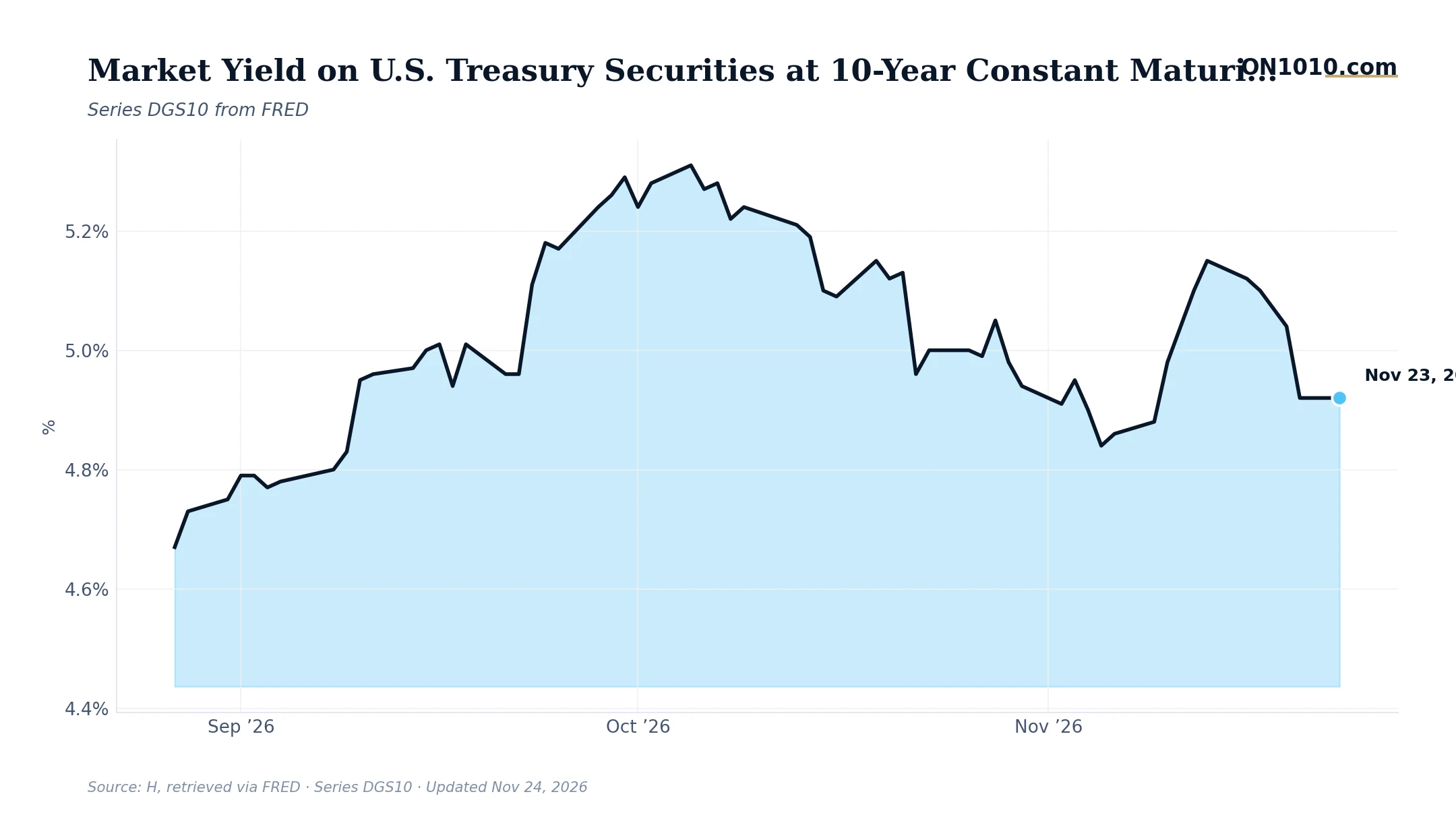
The 10-year Treasury yield held steady at 4.92% on Monday, unchanged from Thursday’s close. That flat reading is actually the first calm moment in a week of real drama: the yield touched 5.12% just seven days ago before pulling back nearly 20 basis points in a matter of days.
A 20-basis-point move in the 10-year in under two weeks is not a footnote. It is a signal that something in the market’s calculus shifted. The bond market is telling a story, and it starts here: long-term rates remain near the top of their historical range, credit spreads are historically wide, consumer sentiment is near historical lows, and the VIX sits at levels higher than roughly nine of every ten months on record. That is not one warning light. That is a dashboard. Meanwhile, sector rotation data shows institutional money moving decisively into consumer staples, utilities, real estate, and health care, while technology has been left behind by more than 6 percentage points over the past month. Capital is repositioning for durability, not growth.
Historically, when long-term rates have been this elevated, a new recession has begun within the following 12 months roughly 20% of the time. When monetary policy has also been running this restrictive alongside high rates, that figure has edged even higher. The important caveat: 80% of the time nothing broke. But those odds are worth knowing before assuming the economy simply absorbs this cost of capital the way it did in earlier, lower-debt cycles.
For businesses and operators, the question rates at this level force is a refinancing question. Any debt maturing in the next one to three years is rolling into a materially different cost structure than it carried when it was issued. That changes the math on margins, which eventually changes the math on hiring and investment.
Bottom Line: The 10-year yield stabilizing near 4.92% is better than 5.12%, but “stabilizing near a 15-year high” is a strange definition of relief. The question now is whether the pullback is the start of a genuine easing in financial conditions, or just a pause before the next leg higher.
Source: Federal Reserve Economic Data (FRED)
ON1010 Research is an independent publisher of economic education and is not a registered investment adviser, broker-dealer, or investment company. This content is for educational and informational purposes only and is not investment advice or a recommendation to buy, sell, or hold any security. Published under the publisher exemption recognized by Section 202(a)(11)(D) of the Investment Advisers Act of 1940 (Lowe v. SEC). Always consult a qualified financial professional before making any financial decision.
Free Research
The economy moves fast. We make sure you move faster.
Economic data, policy shifts, and market signals — delivered to your inbox.
Subscribe Free