
The 2-Year Treasury Is Stuck. That Tells You Something.
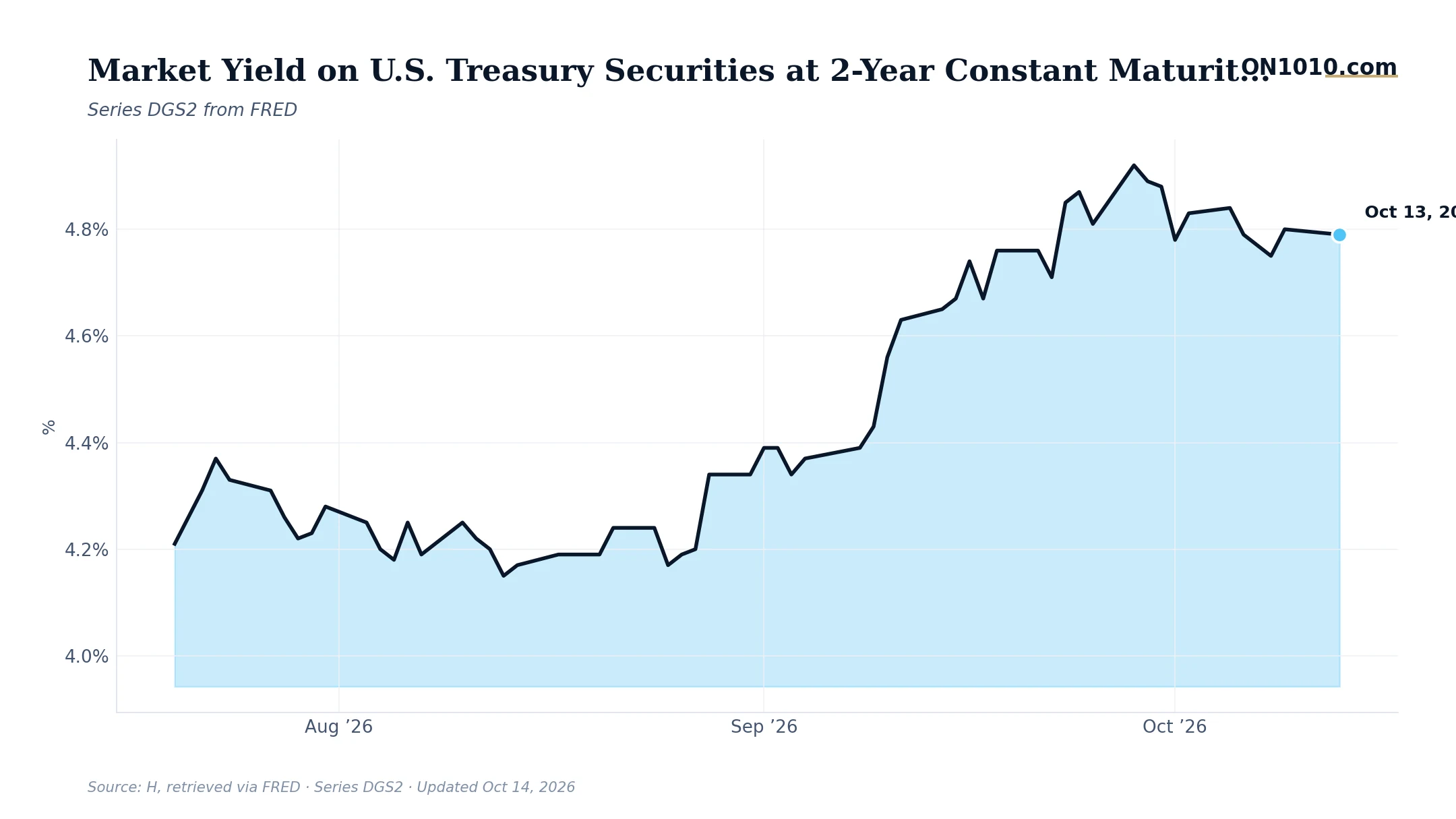
The 2-year Treasury yield slipped to 4.79% on October 13, down a hair from 4.80% the day before. That’s not the interesting part. What’s interesting is how little it has moved all week, bouncing between 4.75% and 4.84% with almost nothing to show for it. The bond market is telling us it has no idea what the Fed does next.
The 2-year yield is essentially the market’s best guess at where the Fed funds rate will be over the next couple of years. When it moves sharply, traders are repricing their expectations. When it flatlines like this, the market is caught in a genuine standoff. On one side: inflation that’s still running hot by historical standards. On the other: monetary policy already well above its historical norm, with growth sitting near its midpoint and consumer sentiment near its weakest in decades. Neither side has enough evidence to win the argument yet.
That tension shows up elsewhere too. Credit conditions, which had been elevated, just pulled back to their historical midpoint, suggesting some stress in the system may be easing at the margin. But long-term rates remain high by historical standards, meaning the cost of capital for businesses and households is still a headwind. Historically, when both short and long rates have sat at elevated levels simultaneously, the refinancing math gets uncomfortable fast, particularly for companies that took on floating-rate debt during the low-rate era.
In past cycles, a prolonged plateau in the 2-year yield, after a major rate-hiking campaign, has often been followed by one of two outcomes: a pivot as growth slowed enough to force the Fed’s hand, or a renewed push higher if inflation proved sticky. The base rate doesn’t favor either outcome cleanly right now, which is exactly why the market is sitting still.
Bottom Line: The 2-year yield at 4.79% isn’t a number to react to. It’s a question the bond market is openly asking: is the Fed done, or just pausing?
Source: Federal Reserve Economic Data (FRED)
ON1010 Research is an independent publisher of economic education and is not a registered investment adviser, broker-dealer, or investment company. This content is for educational and informational purposes only and is not investment advice or a recommendation to buy, sell, or hold any security. Published under the publisher exemption recognized by Section 202(a)(11)(D) of the Investment Advisers Act of 1940 (Lowe v. SEC). Always consult a qualified financial professional before making any financial decision.
Free Research
The economy moves fast. We make sure you move faster.
Economic data, policy shifts, and market signals — delivered to your inbox.
Subscribe Free