
The 2-Year Yield Is Frozen. The Economy Around It Is Not.
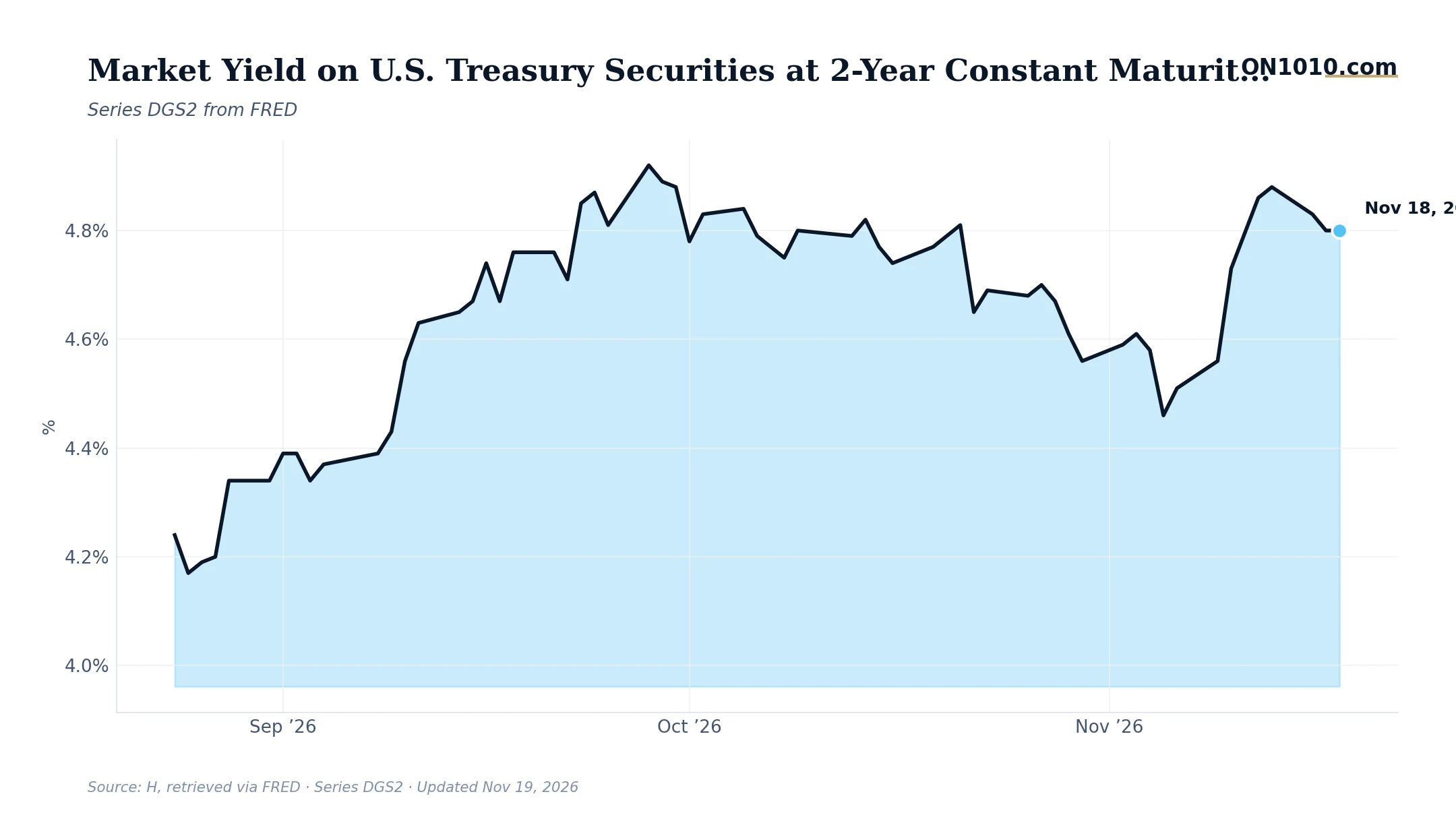
The 2-year Treasury yield has barely moved in two days, holding at 4.80% after a brief dip to 4.73% last week and a push toward 4.88% earlier this month. On its surface, that looks like calm. Look at what’s happening around it, and calm is the wrong word.
The 2-year yield is essentially the bond market’s best guess at where the Fed funds rate will average over the next two years. When it holds at 4.80%, the market is saying: rates are staying higher, longer. The Fed has not convinced anyone it’s close to cutting. And that message is arriving at a complicated moment. Core inflation is running hotter than roughly 90% of all months on record. The real policy rate (the Fed’s rate minus inflation) is in restrictive territory by historical standards. Credit spreads are wide and rising, which means lenders are quietly demanding more compensation for risk. Those conditions tend to compound each other.
What makes this reading worth watching is the combination, not the number alone. Historically, when long-term rates have been this elevated AND credit spreads have been widening simultaneously, the economy was already absorbing stress that hadn’t yet shown up in headline data. In past cycles, businesses running on floating-rate debt or facing near-term refinancing have felt this combination first. Capital allocation decisions, particularly around investment and hiring, tend to slow before any official economic turn is visible.
Meanwhile, the stock market is sending its own signal. Technology is significantly lagging the broader market, while consumer staples, real estate, and utilities are leading. Institutional money has been rotating toward defensive sectors, which historically has reflected growing caution rather than confidence.
Bottom Line: The 2-year yield sitting still at 4.80% while credit stress rises and defensive sectors lead is a tension worth watching. What would it take for rates to actually come down from here, and who is most exposed if they don’t?
Source: Federal Reserve Economic Data (FRED)
ON1010 Research is an independent publisher of economic education and is not a registered investment adviser, broker-dealer, or investment company. This content is for educational and informational purposes only and is not investment advice or a recommendation to buy, sell, or hold any security. Published under the publisher exemption recognized by Section 202(a)(11)(D) of the Investment Advisers Act of 1940 (Lowe v. SEC). Always consult a qualified financial professional before making any financial decision.
Free Research
The economy moves fast. We make sure you move faster.
Economic data, policy shifts, and market signals — delivered to your inbox.
Subscribe Free