
The Credit Warning Signal That Markets Finally Heard
The bond market has been flashing stress for months. Friday, equities caught up fast.
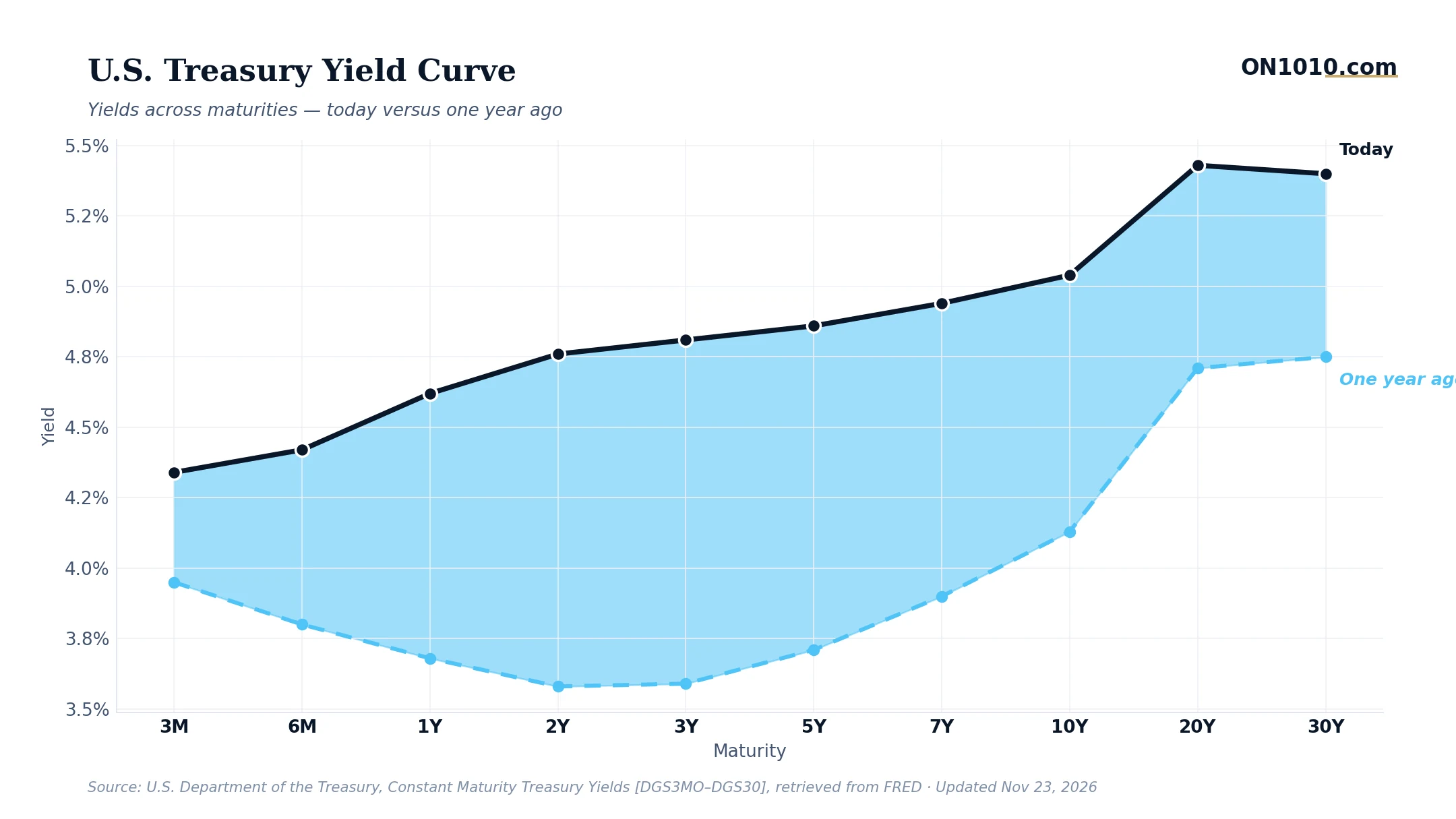
What moved. The Nasdaq dropped 5.28% Friday, the S&P 500 fell 3.70% to 6,910, and the Russell 2000 shed 2.76%. Gold climbed 3.10% to $3,624.50, the clearest sign of where money ran. The VIX closed at 30.09, up from 28.62 on November 20, putting market uncertainty in the upper quarter of its historical range and still rising. The 10-year Treasury yield sits at 5.04%, a full 1.04 percentage points above the Fed’s 4.0% policy rate. That gap tells you the bond market is demanding more compensation to hold long-term debt, and that extra demand is a cost that ripples through every business that needs to borrow.
The sector picture is blunt. Consumer staples, health care, real estate, and utilities are all outperforming the broad market by wide margins over the past month. Technology is lagging by 8.6 percentage points. Institutional money has been rotating toward defense for weeks. Friday’s selloff accelerated what was already in motion.
On deck today. No major scheduled data releases Monday morning. The focus stays on credit conditions and whether last week’s move in spreads finds any relief.
Why it matters. Credit spreads are now at a reading higher than roughly nine of every ten months on record. As The Long View covered Sunday, consumers saw this stress coming well before lenders priced it in. When credit tightens at this level, the cost of capital rises for businesses, which puts pressure on margins, and margins lead hiring decisions.
The deeper read on the credit stress story, what it has meant before, and the questions worth asking is in The Long View. It is free, and it lands every Sunday.
ON1010 Research is an independent publisher of economic education and is not a registered investment adviser, broker-dealer, or investment company. This content is for educational and informational purposes only and is not investment advice or a recommendation to buy, sell, or hold any security. Published under the publisher exemption recognized by Section 202(a)(11)(D) of the Investment Advisers Act of 1940 (Lowe v. SEC). Always consult a qualified financial professional before making any financial decision.
Free Research
The economy moves fast. We make sure you move faster.
Economic data, policy shifts, and market signals — delivered to your inbox.
Subscribe Free