
The Economy Is Fine. The Bond Market Didn’t Get the Memo.
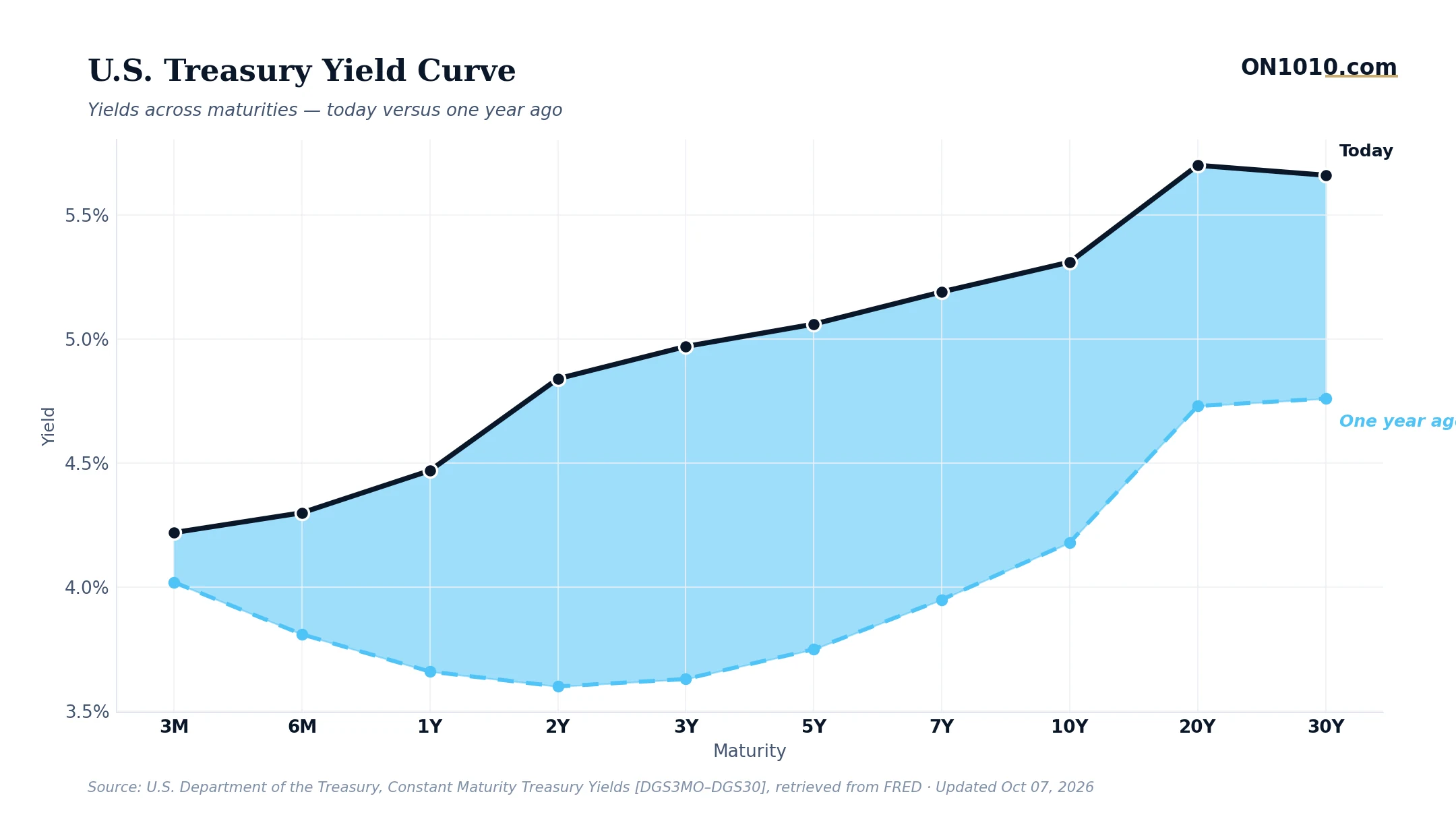
Growth is sitting right at its historical midpoint, recession odds from this zone historically run around 7%, and stocks just pushed the S&P 500 to 7,818. So why is the 10-year Treasury yield at 5.31%? That gap is the story most people are walking past.
What moved. The S&P 500 rose 0.58% to close at 7,818.93, with large-cap tech doing the heavy lifting. Small caps told a different story: the Russell 2000 slipped 0.59% to 2,830. The 10-year yield sits at 5.31% while the 2-year is at 4.84%, a spread of 48 basis points. The 10-year breakeven inflation rate, which tells you what bond traders expect prices to do over the next decade, sits at 2.36%. That means roughly 3 full percentage points of the 10-year yield reflects something other than inflation expectations. The market is demanding extra compensation, and the reasons worth watching include the growing cost of financing a $40.2 trillion national debt, where the average interest rate on Treasury bonds just rose to 3.466%.
On deck today. FOMC minutes from the last Fed meeting drop today. Traders will be reading for any signal on how much longer the Fed plans to hold at 3.75% to 4.0%.
Why it matters. When long-term borrowing costs stay high while growth holds steady, the real test is whether businesses can sustain margins. High rates are a slow friction, not an immediate crash, but they quietly tighten the conditions that drive capital allocation.
The deeper read on what the bond market is actually signaling lands Sunday in The Long View. It is free, and this week’s issue was built around exactly that question.
ON1010 Research is an independent publisher of economic education and is not a registered investment adviser, broker-dealer, or investment company. This content is for educational and informational purposes only and is not investment advice or a recommendation to buy, sell, or hold any security. Published under the publisher exemption recognized by Section 202(a)(11)(D) of the Investment Advisers Act of 1940 (Lowe v. SEC). Always consult a qualified financial professional before making any financial decision.
Free Research
The economy moves fast. We make sure you move faster.
Economic data, policy shifts, and market signals — delivered to your inbox.
Subscribe Free