
THE Fed Just Showed Us Where American Household Wealth Really Stands. The Timing Is Uncomfortable.
According to the Federal Reserve’s 2025 Survey of Consumer Finances, American families entered the current high-rate environment with a balance sheet picture worth understanding carefully. The survey, released Thursday, is the most comprehensive snapshot of household wealth, debt, income, and savings the Fed produces. The timing lands in an economy where rates are historically elevated, inflation remains hot versus history, and consumer sentiment sits near the bottom of its historical range.
The structural tension is this. The SCF is a balance sheet story as much as an income story, and the economy right now runs on both. If the 2025 data shows households carried meaningful leverage into this rate cycle, refinancing pressure becomes the mechanism to watch: higher borrowing costs compound slowly, then quickly. If instead it shows wealth concentration at the top held steady or grew, the spending picture gets more complicated. High-income households save a larger share of income. Lower-income households spend a larger share. A wealth distribution that skewed further upward during the post-2020 asset boom could mean aggregate consumer spending is more fragile than the headline income numbers suggest.
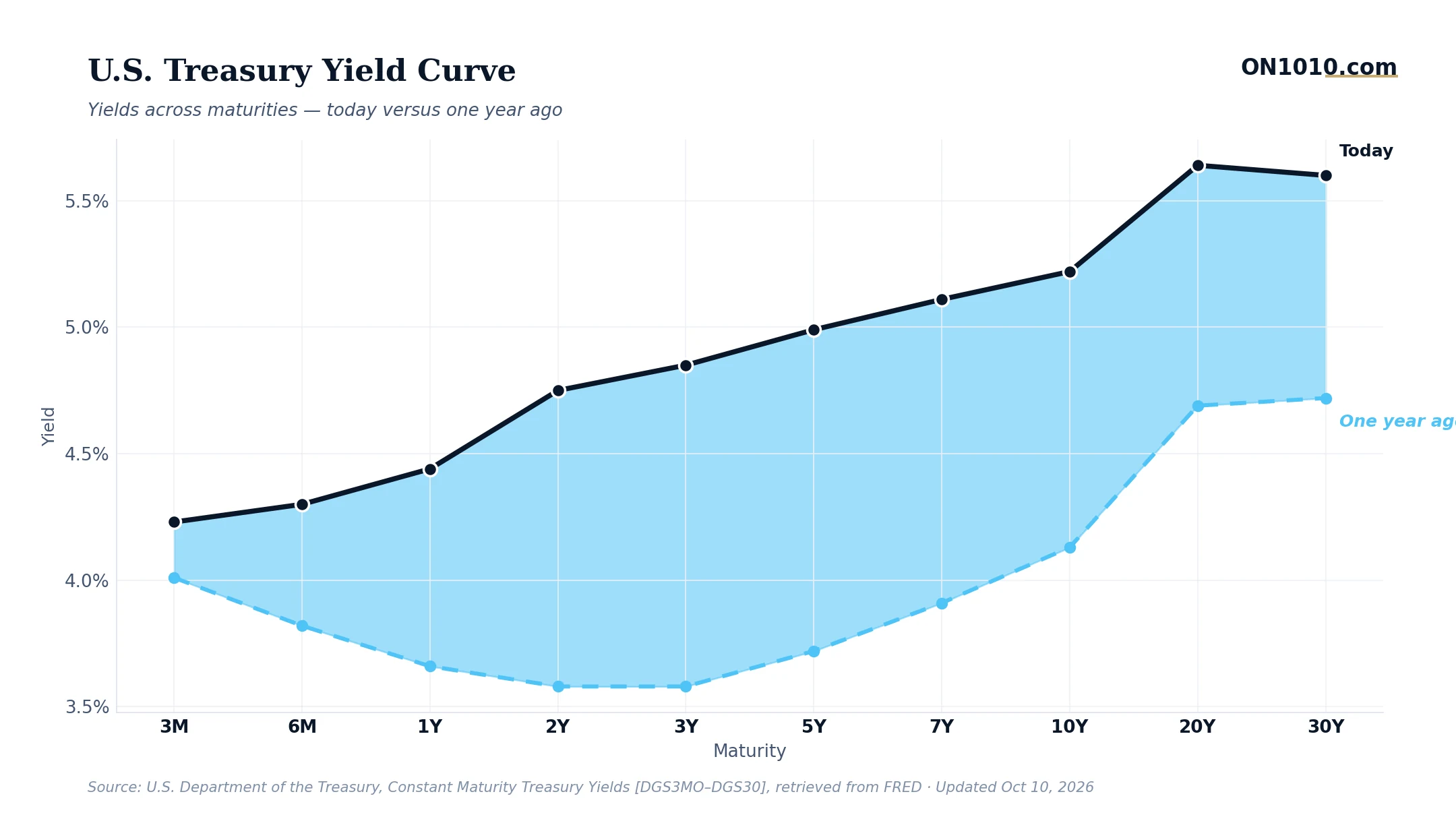
The macro backdrop underscores the question. Monetary policy is restrictive by historical standards. Long-term interest rates are in the upper range of their history. Credit spreads have moved wider in recent months, a signal that credit markets are pricing more caution. Historically, when monetary policy has been this tight alongside wide credit spreads, household balance sheet quality becomes a genuine determinant of whether the economy absorbs the pressure or cracks under it. Past cycles, including the mid-1980s and early 2000s, showed that households with low debt loads and liquid savings could ride out extended tight-money periods. Those carrying heavy fixed obligations found the adjustment much harder.
Historically, investors and business operators have used SCF releases to calibrate assumptions about consumer durability, credit quality, and the distribution of purchasing power across income tiers. The question this particular survey raises: did the post-2020 wealth surge leave a broad enough base of household financial strength to sustain spending through a prolonged high-rate environment, or was most of the gain concentrated where it gets saved rather than spent?
Bottom Line: The 2025 Survey of Consumer Finances is a rearview mirror on the household balance sheet entering one of the tightest monetary environments in decades. What it shows about debt loads, wealth distribution, and liquid savings will tell us a great deal about how much runway the American consumer actually has.
Read more: Federal Reserve Press Releases
ON1010 Research is an independent publisher of economic education and is not a registered investment adviser, broker-dealer, or investment company. This content is for educational and informational purposes only and is not investment advice or a recommendation to buy, sell, or hold any security. Published under the publisher exemption recognized by Section 202(a)(11)(D) of the Investment Advisers Act of 1940 (Lowe v. SEC). Always consult a qualified financial professional before making any financial decision.
Free Research
The economy moves fast. We make sure you move faster.
Economic data, policy shifts, and market signals — delivered to your inbox.
Subscribe Free