
The Fed’s Rate Has Been Frozen for Six Straight Days. That Stillness Is the Story.
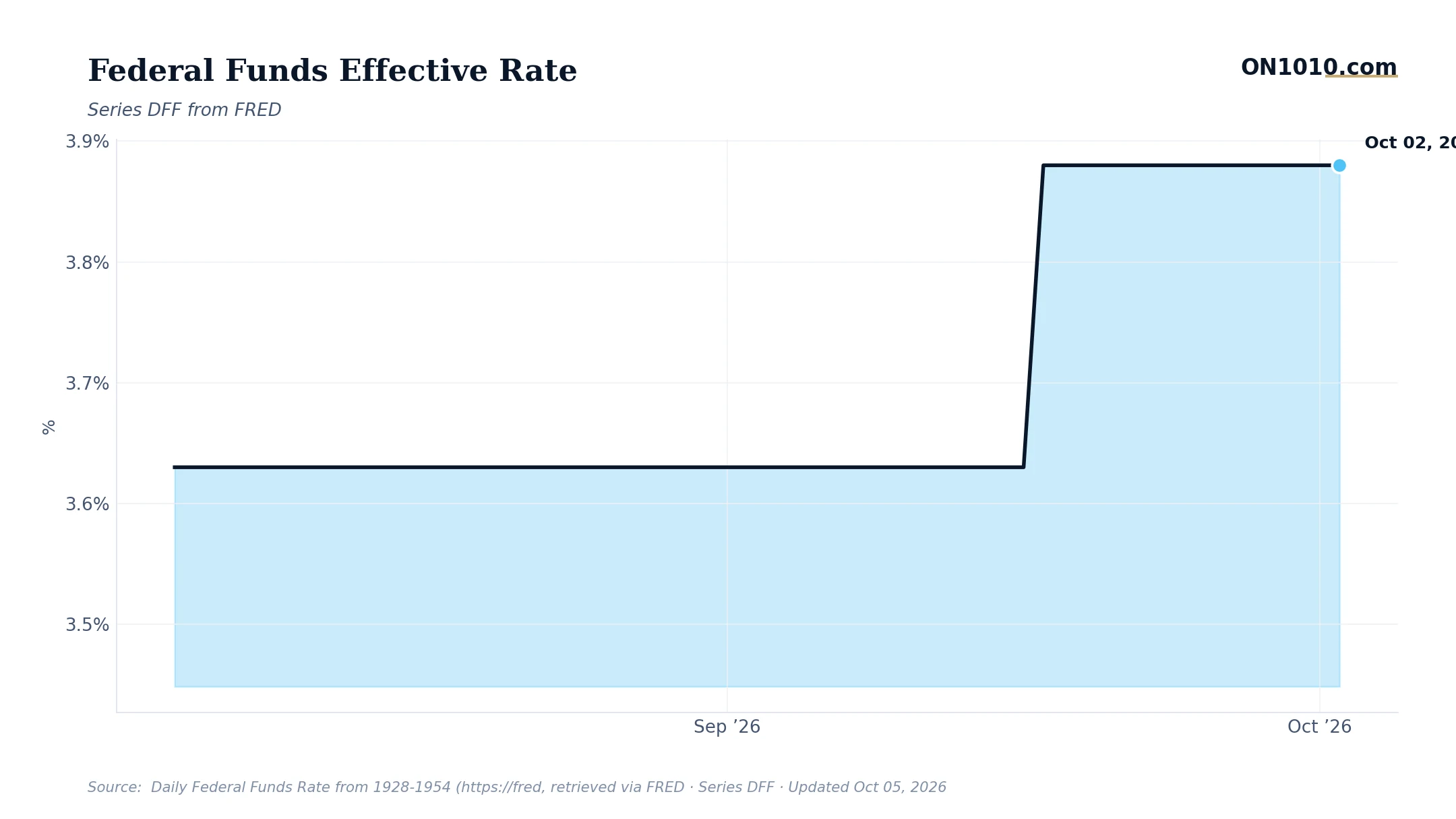
The effective federal funds rate has sat at 3.88% for six consecutive trading days. No drift up, no drift down. When the overnight rate locks in that tightly, it usually means one thing: the Fed is comfortable exactly where it is, and the market knows it.
That kind of precision matters more than it sounds. The effective rate is the actual rate banks charge each other overnight, not the target the Fed announces. The two rarely match perfectly. When they do, and when they hold that match for days on end, it signals that the Fed’s open market operations are running smoothly and that nobody in the banking system is under funding stress.
Here is where it gets interesting. The broader backdrop is anything but calm. Core inflation is still running hot relative to its long-run history, even as it edges lower. The real policy rate (the fed funds rate minus inflation) sits in restrictive territory relative to history, with monetary policy tighter than it has been across the majority of past cycles. Long-term rates are similarly elevated. Credit spreads have been widening. Consumer sentiment is near its weakest readings in decades. And yet the overnight rate just sits there, unmoved.
Historically, when monetary policy has been this restrictive relative to history, a recession has followed within twelve months roughly 18% of the time. That is not a prediction. It is a base rate worth knowing, because 18% is not negligible, and the combination of tight policy, wide credit spreads, and depressed consumer sentiment has appeared together before in ways that eventually slowed growth.
For business leaders and capital allocators, the relevant question is how long the Fed can hold here. Historically, the longer policy stays restrictive after inflation begins falling, the more pressure builds on credit-sensitive parts of the economy: commercial real estate, leveraged borrowers, and anyone refinancing floating-rate debt. A qualified financial professional who knows your specific situation is the right person to think through what that timing means for you.
Bottom Line: A rate frozen at 3.88% reads like quiet. But when that stillness sits against rising credit stress, weak consumer confidence, and a historically tight real policy rate, the question to keep asking is whether the calm is stability or just the pause before the next move.
Source: Federal Reserve Economic Data (FRED)
ON1010 Research is an independent publisher of economic education and is not a registered investment adviser, broker-dealer, or investment company. This content is for educational and informational purposes only and is not investment advice or a recommendation to buy, sell, or hold any security. Published under the publisher exemption recognized by Section 202(a)(11)(D) of the Investment Advisers Act of 1940 (Lowe v. SEC). Always consult a qualified financial professional before making any financial decision.
Free Research
The economy moves fast. We make sure you move faster.
Economic data, policy shifts, and market signals — delivered to your inbox.
Subscribe Free