
The Fed’s Rate Is Frozen. That’s the Story.
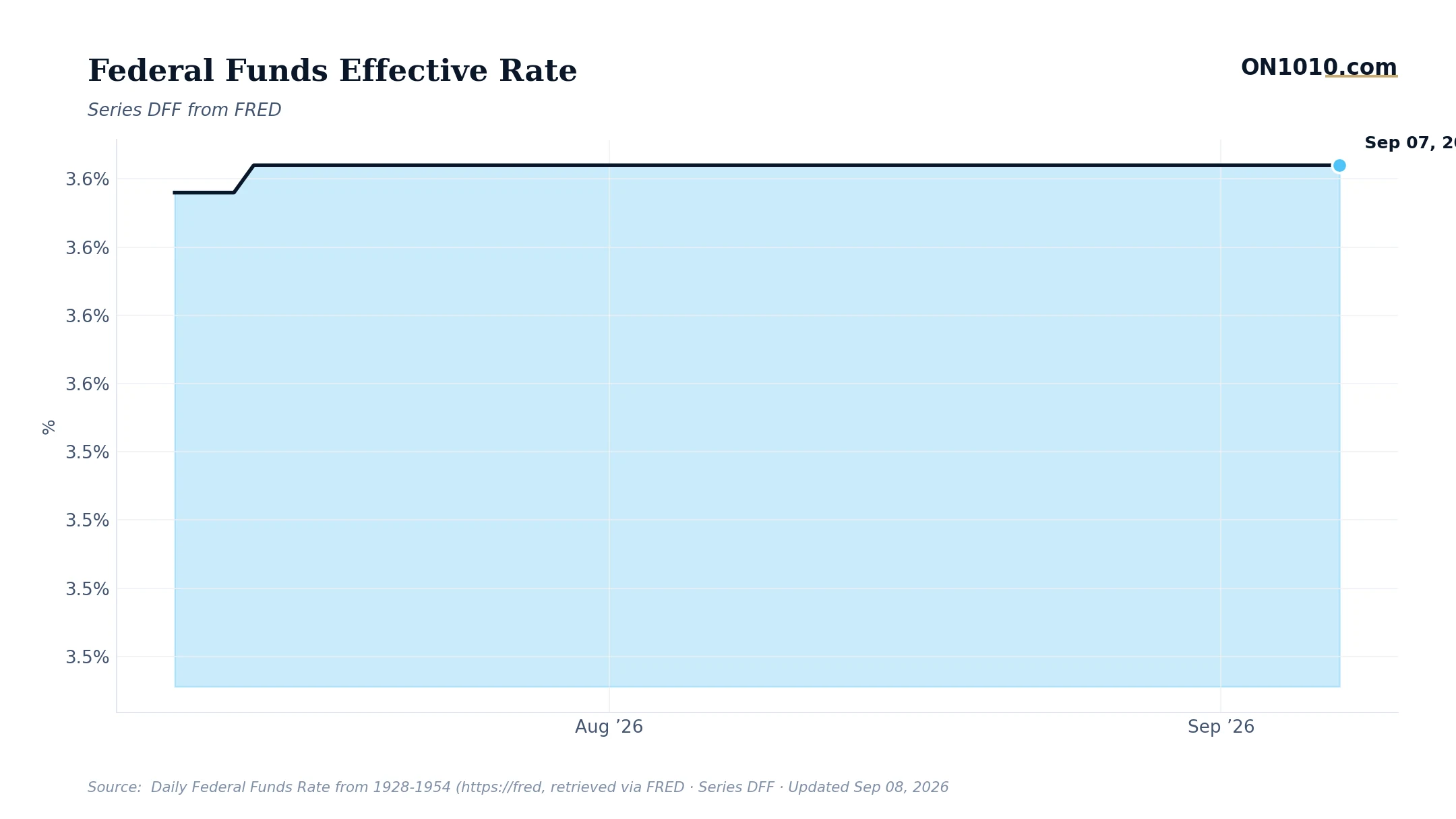
The effective federal funds rate has sat at exactly 3.63% for six straight days. No drift, no wobble. The market is doing precisely what the Fed told it to do, and that kind of precision is worth pausing on.
The Fed’s target range sits at 3.5% to 3.75%, and 3.63% lands almost exactly in the middle. That means the plumbing of overnight lending is working as designed. Banks aren’t scrambling for liquidity (which would push rates toward the top of the range), and there’s no excess flooding the system (which would push rates toward the floor). It’s calm. Almost suspiciously calm.
Here’s the tension worth sitting with. The economic gauges around this steady rate tell a more complicated story. Inflation is still running hot relative to most of the historical record. Long-term interest rates are elevated and rising, which is where businesses actually borrow. Credit spreads are tight, suggesting credit markets are relaxed about default risk. Consumer sentiment, meanwhile, is near historically weak levels. Four data points, four different directions. The overnight rate being anchored tells you about the Fed’s current posture, not necessarily about where the stress is building.
Historically, when the policy rate has sat in a neutral zone while long-term rates continued rising, the gap between where the Fed parks overnight money and where businesses pay to borrow multi-year capital widened. That spread is where capital allocation decisions get made. In past cycles, investors and business operators have watched that spread closely when deciding whether to lock in financing, delay expansion, or reassess project returns against the actual cost of borrowing.
Bottom Line: The overnight rate is steady, but steadiness at the short end doesn’t mean calm everywhere else. The question worth sitting with is whether long-term rates keep drifting higher on their own, even as the Fed holds still.
Source: Federal Reserve Economic Data (FRED)
ON1010 Research is an independent publisher of economic education and is not a registered investment adviser, broker-dealer, or investment company. This content is for educational and informational purposes only and is not investment advice or a recommendation to buy, sell, or hold any security. Published under the publisher exemption recognized by Section 202(a)(11)(D) of the Investment Advisers Act of 1940 (Lowe v. SEC). Always consult a qualified financial professional before making any financial decision.
Free Research
The economy moves fast. We make sure you move faster.
Economic data, policy shifts, and market signals — delivered to your inbox.
Subscribe Free