
The Hiring Freeze No One Is Talking About
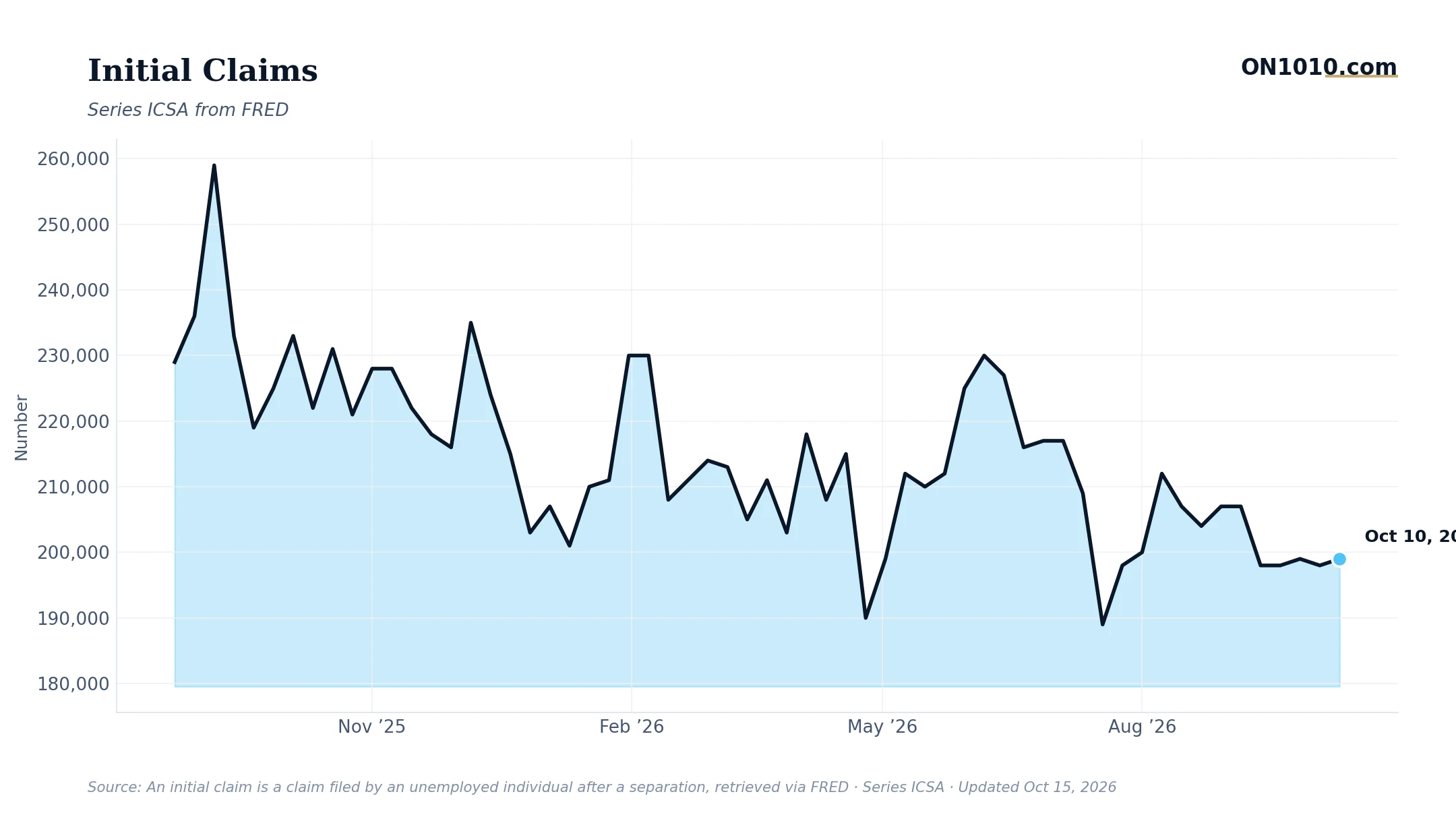
Initial jobless claims ticked up to 199,000 for the week ending October 10, a gain of just 1,000 from the prior week’s 198,000. On the surface, that reads as noise. Zoom out, and the story gets more interesting: claims have been essentially locked between 198,000 and 199,000 for four straight weeks, after a brief spike to 207,000 in early September.
That is an unusually tight range for a data series known for week-to-week volatility. The labor market has not cracked. Layoffs, at least by this measure, remain historically low. The economy is sitting well below the 250,000 threshold that analysts have traditionally used as a sign that labor market stress is building.
Here is where the bigger picture adds texture. The labor market’s surface looks calm, but the surrounding conditions tell a more complicated story. Monetary policy remains restrictive by historical standards. Long-term interest rates are elevated. Credit spreads have widened since the last reading, a signal that lenders are getting more cautious. Consumer sentiment sits near the bottom of its historical range. These are not recession warning lights, but they are the conditions under which a crack in the labor market, if it comes, tends to arrive quietly and then all at once.
In past cycles, persistently low claims alongside tightening credit conditions have raised a specific question for business operators: is the economy holding up, or is it holding its breath? Historically, this kind of reading has been consistent with continued expansion, but it has also appeared late in cycles when layoffs had not yet started but hiring had quietly slowed. The distinction matters. Low claims tell you people are keeping their jobs. They do not tell you whether new jobs are being created at a pace that sustains growth.
Bottom Line: The labor market’s stillness is either a sign of genuine resilience or a calm before adjustment, and the surrounding indicators suggest the answer is worth watching closely over the next several months.
Source: Federal Reserve Economic Data (FRED)
ON1010 Research is an independent publisher of economic education and is not a registered investment adviser, broker-dealer, or investment company. This content is for educational and informational purposes only and is not investment advice or a recommendation to buy, sell, or hold any security. Published under the publisher exemption recognized by Section 202(a)(11)(D) of the Investment Advisers Act of 1940 (Lowe v. SEC). Always consult a qualified financial professional before making any financial decision.
Free Research
The economy moves fast. We make sure you move faster.
Economic data, policy shifts, and market signals — delivered to your inbox.
Subscribe Free