
The Housing Market Is Already in Recession. The Fed Is Still Debating Whether to Make It Worse.
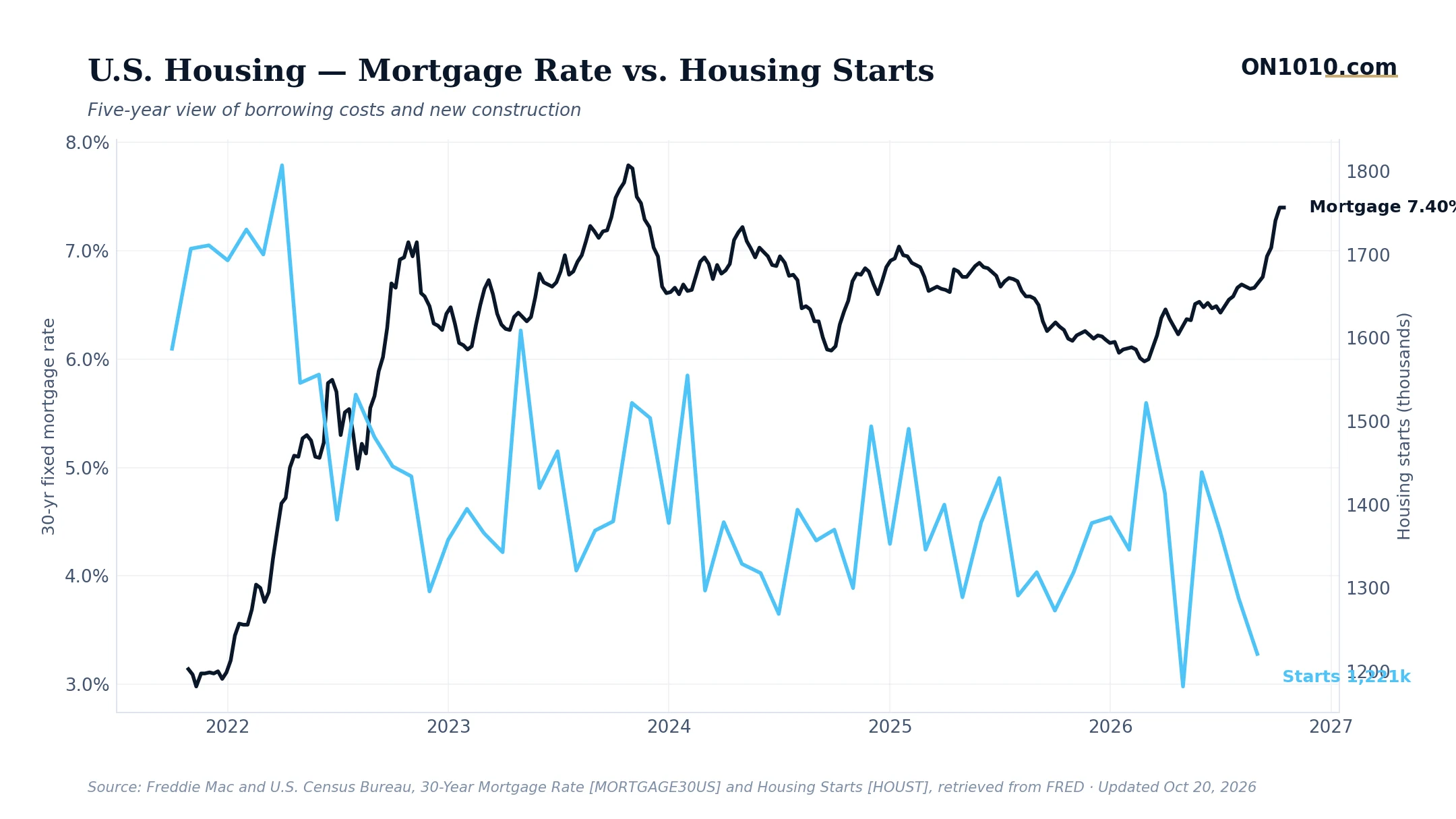
According to CNBC Economy, September housing data deteriorated further across multiple reports, even as the Fed weighs whether to push its policy rate above the current 3.75%-4.0% target range. The headline frames this as a warning sign. The more uncomfortable read: housing may already be telling us what the broader economy refuses to admit yet.
Housing is one of the most interest-rate-sensitive parts of the economy, and it moves first. When mortgage rates climb, builders pull back permits, existing homeowners stay locked into their lower-rate mortgages rather than sell, and transaction volume collapses. That is exactly what September’s data is showing. The mechanism matters here because housing weakness does not stay in housing. Construction employment, furniture and appliance sales, mortgage lending, and local tax revenues all follow the same current downstream.
The broader backdrop makes this harder to dismiss. Long-term interest rates are sitting in the upper quarter of their historical range, and credit spreads have recently widened from already elevated levels, a combination that signals genuine stress in how capital markets are pricing risk. Consumer sentiment is near historical lows. Sector rotation data shows money moving out of financials and technology and into consumer staples and health care, the classic defensive positioning that tends to precede, not follow, economic softening. When multiple signals line up like this, the argument that housing is an isolated problem gets weaker.
Historically, investors and business operators have watched housing starts and permits as early-warning gauges because the sector leads the cycle by six to eighteen months. When housing weakens under restrictive monetary policy that is already above its historical midpoint, the question worth asking is how much of the eventual slowdown is already locked in before the Fed makes its next move. Past cycles where both housing and credit conditions deteriorated simultaneously resolved more slowly than most forecasts expected. Past performance does not predict future results, but the historical base rate carries weight.
Bottom Line: The Fed is staring at a lagging inflation problem while housing is already flashing a forward-looking contraction signal. Both things are happening at the same time, and only one of them is getting the Fed’s full attention.
Read more: CNBC Economy
ON1010 Research is an independent publisher of economic education and is not a registered investment adviser, broker-dealer, or investment company. This content is for educational and informational purposes only and is not investment advice or a recommendation to buy, sell, or hold any security. Published under the publisher exemption recognized by Section 202(a)(11)(D) of the Investment Advisers Act of 1940 (Lowe v. SEC). Always consult a qualified financial professional before making any financial decision.
Free Research
The economy moves fast. We make sure you move faster.
Economic data, policy shifts, and market signals — delivered to your inbox.
Subscribe Free