
The Housing Number Nobody Is Talking About While Bonds Flash Yellow
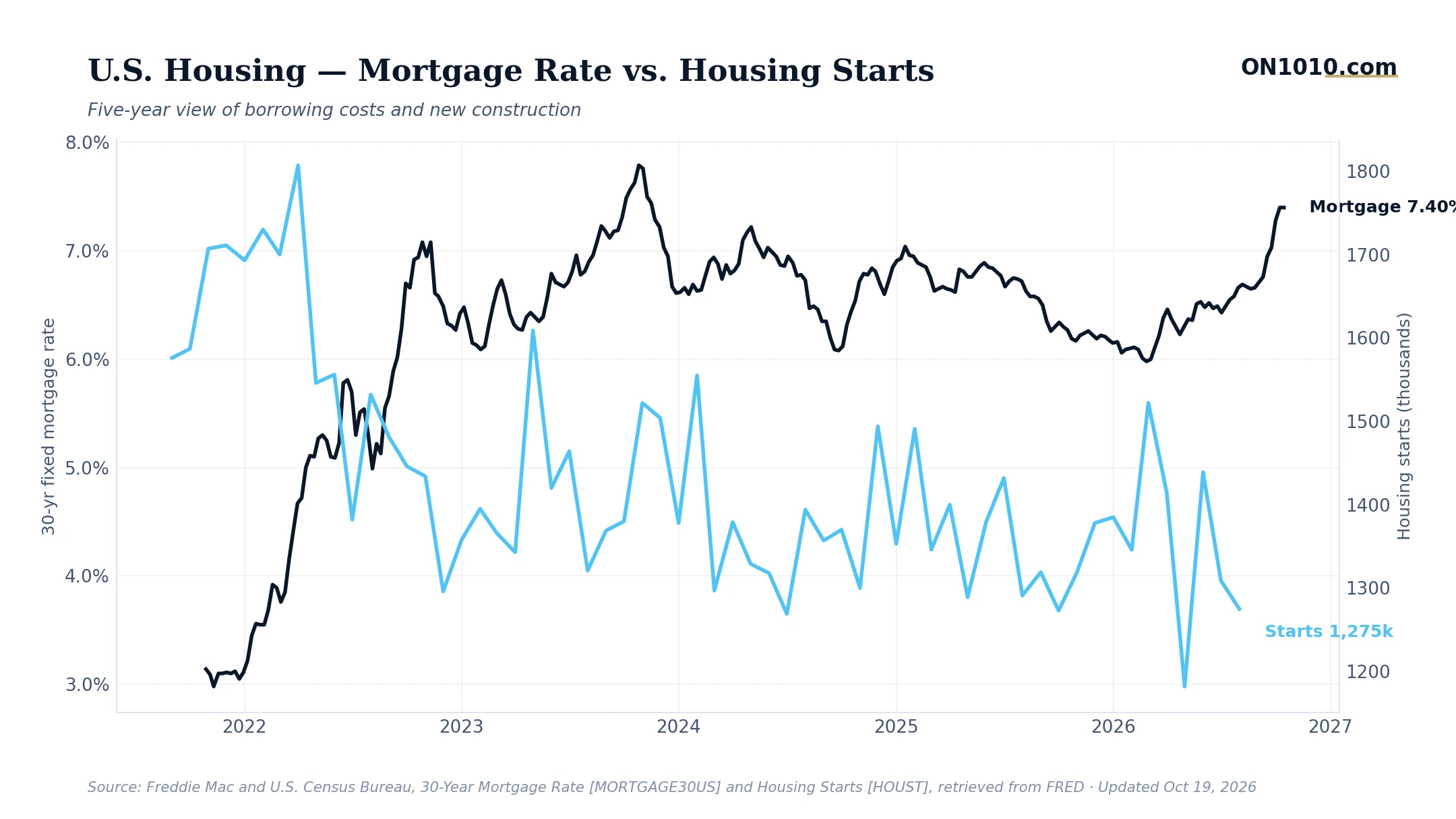
The 10-year Treasury yield sits at 5.1% this morning. That is the number every mortgage lender, homebuilder, and aspiring buyer wakes up thinking about, and right now it is doing serious damage to housing affordability in ways the stock market has not priced in.
Here is the twist: credit markets are already signaling stress. The spread between the 10-year and the 2-year sits at just 35 basis points, and credit conditions are running wide versus their long-run history. Equity markets closed Friday down, with the Nasdaq dropping 2.15% to 26,140 and the S&P 500 falling 1.09% to 7,659. But the real story is not Friday’s selloff. It is what a 5.1% 10-year means for the one sector that is most sensitive to long-term borrowing costs.
A 30-year mortgage typically prices off the 10-year. When the 10-year runs this high, monthly payments on a median-priced home can easily price out a significant share of buyers. Demand cools, builder starts slow, and housing wealth stops compounding for existing owners. Meanwhile, defensive sectors including Consumer Staples and Health Care are outrunning the S&P 500 by more than 5 points over the past month. Money is quietly repositioning.
On deck today: No major scheduled housing data prints Monday, but remarks from Fed officials or any fresh inflation commentary could move the 10-year and reset the affordability math in real time.
Why it matters: When long-term rates are high versus history and credit conditions are tightening, housing tends to feel it first. That is not a recession call. It is where the squeeze shows up earliest, and it is worth watching.
The deeper read on what rising long-term rates mean for the cycle lands Sunday in The Long View, and it is free.
ON1010 Research is an independent publisher of economic education and is not a registered investment adviser, broker-dealer, or investment company. This content is for educational and informational purposes only and is not investment advice or a recommendation to buy, sell, or hold any security. Published under the publisher exemption recognized by Section 202(a)(11)(D) of the Investment Advisers Act of 1940 (Lowe v. SEC). Always consult a qualified financial professional before making any financial decision.
Free Research
The economy moves fast. We make sure you move faster.
Economic data, policy shifts, and market signals — delivered to your inbox.
Subscribe Free