
The Job Market’s Quiet Message
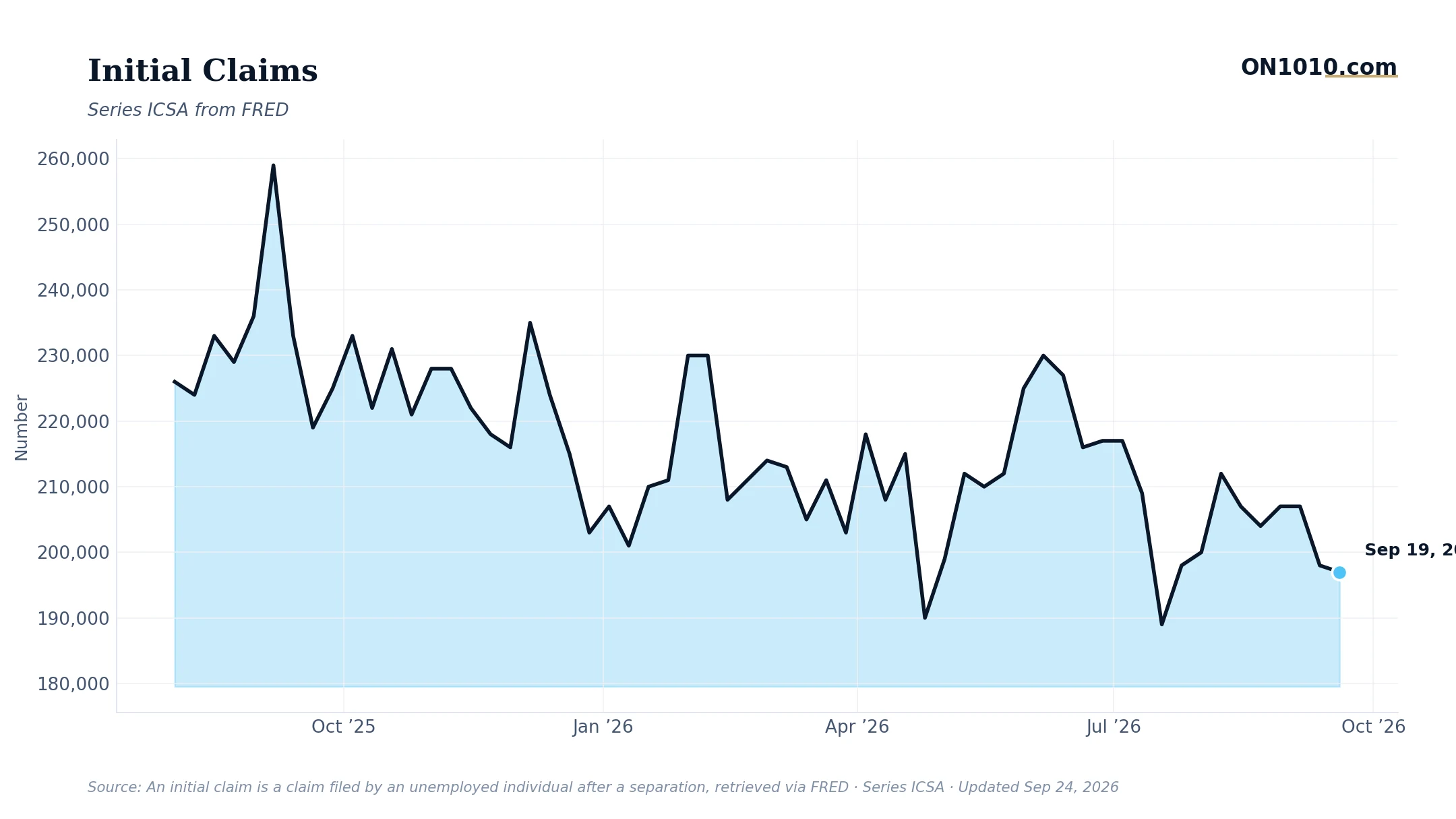
Initial jobless claims fell to 197,000 last week, the lowest reading in the recent trend and a continuation of a notable pullback from the 204,000-207,000 range that defined most of August.
One week of data is noise. Six weeks of data starts to tell a story. Claims have now dropped roughly 10,000 from their August plateau, a move that suggests the labor market is holding firmer than many expected given elevated interest rates and persistent uncertainty about the direction of policy.
Here is the context that makes this reading interesting. Consumer sentiment sits near historic lows, yet employers are still not pushing workers out the door at any unusual rate. That is a meaningful tension. Sentiment surveys measure how people feel; claims data measures what businesses actually do. Right now, businesses are not cutting. Credit spreads are tight, the market is calm by historical standards, and layoff activity is running well below anything that has historically preceded a broad economic downturn. Growth is tracking near its long-run average, which means this is a labor market consistent with a steady-state economy, not a deteriorating one.
Historically, claims readings in this range have appeared during healthy expansions and have also appeared just before labor markets began to soften. The direction matters as much as the level. When claims drop back after a multi-week plateau, it has often signaled that any softening was temporary rather than the start of a trend. In past cycles, business leaders and capital allocators have used sustained claims movement (three to six months in one direction, not one or two weeks) as a more reliable input than any single print.
Bottom Line: The labor market keeps telling us it is fine, even as consumers say they are worried and long-term rates remain historically elevated. Which signal is leading and which is lagging?
Source: Federal Reserve Economic Data (FRED)
ON1010 Research is an independent publisher of economic education and is not a registered investment adviser, broker-dealer, or investment company. This content is for educational and informational purposes only and is not investment advice or a recommendation to buy, sell, or hold any security. Published under the publisher exemption recognized by Section 202(a)(11)(D) of the Investment Advisers Act of 1940 (Lowe v. SEC). Always consult a qualified financial professional before making any financial decision.
Free Research
The economy moves fast. We make sure you move faster.
Economic data, policy shifts, and market signals — delivered to your inbox.
Subscribe Free