
The Jobs Market Is Adding Positions. The Pace Is the Story.
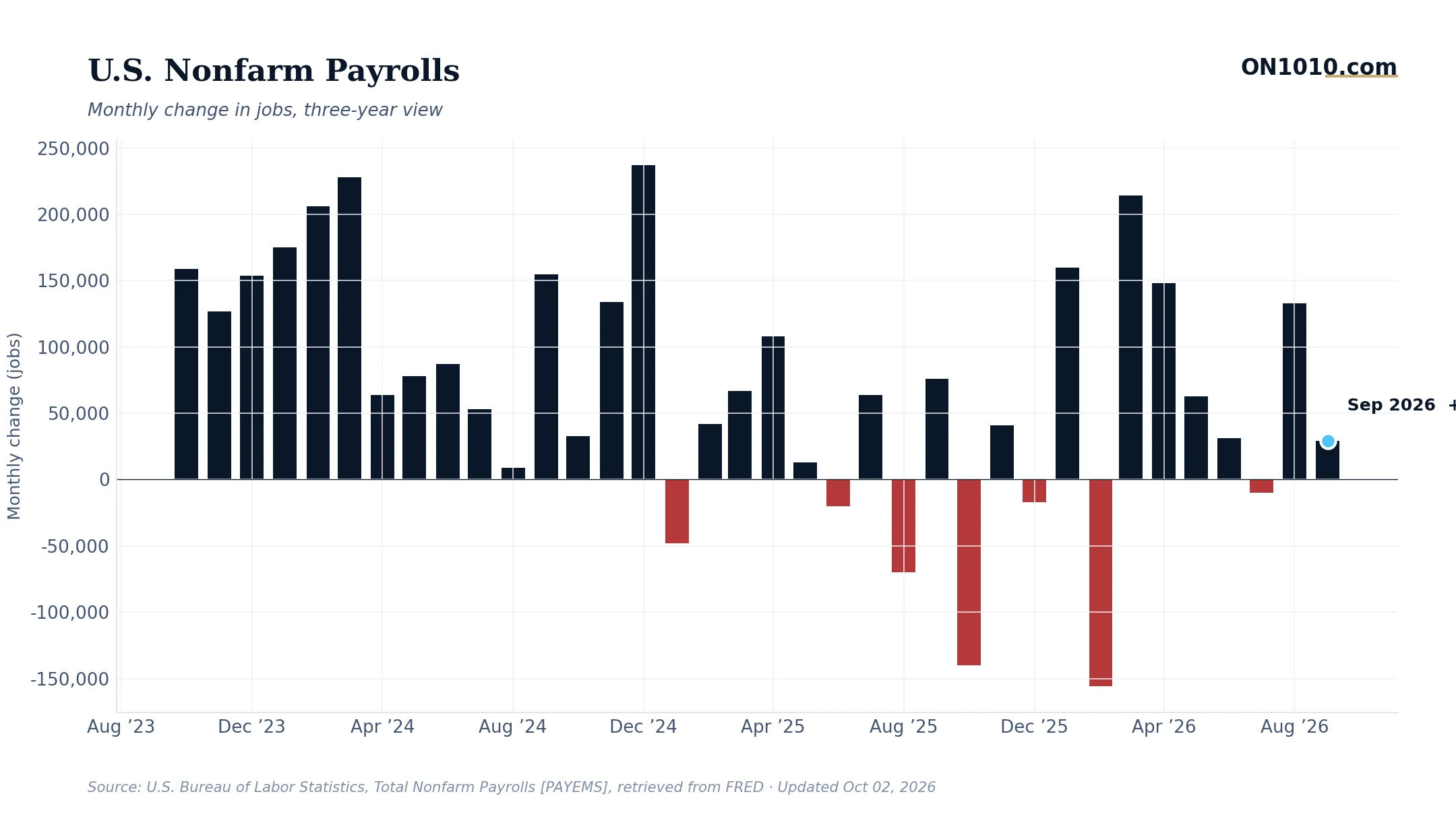
The U.S. economy added 29,000 jobs in September, according to the latest nonfarm payrolls release. That number is technically positive, but it is running well below the 100,000 per month economists generally consider the floor needed to absorb new workers entering the labor force.
Zoom out and the trend is consistent, not collapsing. Over the past six months, the economy has added roughly 246,000 jobs total, averaging about 41,000 per month. That is a meaningful slowdown from the post-pandemic surge years, when monthly gains regularly topped 200,000 to 400,000. The year-over-year gain of 595,000 jobs sounds solid in isolation, but spread across twelve months it averages under 50,000 per month.
The context around this release makes the slowdown harder to dismiss. Long-term interest rates sit in the upper range of their historical history and are still rising, which increases borrowing costs for businesses thinking about expansion. Monetary policy remains restrictive by historical standards. Consumer sentiment is near its weakest readings in decades, which typically filters into cautious household spending. When consumers pull back, firms eventually follow with hiring. The gauge connecting all of this: margin pressure. Businesses facing higher financing costs, softer demand, and sticky labor expenses tend to slow hiring before they cut prices.
Historically, this type of slow-growth, low-churn jobs environment has raised a specific set of questions for business operators and capital allocators. Is the economy decelerating into a soft landing, or is the deceleration itself building momentum? In past cycles, a sustained period of sub-50,000 monthly job additions, combined with restrictive policy and weak consumer confidence, has often preceded a more meaningful shift in labor demand. Historically, from readings like these, a recession began within the following twelve months about 7% of the time, which means the base case is still expansion, but the conditions warrant attention.
Bottom Line: The jobs market is not breaking down, but it is grinding lower at a pace that leaves little cushion if something else softens. The question worth tracking is whether the slowdown stabilizes here or has further to run.
Source: Federal Reserve Economic Data (FRED)
ON1010 Research is an independent publisher of economic education and is not a registered investment adviser, broker-dealer, or investment company. This content is for educational and informational purposes only and is not investment advice or a recommendation to buy, sell, or hold any security. Published under the publisher exemption recognized by Section 202(a)(11)(D) of the Investment Advisers Act of 1940 (Lowe v. SEC). Always consult a qualified financial professional before making any financial decision.
Free Research
The economy moves fast. We make sure you move faster.
Economic data, policy shifts, and market signals — delivered to your inbox.
Subscribe Free