
The Jobs Number That Has to Be Read in Two Languages
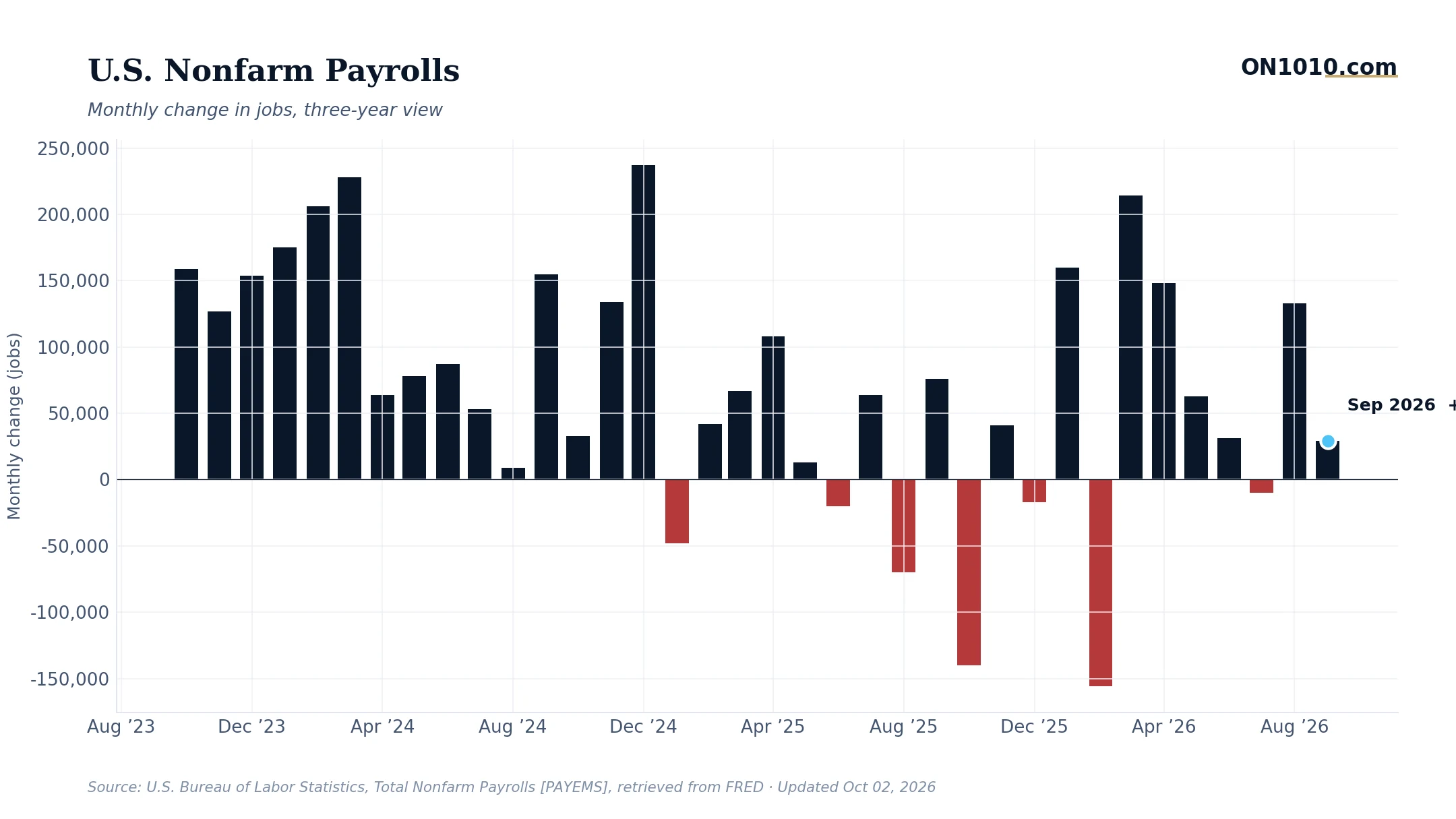
According to CNBC, Wall Street is bracing for payroll growth of around 84,000 when September’s jobs report drops Friday. After 159 million Americans on nonfarm payrolls heading into the month, that would represent one of the softer prints of the post-pandemic expansion. The interesting question isn’t whether the number misses or beats. It’s what 84,000 actually means in the current economic language.
Here’s the translation problem. The U.S. economy needs somewhere between 100,000 and 150,000 jobs per month just to absorb new workers entering the labor force. A print of 84,000 doesn’t sound like a slowdown, it reads like one, particularly against a backdrop where inflation is still running hot by historical standards, monetary policy is genuinely restrictive, and long-term interest rates sit in the upper range of their multi-decade history. Real borrowing costs are high. Businesses feel that. Hiring is a capital allocation decision, and expensive capital slows it down.
The setup going into Friday is more complicated than a single number can capture. Consumer sentiment is near the bottom of its historical range, yet a recession has historically followed that kind of reading almost never in the near term. Separately, markets are sending a mixed signal: the broad trend is technically intact with SPY above both its 50-day and 200-day moving averages, but market trend and participation are deteriorating beneath the surface. Technology is carrying significant weight while financials and industrials lag, which raises a legitimate question about whether the growth story is narrowing rather than broadening.
Historically, investors have treated a jobs report near or below labor force replacement as a signal to watch the wage line just as closely as the headline count. If workers are fewer but wages are higher, the nominal spending pool may hold up even as employment growth cools. That dynamic has historically kept margins from collapsing as fast as the jobs headline might imply.
Bottom Line: 84,000 jobs is a number that only matters in context. With restrictive policy, elevated rates, and participation fading under the surface, Friday’s report could clarify whether the economy is finding a soft landing or beginning to lose altitude.
Read more: CNBC Economy
ON1010 Research is an independent publisher of economic education and is not a registered investment adviser, broker-dealer, or investment company. This content is for educational and informational purposes only and is not investment advice or a recommendation to buy, sell, or hold any security. Published under the publisher exemption recognized by Section 202(a)(11)(D) of the Investment Advisers Act of 1940 (Lowe v. SEC). Always consult a qualified financial professional before making any financial decision.
Free Research
The economy moves fast. We make sure you move faster.
Economic data, policy shifts, and market signals — delivered to your inbox.
Subscribe Free