
The Long View, Week of July 20, 2026
The Signal
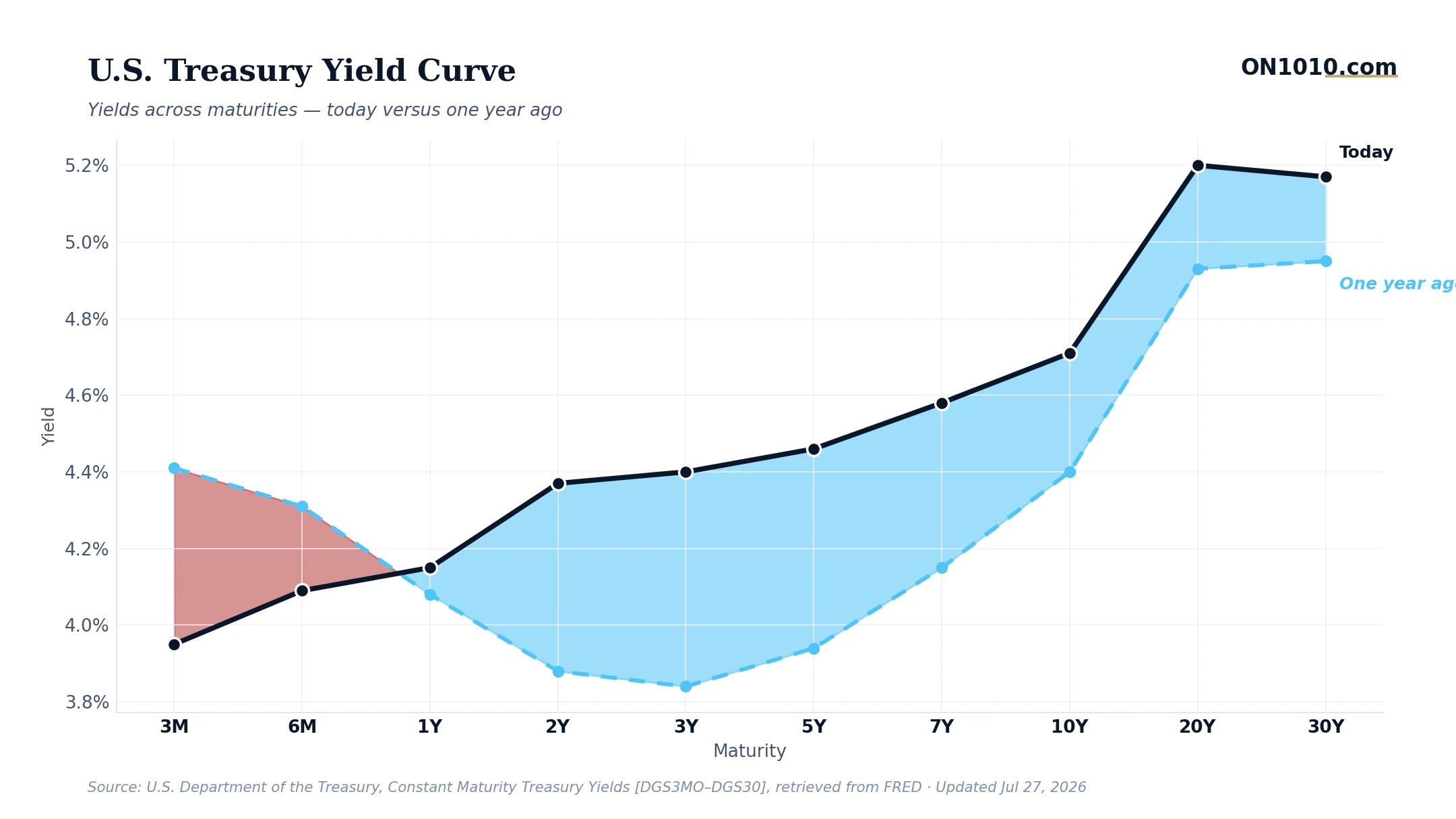
> The bond market is quietly delivering a verdict on the Fed’s next chapter, and it is not a flattering one. Kevin Warsh, the incoming Fed chair nominee, has made inflation credibility the centerpiece of every public appearance since his nomination, using language designed to signal that the Fed will not blink. But the 10-year Treasury yield has climbed from 4.55% to 4.71% in a single week, the 2-year has risen seven straight trading days to 4.37%, and the 10-year breakeven inflation rate sits at 2.26%, essentially unmoved despite all the hawkish signaling. Bond traders are not fighting the rhetoric. They are simply pricing in a world where inflation stays sticky, the Fed stays cautious, and the rate cycle resolves later and higher than the consensus expected coming into 2026. When a new Fed chair promises credibility and the bond market responds by pushing long yields higher anyway, that is not a sign of confidence. That is the market saying it will believe it when it sees it.
Market Pulse
S&P 500: ~5,470 (approximate, live data unavailable at time of writing) (approximately flat to slightly negative on the week)
SPY at $738.93 sits below its 50-day moving average of $744.11, reflecting a market digesting rising long-term yields and earnings divergence, where GM beat and Intel surged but Tesla and Alphabet erased hundreds of billions in a single session.
Nasdaq: Current data unavailable at time of writing (Current data unavailable at time of writing)
Technology as a sector underperformed SPY by 4.7% this week, with Tesla and Alphabet posting large post-earnings drops that concentrated losses in the index’s heaviest-weighted names.
10-Year Treasury: 4.71% (+0.16pp from 4.55% a week ago)
Yields climbed steadily as bond traders priced in a Fed that stays on hold longer than hoped, with Middle East escalation and sticky breakeven inflation readings reinforcing that the path to rate cuts is longer than the Fed’s own forward guidance implies.
U.S. Dollar Index: Current data unavailable at time of writing (Current data unavailable at time of writing)
Rising U.S. yields typically support the dollar, but Middle East risk and commodity price pressure are creating cross-currents that make a clean directional read on the dollar this week difficult.
VIX: 18.58 (above the 20-day average of 16.96)
Volatility has quietly crept above its recent average as defensive sectors outperform and tech sells off, reflecting institutional caution even as the VIX remains below the 20 threshold that historically signals genuine fear.
WTI Crude: Current data unavailable at time of writing, Brent crossed $100 per barrel on tanker strike reports (Current data unavailable at time of writing)
Eleven consecutive days of U.S. strikes on Iran, Houthi resumption of shipping attacks in the Bab el-Mandeb Strait, and tanker strikes off Saudi Arabia drove Brent crude above $100, a threshold with direct implications for input costs across the economy.
Three Stories That Matter
The New Fed Chair Is Talking Tough. The Bond Market Is Talking Back.
Kevin Warsh has made five public appearances since his nomination and keeps returning to three phrases that signal hawkish credibility. The theory is that a Fed chair who convincingly commits to price stability can lower inflation expectations without having to raise rates as aggressively. But this week told a different story. The 2-year Treasury yield rose seven consecutive trading days, climbing from 4.13% to 4.37%, while the 10-year moved from 4.55% to 4.71%. The 10-year breakeven inflation rate, the bond market’s real-time inflation forecast, barely budged at 2.26%. Bond traders are essentially saying that words are words, and they will price inflation based on what the data shows, not on what the next Fed chair promises.
Why it matters: The gap between a credibility-signaling Fed and a skeptical bond market matters because the 10-year yield is the discount rate that touches everything: mortgage rates, corporate borrowing costs, and equity valuations. With the 30-year mortgage already at 6.58% and climbing for four straight weeks, every additional basis point the bond market extracts from a Fed it does not fully trust is a tax on growth the Fed did not authorize.
Money Is Rotating Into Defense. Here Is What That Has Meant Before.
This week’s sector data shows a pattern that institutional investors recognize immediately. Health care beat SPY by 5.2%, real estate outperformed by 2.5%, and technology trailed by 4.7%, all while the VIX climbed above its 20-day average. That combination, defensive sectors leading, tech lagging, and volatility quietly rising, has appeared at recognizable points in past cycles. It appeared in late 2007 as financials rolled over before the broader economy did. It appeared in late 2015 as growth slowed before the 2016 earnings recession. It does not always precede a downturn. But it is the market’s way of saying that the participants with the most capital to protect are starting to hedge rather than reach.
Why it matters: Sector rotation is a leading indicator because institutional money moves before earnings revisions do. When health care and real estate are absorbing capital that is leaving technology, the implicit message is that some large participants expect either slower nominal growth, lower long-term rates eventually, or both. The SPY sitting below its 50-day moving average while the VIX edges higher above its recent average is the kind of setup worth monitoring into the next earnings season, because it often means margin guidance becomes more important than the headline beat.
A 25% Brazil Tariff Is a Supply Chain Problem in Slow Motion
The Trump administration’s proposed tariff on Brazilian goods, including agricultural inputs, steel, and manufactured components, arrives at precisely the moment when supply chains are still mid-rewire from the first round of trade disruptions. Brazil is not a peripheral trading partner. It is the world’s largest exporter of soybeans, a major steel supplier, and an increasingly important manufacturing node. A 25% cost shock to those input categories does not land as a one-time price increase. It forces procurement decisions, reconfigures supplier relationships, and pressures margins across food processing, construction, and durable goods manufacturing, all sectors that are not yet operating with the pricing power they had in 2021 and 2022.
Why it matters: Tariff cost shocks are slow-moving but persistent. When input costs rise faster than companies can pass them through to consumers, the gap comes out of margins. With corporate margins already under watch as a leading indicator of hiring and investment, a sustained input cost shock from a major agricultural and materials supplier is the kind of second-order pressure that does not show up in the headline CPI immediately but does show up in earnings calls three to six months later.
The Framework: The Term Premium: Why Long Yields Can Rise Even When the Fed Stands Still
The term premium is the extra yield bond investors demand to hold a long-term bond instead of rolling over a series of short-term ones. It is compensation for uncertainty: uncertainty about future inflation, future Fed policy, and future government borrowing needs. When the term premium is low or negative, it means investors are comfortable with the long-term outlook and do not require much extra return to lock their money up for a decade. When it rises, it signals that investors see more risk in the future than they did before. This week illustrated that mechanism cleanly. The Fed held its target rate at 3.5% to 3.75%, entirely unchanged. But the 10-year yield rose from 4.55% to 4.71%, a 16 basis point move in seven trading days with no policy change to explain it. The driver was term premium expansion: bond traders demanding more compensation to hold 10-year paper as Middle East escalation pushed oil toward $100, the incoming Fed chair’s credibility remained untested, and breakeven inflation held steady at 2.26% rather than falling. What this suggests going forward is that even if the Fed begins cutting the short end of the curve, long yields may not follow in lockstep, which is precisely what happened in 2004 and 2005 when the Fed raised rates 17 times and the 10-year barely moved, a phenomenon Alan Greenspan famously called a conundrum. Today the risk is the mirror image: the Fed holds or cuts, but term premium expansion keeps long yields elevated, tightening financial conditions without any formal Fed action.
Our Take
The setup this week rhymes most closely with the spring of 1994, when the Fed had already moved rates higher, a new policy regime was being internalized by markets, and long yields kept climbing even as the central bank signaled it was done moving aggressively. The parallel is not exact, but the mechanism is the same: a bond market that does not fully trust the inflation narrative pushes long yields higher independently of what the Fed does at the short end, and that self-reinforcing dynamic tightens financial conditions on its own. This week’s 10-year at 4.71% against a Fed funds rate of 3.63% produces a positive term spread of roughly 108 basis points, which looks healthy on the surface, but the direction of travel matters more than the level. The 2-year rising seven consecutive days to 4.37% tells you that the market is not pricing imminent cuts. Meanwhile, the 30-year mortgage at 6.58% and climbing four straight weeks is already doing the Fed’s work for it in the housing market, and that is before any formal policy tightening. What consensus is missing is that the real tightening agent right now is not the Fed, it is the term premium, and it is being driven by three forces simultaneously: geopolitical risk pushing oil toward $100, fiscal uncertainty keeping Treasury supply elevated, and a Fed credibility transition that the bond market is still pricing as an open question. What to watch is the 10-year breakeven inflation rate over the next three weeks. If it holds above 2.25% as Middle East risk persists and the tariff pipeline feeds through, term premium expansion has room to continue and long yields could test 4.85% to 5.00% without any Fed action whatsoever. If the breakeven drops back toward 2.10%, it signals that the bond market is beginning to grant the new Fed chair the credibility he is asking for, and that would be the first real evidence that the policy transmission is working as intended. Those are two very different worlds for anyone thinking about capital allocation over the next two quarters, and a qualified financial professional who knows your situation is the right person to work through what each scenario means for you specifically.
What I’m Reading
The Term Premium: What Is It, Why Does It Matter, and How Do We Measure It?, Federal Reserve Bank of New York
The New York Fed’s Adrian, Crump, and Moench term premium model is the benchmark framework for understanding why long yields move independently of Fed policy, which is exactly the dynamic driving markets this week.
Sector Rotation and Business Cycle Stages, Fidelity Investments Learning Center
Fidelity’s classic business cycle sector rotation framework is a clean primer for understanding what defensive outperformance historically signals about where the cycle is turning, directly relevant to this week’s rotation data.
How Supply Chain Disruptions Pass Through to Consumer Prices, Federal Reserve Bank of San Francisco Economic Letter
With a 25% Brazil tariff entering a supply chain still mid-rewire, the San Francisco Fed’s research on tariff cost pass-through timing and magnitude provides the analytical framework for thinking about the margin implications that will show up in earnings calls later this year.
The Week Ahead
PCE Price Index (June) (Friday, 8:30 AM ET)
The Fed’s preferred inflation measure will either validate or challenge the bond market’s 2.26% breakeven reading. A hot print would add fuel to the term premium expansion story and push the case for rate cuts even further into the future.
Q2 GDP Advance Estimate (Wednesday, 8:30 AM ET)
The first look at second-quarter growth lands in a week where the bond market is already nervous. Strong growth with sticky inflation would reinforce the higher-for-longer narrative. Weak growth with sticky inflation is the scenario most difficult for policy to navigate.
Consumer Confidence (July) (Tuesday, 10:00 AM ET)
With GM citing a resilient consumer to justify raised guidance and mortgage rates at a six-week high, the gap between what corporate America is saying and what households are feeling is worth monitoring directly.
FOMC Meeting and Rate Decision (Wednesday, 2:00 PM ET)
No change is universally expected at 3.5% to 3.75%, but Chair Powell’s press conference takes on extra weight this week, because any comment on Warsh’s incoming approach to inflation credibility becomes a data point the bond market will immediately reprice.
Initial Jobless Claims (week ending July 25) (Thursday, 8:30 AM ET)
Last week’s 187,000 print was the lowest reading in months. A second consecutive sub-200,000 reading would confirm that labor market strength is not fading, which removes one of the Fed’s clearest justifications for cutting rates and keeps the term premium story alive.
ON1010 Research is an independent publisher of economic education and is not a registered investment adviser, broker-dealer, or investment company. Nothing published by ON1010 constitutes investment advice, a recommendation to buy, sell, or hold any security, or a solicitation of any kind. All content is for informational and educational purposes only. ON1010 publishes under the publisher exemption recognized by Section 202(a)(11)(D) of the Investment Advisers Act of 1940 (Lowe v. SEC, 472 U.S. 181, 1985). Always consult a qualified financial professional before making any financial decision.
Free Research
The economy moves fast. We make sure you move faster.
Economic data, policy shifts, and market signals — delivered to your inbox.
Subscribe Free