
The Unemployment Rate Ticked Up. The Context Is What Makes It Interesting.
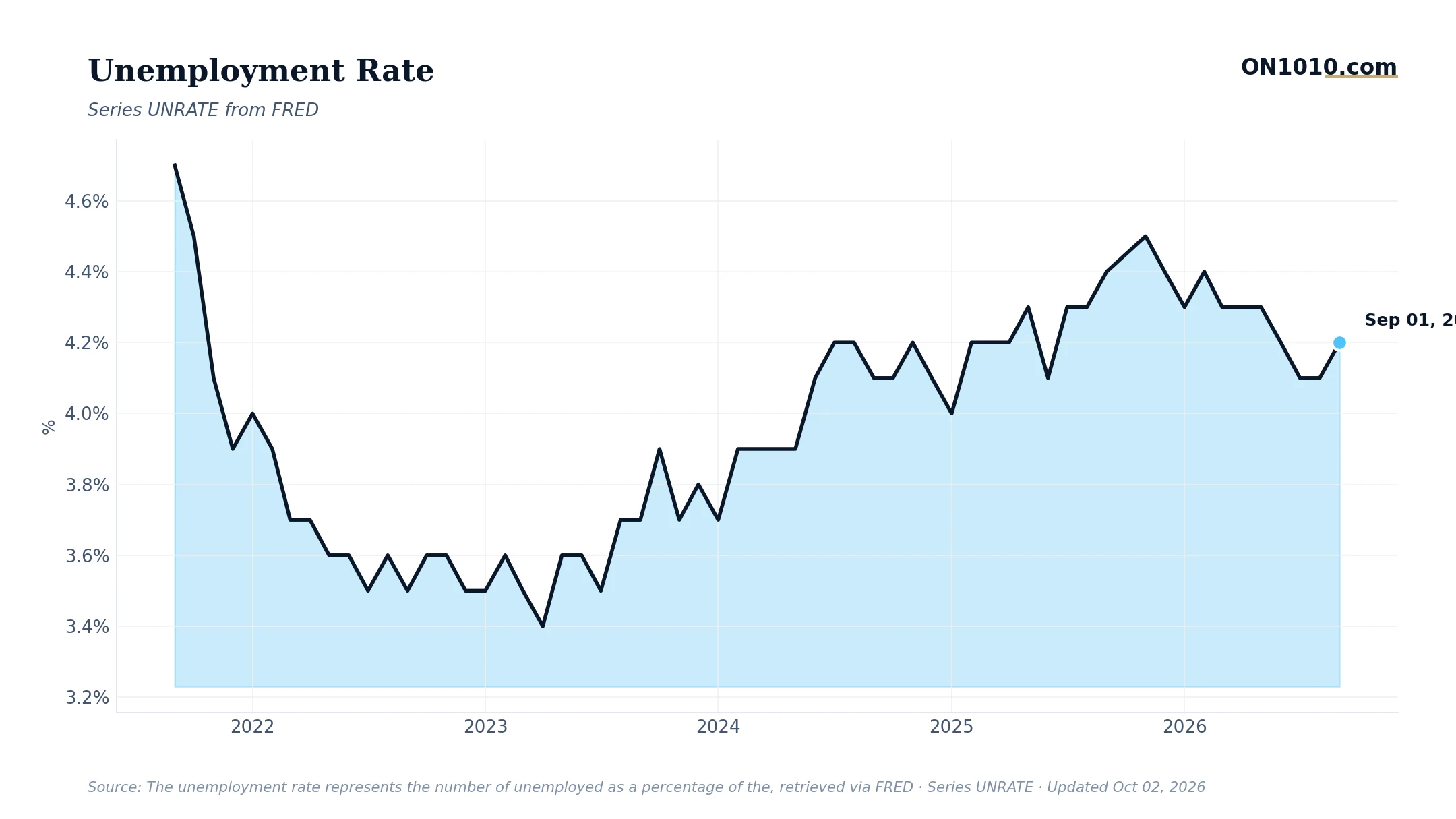
The headline number is straightforward: unemployment rose 0.1 percentage point to 4.2% in September 2026. But here is what makes it worth examining more closely. Over the past six months, the rate has oscillated in a tight band between 4.1% and 4.3%, never breaking cleanly in either direction. A labor market that won’t move is telling you something, and the question is what.
Zoom out and the picture gets more nuanced. Unemployment is actually 0.3 percentage points lower than it was a year ago, which sounds like progress. But set that against the broader backdrop: real policy rates remain restrictive relative to history, long-term interest rates are in the upper range of their historical track record, and consumer sentiment sits near the bottom of its historical range. Workers still have jobs. They just aren’t feeling great about it, and the businesses that employ them are borrowing in a high-rate environment.
This combination deserves attention. Historically, restrictive monetary policy tends to show up in labor markets with a lag, sometimes 12 to 18 months after the policy tightens. When rates have been this elevated relative to history, new recessions followed within a year roughly 18% of the time. That is not a forecast. It is a base rate worth knowing, especially when a labor market that looks “fine” on the surface is flashing subtle signs of fatigue underneath.
For business operators and capital allocators, the relevant question is margin math. In past cycles, when unemployment moved sideways at elevated levels while borrowing costs stayed high, the squeeze tended to show up in investment decisions before it showed up in payrolls. Businesses watching their financing costs and their revenue growth in opposite directions face a narrowing gap. History says that gap eventually closes, one way or another.
Bottom Line: A 4.2% unemployment rate is not a crisis, but a labor market that refuses to improve while rates stay high and consumers stay anxious is worth watching carefully. The lag between tight policy and real hiring pain has not always been gentle.
Source: Federal Reserve Economic Data (FRED)
ON1010 Research is an independent publisher of economic education and is not a registered investment adviser, broker-dealer, or investment company. This content is for educational and informational purposes only and is not investment advice or a recommendation to buy, sell, or hold any security. Published under the publisher exemption recognized by Section 202(a)(11)(D) of the Investment Advisers Act of 1940 (Lowe v. SEC). Always consult a qualified financial professional before making any financial decision.
Free Research
The economy moves fast. We make sure you move faster.
Economic data, policy shifts, and market signals — delivered to your inbox.
Subscribe Free