
The Yield Curve Came Back From the Dead. Now What?
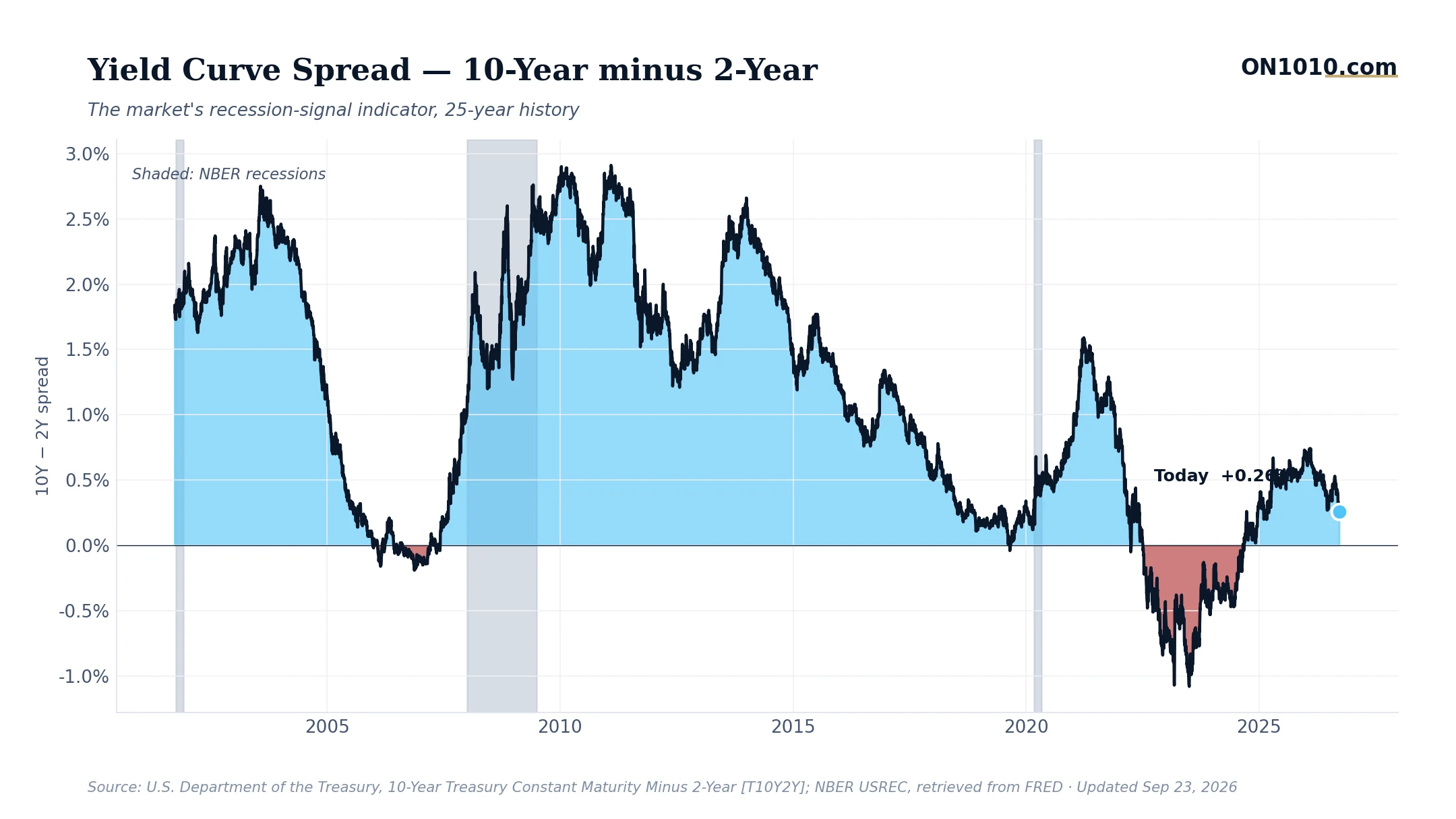
The 10-year/2-year Treasury spread sits at 0.26% as of September 23, a hair wider than the 0.25% the day before. The number sounds small because it is. But the direction matters more than the level right now: this spread spent much of 2022 through 2024 deeply negative, which was one of the most sustained yield curve inversions in modern history. It has now fully re-emerged into positive territory and has stayed there.
The journey from deeply inverted to positive is the story. A negative spread means short-term rates are higher than long-term rates, which historically signals that bond markets expect the economy to weaken and rates to fall. The return to positive territory suggests that view has shifted: markets now believe longer-run growth and inflation justify higher long-term yields relative to short ones. What makes today’s reading interesting is the broader backdrop. Long-term interest rates remain high versus history. Core inflation is still running hot relative to most of the historical record. And consumer sentiment remains unusually weak despite equity markets trading above their long-term trend lines.
Historically, when the curve moves from inversion back to positive, it has often marked the beginning of a new phase, but one that requires careful reading. The inversion typically signals recession risk ahead; the re-steepening can either mean the risk is fading or that long rates are rising faster than short rates because of persistent inflation expectations rather than renewed growth optimism. Those are two very different stories wearing the same number.
In past cycles, business leaders and capital allocators have watched the re-steepening closely to answer one question: is this a growth signal or an inflation signal? The difference shapes decisions around financing duration, capital expenditure timing, and how much of a margin cushion is realistic in a higher-for-longer rate environment.
Bottom Line: The curve is no longer flashing the recession warning it sent for two-plus years, but a spread of 0.26% is not a confident all-clear either. The real question is whether long rates are rising because growth is accelerating or because inflation is proving stickier than expected.
Source: Federal Reserve Economic Data (FRED)
ON1010 Research is an independent publisher of economic education and is not a registered investment adviser, broker-dealer, or investment company. This content is for educational and informational purposes only and is not investment advice or a recommendation to buy, sell, or hold any security. Published under the publisher exemption recognized by Section 202(a)(11)(D) of the Investment Advisers Act of 1940 (Lowe v. SEC). Always consult a qualified financial professional before making any financial decision.
Free Research
The economy moves fast. We make sure you move faster.
Economic data, policy shifts, and market signals — delivered to your inbox.
Subscribe Free