
The Yield Curve Is Positive Again. Here’s Why That Might Not Be the Good News It Sounds Like.
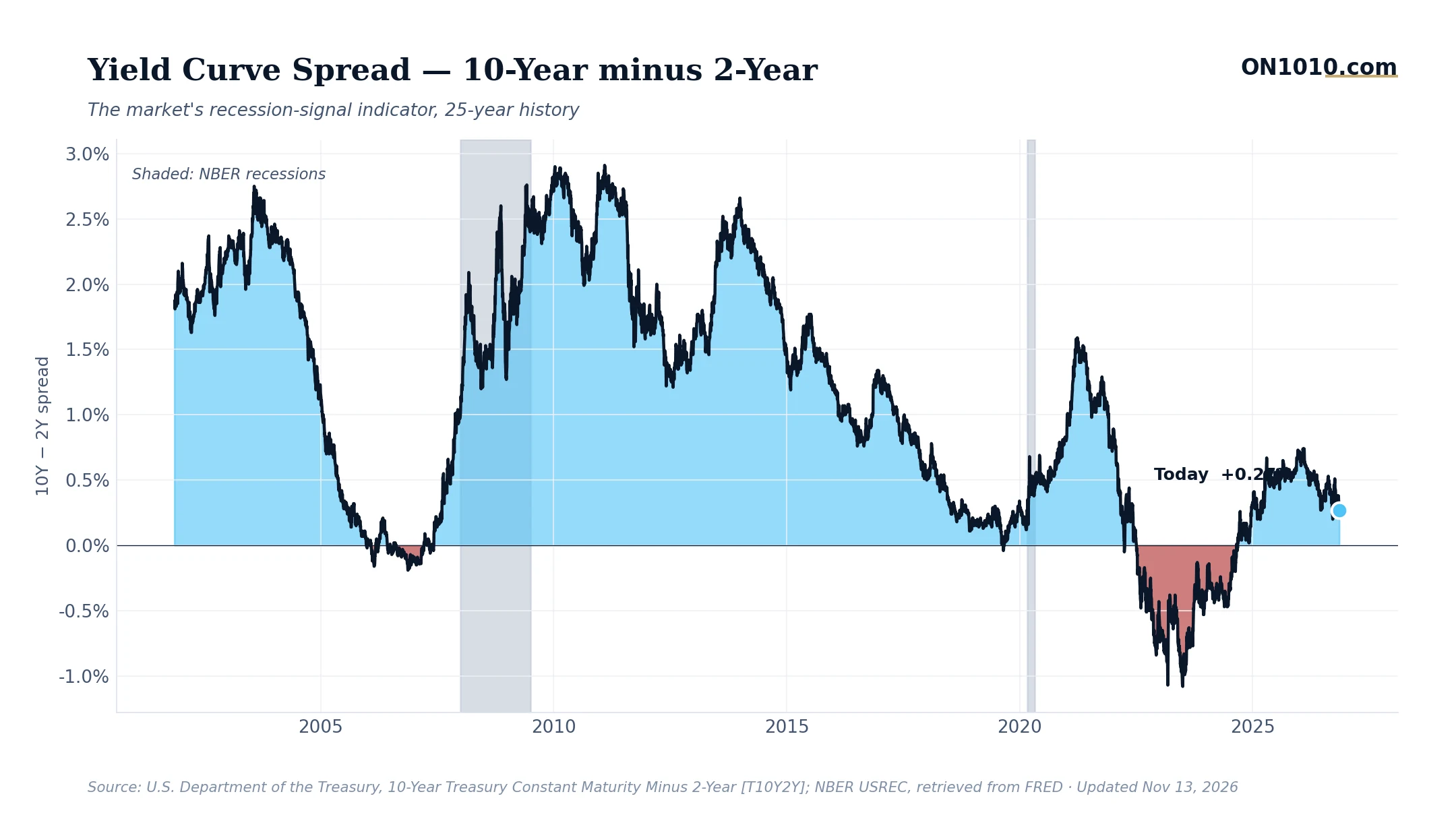
The 10-year/2-year Treasury spread ticked up to 0.27% on November 13, its third reading in four days above zero after the longest yield curve inversion in modern history. The curve is no longer sending the classic recession alarm. But the story of what comes after an inversion clears is more complicated than the headline suggests.
Here’s the puzzle. The yield curve spent roughly two years inverted, a stretch that historically preceded every major recession since the 1970s. Now it’s positive again. Consensus reaction: relief. But students of past cycles know that the inversion ending is not the all-clear signal. In 2006 and again in 2019, the curve un-inverted before recessions began, as short rates fell in anticipation of Fed cuts rather than because the economic outlook had genuinely brightened. The re-steepening, in those cases, was the warning, not the recovery.
The broader dashboard makes this worth watching carefully. Credit spreads are wide and moving wider, sitting near historical stress levels. Consumer sentiment is at the low end of its historical range. Long-term interest rates are high and rising, which means borrowing costs are still a headwind for businesses and households. Defensive sectors, specifically health care, real estate, consumer staples, and utilities, have been dramatically outperforming growth-oriented sectors over the past month. Capital is repositioning toward safety, which often precedes economic softness rather than following it.
Historically, when the curve re-steepened from deep inversion, in past cycles this came in two flavors: a benign soft landing, or the early phase of a downturn that markets hadn’t fully priced yet. Differentiating between the two required watching whether short rates fell because growth recovered or because the Fed was cutting in response to weakness. The monetary policy gauge remains restrictive, and that distinction matters enormously for how businesses should think about financing costs and investment timelines. A qualified financial professional can help frame what this means for a specific situation.
Bottom Line: A positive yield curve is better than a negative one, but re-steepening from inversion has historically been one of the most misread signals in macro. The question to keep asking is whether rates are normalizing because the economy is healthy or because something is quietly breaking.
Source: Federal Reserve Economic Data (FRED)
ON1010 Research is an independent publisher of economic education and is not a registered investment adviser, broker-dealer, or investment company. This content is for educational and informational purposes only and is not investment advice or a recommendation to buy, sell, or hold any security. Published under the publisher exemption recognized by Section 202(a)(11)(D) of the Investment Advisers Act of 1940 (Lowe v. SEC). Always consult a qualified financial professional before making any financial decision.
Free Research
The economy moves fast. We make sure you move faster.
Economic data, policy shifts, and market signals — delivered to your inbox.
Subscribe Free