
The Yield Curve Is Positive Again. History Says That’s the Moment to Pay Attention.
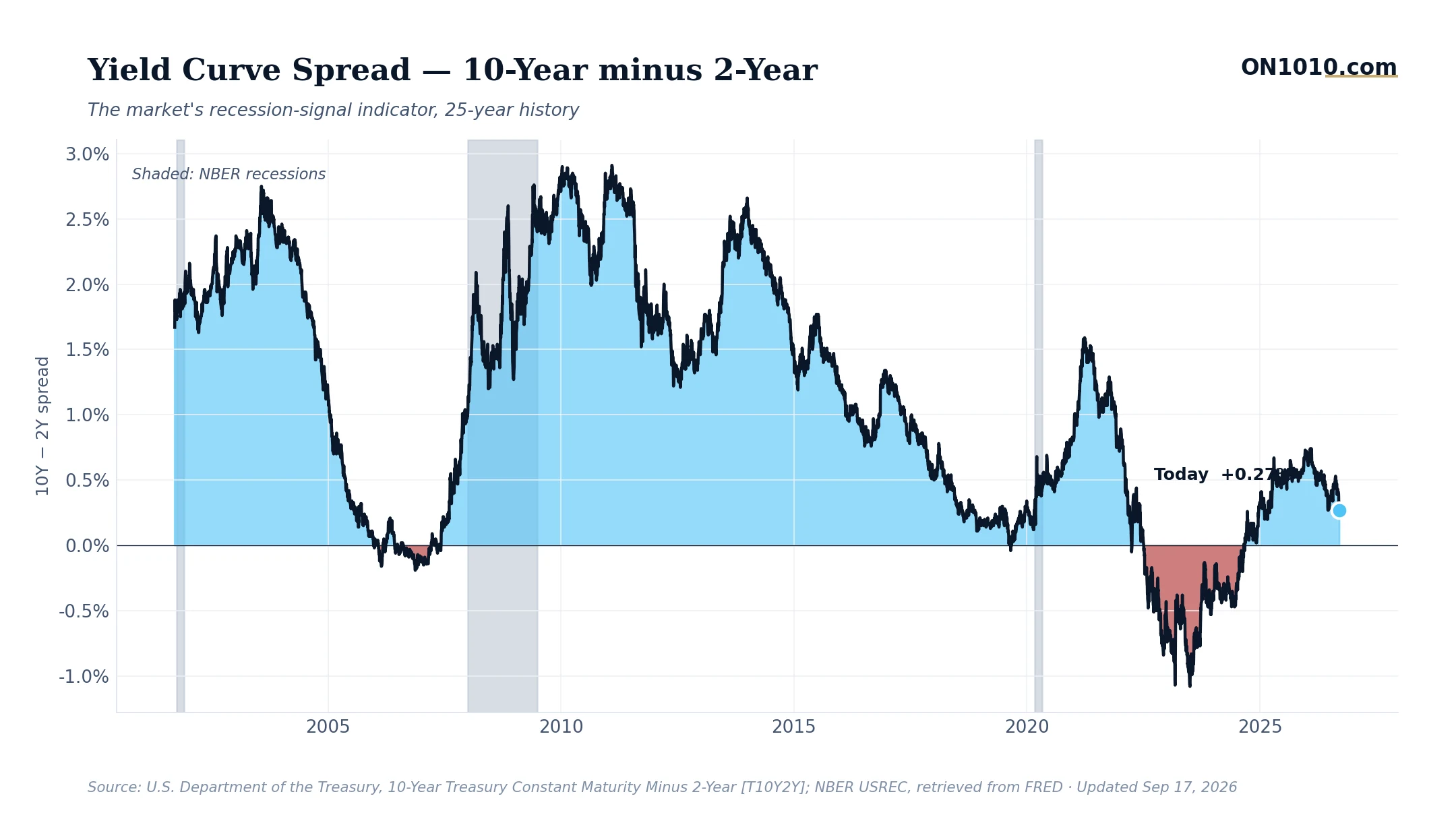
The 10-year minus 2-year Treasury spread sits at 0.27% as of September 17, down from 0.39% just a week ago. The curve is still positive, which sounds like good news. The tricky part is what happens after the curve un-inverts.
Here’s the puzzle most people miss. The yield curve spent much of 2023 and 2024 deeply inverted, with short-term rates towering over long-term ones. Now it has climbed back above zero. The popular instinct is to call that all-clear. But historically, the recession signal from an inverted yield curve has most often arrived not during the inversion itself, but in the months after the spread turns positive again. The economy tends to feel fine right up until it doesn’t.
The broader dashboard makes this worth watching carefully. Long-term interest rates remain high relative to history, and that creates real friction: businesses refinancing debt, consumers carrying variable-rate loans, and municipalities rolling over bonds all face a cost structure that squeezes margins. Credit spreads are tight, which tells you credit markets are calm for now. But consumer sentiment is historically weak, and market trend and participation have been deteriorating. The bond market and the equity market are sending slightly different messages, and that tension is exactly the kind of thing worth tracking over the next several months.
Historically, when the spread has sat in this narrow positive band (0 to 0.5%) after a prolonged inversion, it has marked a transitional phase rather than a clean recovery signal. In past cycles, capital allocators have used this window to examine whether their financing assumptions were built for a world of 3% rates or a world of 5% rates, because those two worlds require very different balance sheets. Historically, from readings in this zone, a new recession began within 12 months roughly 10 to 19% of the time depending on which gauge you anchor to. Base rate worth knowing, not a prediction.
Bottom Line: The yield curve returning to positive territory is not the same as the coast being clear. The real question is whether the economy is healing into this normalization or simply catching its breath before the lag effects of two-plus years of tight policy arrive.
Source: Federal Reserve Economic Data (FRED)
ON1010 Research is an independent publisher of economic education and is not a registered investment adviser, broker-dealer, or investment company. This content is for educational and informational purposes only and is not investment advice or a recommendation to buy, sell, or hold any security. Published under the publisher exemption recognized by Section 202(a)(11)(D) of the Investment Advisers Act of 1940 (Lowe v. SEC). Always consult a qualified financial professional before making any financial decision.
Free Research
The economy moves fast. We make sure you move faster.
Economic data, policy shifts, and market signals — delivered to your inbox.
Subscribe Free