
The Yield Curve Is Shrinking Again. Here’s Why That Matters.
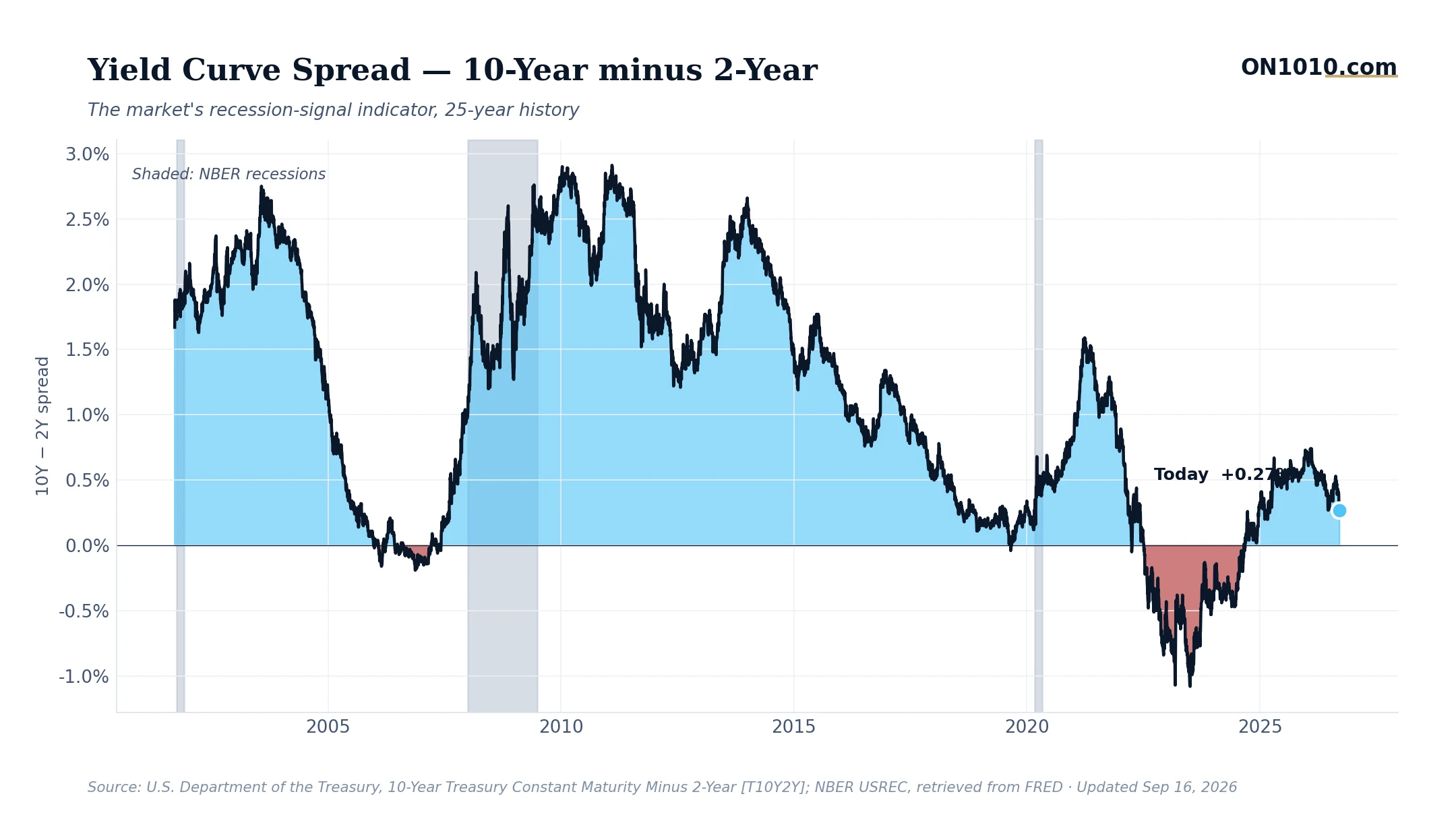
The gap between 10-year and 2-year Treasury yields fell to 0.27% on September 16, down from 0.33% the day before, a drop of roughly 18% in a single session. After briefly widening to 0.40% earlier in the month, the curve is compressing again. Positive territory is better than inverted, but this much movement in one day is worth paying attention to.
The yield curve tells a story about what bond investors collectively expect from the economy. When 10-year yields are notably above 2-year yields, the market is pricing in growth and future inflation. When the gap is this thin, the market is sending a more cautious message: that long-term growth expectations are not running much ahead of short-term ones. The broader dashboard reinforces the tension. Long-term interest rates sit in the upper quarter of their historical range, inflation remains hotter than roughly nine of every ten months on record, and consumer sentiment is near multi-decade lows. Meanwhile, credit spreads are historically tight, meaning corporate bond investors are calm even as the rate structure compresses. These signals pull in different directions, and the yield curve is where a lot of that tension surfaces.
Historically, a yield curve that re-flattens after briefly steepening has sometimes signaled that the initial relief was premature. In past cycles, businesses watching this spread have used it as a rough gauge of future borrowing costs and credit availability, both of which affect investment decisions and hiring plans. When the curve is thin, the usual historical cushion between short-term funding costs and long-term returns narrows, which tends to slow lending at the margin.
Bottom Line: The curve crossed back into positive territory a few months ago, which looked like a clean signal. September’s re-flattening asks whether that story was complete, or just paused.
Source: Federal Reserve Economic Data (FRED)
ON1010 Research is an independent publisher of economic education and is not a registered investment adviser, broker-dealer, or investment company. This content is for educational and informational purposes only and is not investment advice or a recommendation to buy, sell, or hold any security. Published under the publisher exemption recognized by Section 202(a)(11)(D) of the Investment Advisers Act of 1940 (Lowe v. SEC). Always consult a qualified financial professional before making any financial decision.
Free Research
The economy moves fast. We make sure you move faster.
Economic data, policy shifts, and market signals — delivered to your inbox.
Subscribe Free