
Workers Got a Raise. Inflation May Have Eaten It.
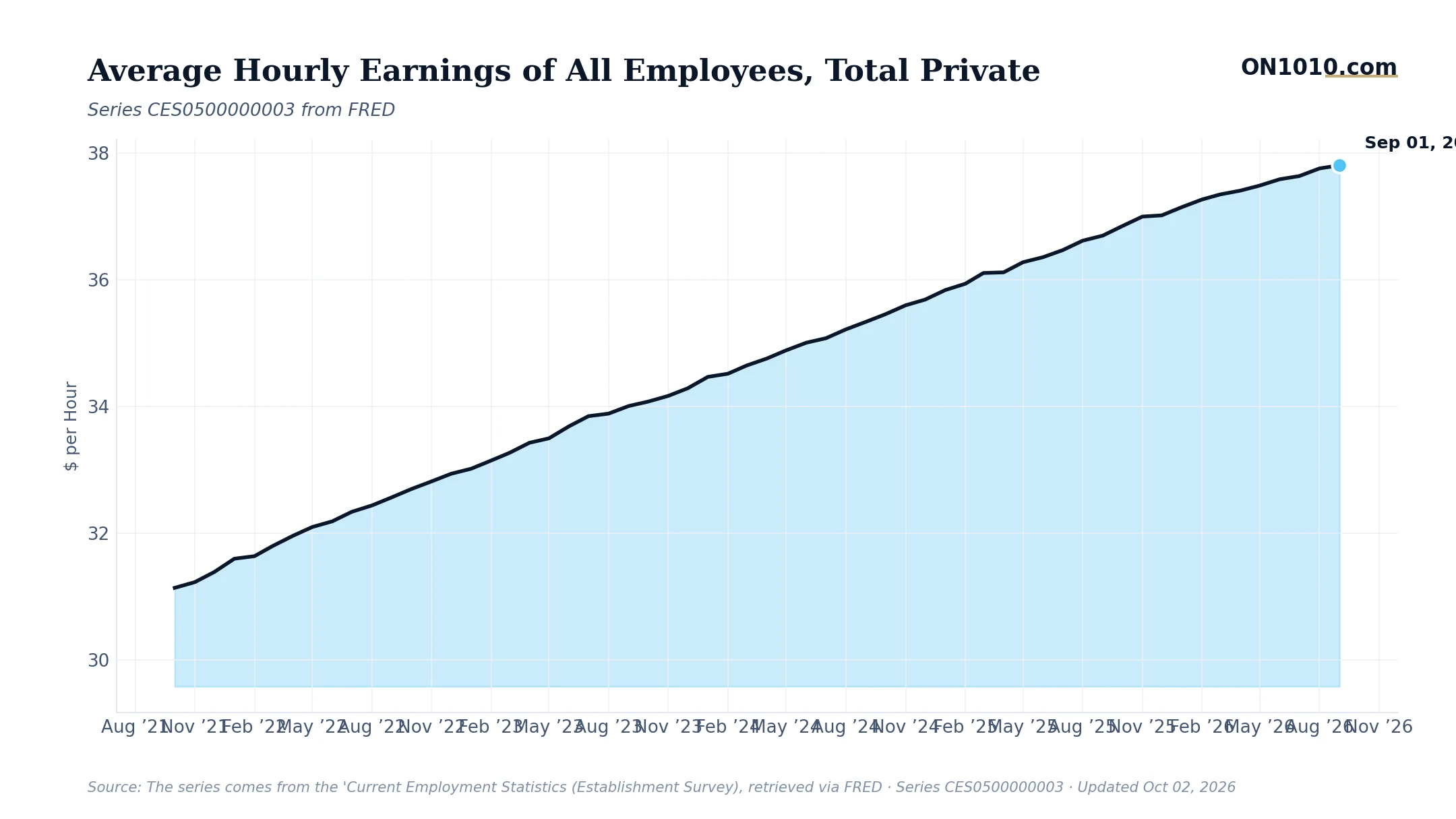
Average hourly earnings rose to $37.81 in September, up from $37.76 in August. The month-over-month gain of 0.13% is modest, but the real story sits in the annual number: wages are up just 2.19% over the past year.
That sounds fine. Until you check what inflation is doing.
Core inflation is still running hot by historical standards, sitting in the upper range of its long-run history. If consumer prices are rising faster than 2.19%, the average worker’s paycheck buys less this month than it did last September, even though the dollar number went up. That gap between nominal wage growth and real purchasing power is where most people’s frustration with the economy actually lives.
Zoom out and the six-month trend tells a consistent story. Earnings have climbed steadily from $37.41 in April to $37.81 today, a gain of about $0.40 over five months. Steady, yes. Dramatic, no. For businesses, slow wage growth is a margin tailwind. For workers, it depends entirely on what prices are doing on the other side of that equation.
Historically, when wage growth runs below or close to the inflation rate for an extended stretch, consumer sentiment tends to soften even when unemployment stays low. That pattern fits the current backdrop: consumer sentiment is near the bottom of its long-run historical range, which seems contradictory in a labor market that’s still adding jobs. The purchasing-power squeeze helps explain why. In past cycles, investors and business operators have watched whether real wage growth can turn positive and sustain itself, because consumer spending doesn’t just follow employment. It follows whether workers feel like they’re gaining ground.
Bottom Line: The nominal wage number is moving in the right direction. The question is whether the real wage number is moving at all.
Source: Federal Reserve Economic Data (FRED)
ON1010 Research is an independent publisher of economic education and is not a registered investment adviser, broker-dealer, or investment company. This content is for educational and informational purposes only and is not investment advice or a recommendation to buy, sell, or hold any security. Published under the publisher exemption recognized by Section 202(a)(11)(D) of the Investment Advisers Act of 1940 (Lowe v. SEC). Always consult a qualified financial professional before making any financial decision.
Free Research
The economy moves fast. We make sure you move faster.
Economic data, policy shifts, and market signals — delivered to your inbox.
Subscribe Free