
THE BOND MARKET’S INFLATION VERDICT: STILL ANCHORED, STILL WORTH WATCHING
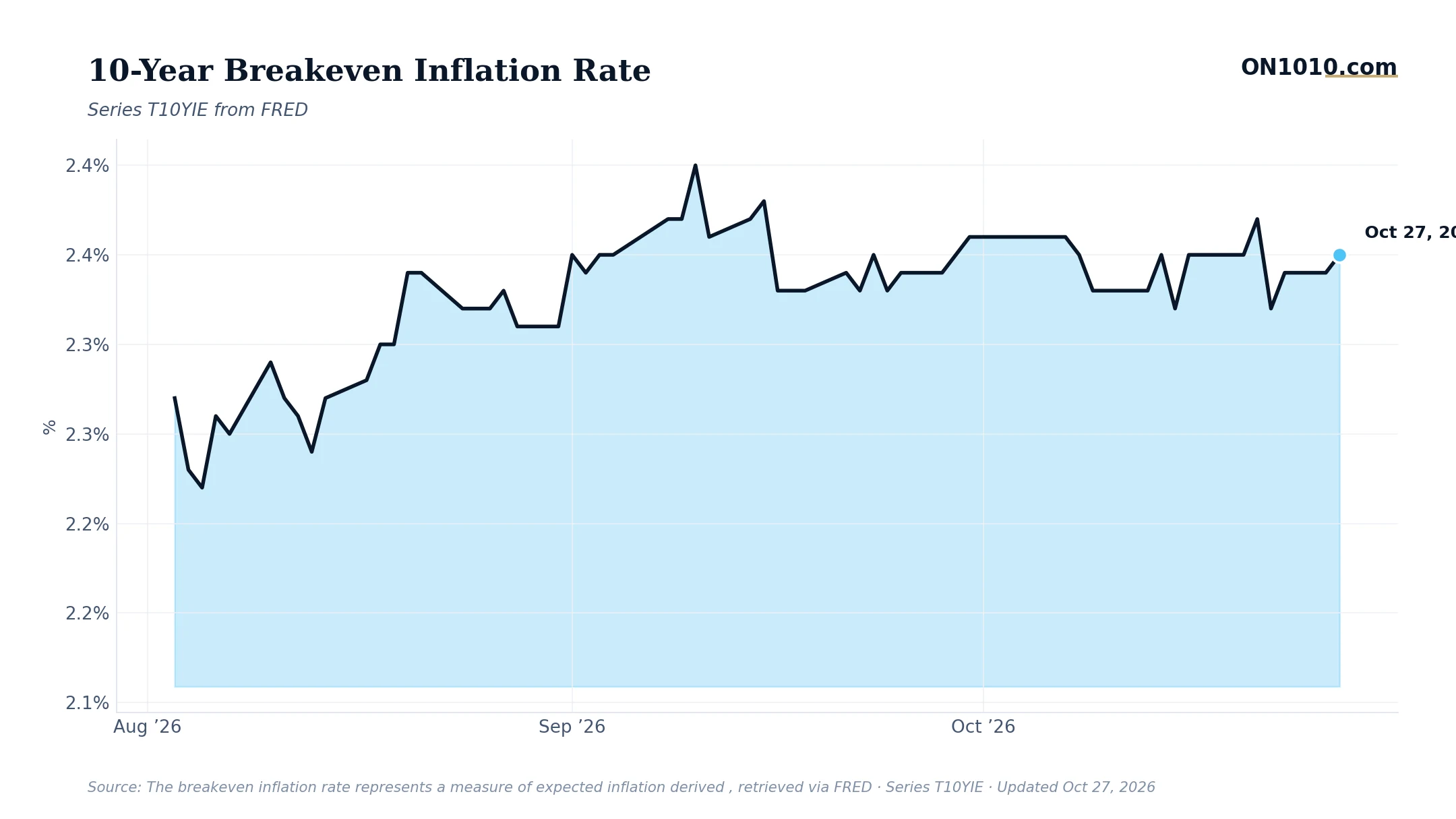
The 10-year breakeven inflation rate ticked up to 2.35% on October 27, from 2.34% the day before. A one basis point move is barely a rounding error, but the bigger story is what the number itself says: bond markets expect inflation to average 2.35% over the next decade, which puts them almost exactly at the Fed’s 2% target zone. Steady? Yes. Comfortable? That depends on what else is happening around it.
Pull back from the daily wiggles and the range over the past week sits between 2.32% and 2.37%. That kind of tight clustering means the bond market has largely made up its mind. Inflation psychology, for now, appears contained. That matters because actual inflation readings remain hot relative to history, and monetary policy is running restrictive by historical standards. The fact that long-run expectations have stayed near 2.35% despite both of those pressures suggests the Fed’s credibility is holding. But credibility is not a permanent condition. It gets priced every single day.
Here is where the backdrop gets complicated. Credit spreads are wide and rising, consumer sentiment is historically weak, and equity market participation is deteriorating. Defensive sectors (utilities, staples, health care) are outperforming growth-oriented technology and communication services by a wide margin over the past month. Bond markets may believe inflation stays contained, but money is quietly repositioning toward safety. Those two signals can coexist for a while, and then they can’t.
In past cycles, when breakevens held in the 2.25% to 2.50% range while credit spreads widened and equity breadth deteriorated, the question investors and business operators asked was whether the Fed had done enough, or too much. Historically, restrictive real policy rates in this zone have preceded economic softening about 18% of the time within the following year. That is not the base case; it is the risk worth pricing.
Bottom Line: The bond market is saying inflation is under control. The credit market and sector rotation are saying something more cautious. When those two signals diverge, the question is which one is leading, and which one is about to catch up.
Source: Federal Reserve Economic Data (FRED)
ON1010 Research is an independent publisher of economic education and is not a registered investment adviser, broker-dealer, or investment company. This content is for educational and informational purposes only and is not investment advice or a recommendation to buy, sell, or hold any security. Published under the publisher exemption recognized by Section 202(a)(11)(D) of the Investment Advisers Act of 1940 (Lowe v. SEC). Always consult a qualified financial professional before making any financial decision.
Free Research
The economy moves fast. We make sure you move faster.
Economic data, policy shifts, and market signals — delivered to your inbox.
Subscribe Free