
The Yield Curve Is Positive Again. That’s Not Necessarily Good News.
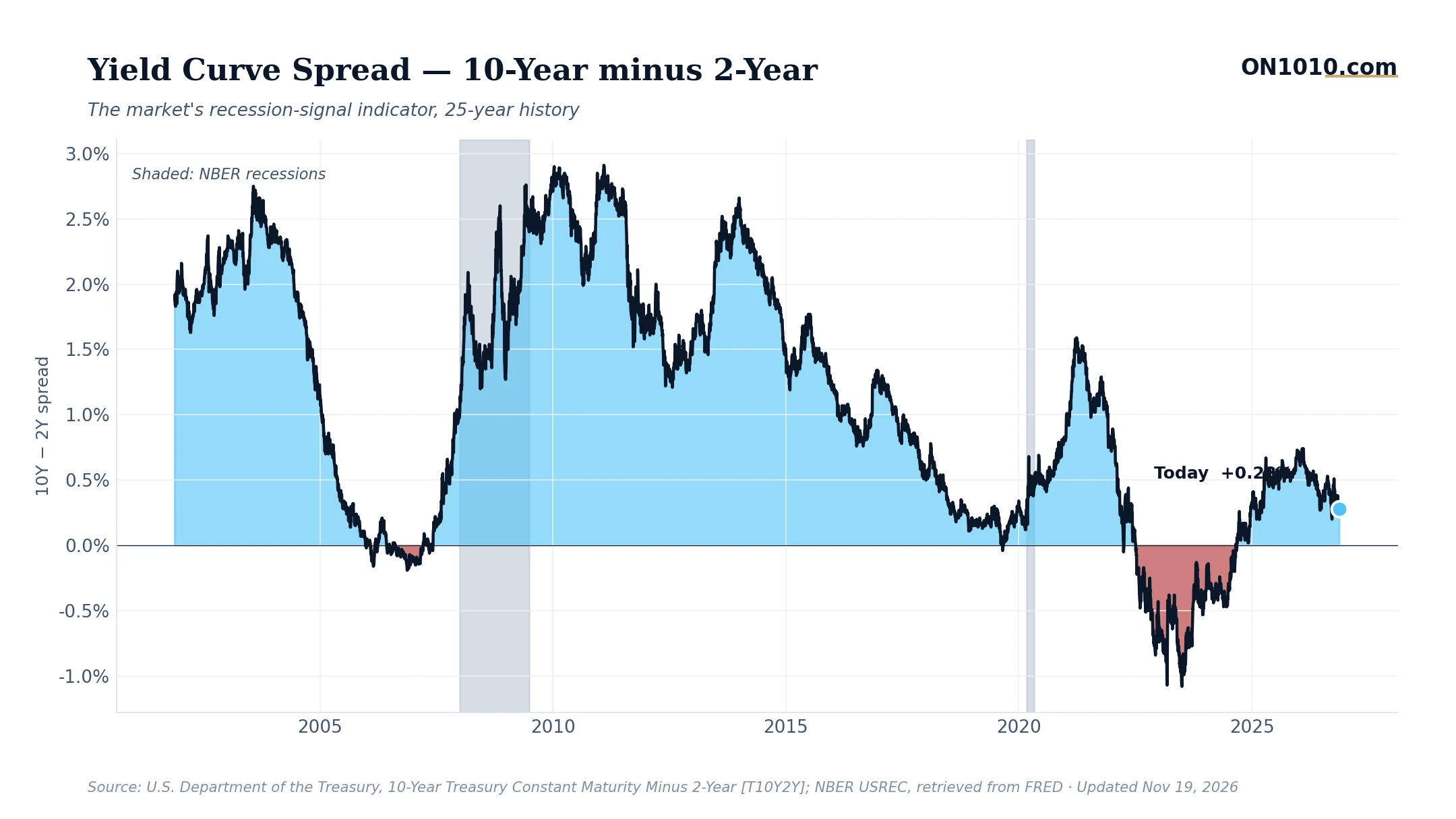
The 10-year/2-year Treasury spread ticked up to 0.28% on November 19, extending a stretch of positive readings after one of the longest yield curve inversions in modern history. The curve has been back above zero for a while now. Here’s what that re-steepening is actually telling us, and why it deserves more scrutiny than celebration.
The yield curve inverts when short-term rates rise above long-term rates, typically because the Fed has tightened aggressively. It un-inverts in two ways: either the economy strengthens and long-term yields climb (a “good” steepening), or the economy softens and the Fed cuts short-term rates to respond (a “bad” steepening). Historically, the second version is more common. The inversion itself isn’t where recessions have tended to arrive. They tend to arrive after the curve turns positive again.
That context matters here. Monetary policy is still running restrictive relative to history, with real rates elevated. Credit spreads are wide and rising. Consumer sentiment is near historic lows. Meanwhile, sector rotation in equity markets shows money moving decisively into defensive names, with consumer staples and utilities outperforming the broader market by roughly 9 percentage points over the past month. That kind of rotation has historically reflected institutional investors repositioning ahead of slower growth, not for it.
In past cycles, a curve at this level, combined with restrictive real rates and widening credit spreads, has raised the probability of further economic slowing. Historically, when real rates have been elevated while the curve re-steepened from inversion, businesses and lenders have both pulled back on new commitments. For anyone making capital allocation or financing decisions, the spread between borrowing costs and expected returns is the number to watch closely.
Bottom Line: A positive yield curve sounds like good news after two years of inversion. But the question worth asking is what drove the return to positive territory: renewed economic strength, or the early footprints of a slowdown the bond market already sees coming?
Source: Federal Reserve Economic Data (FRED)
ON1010 Research is an independent publisher of economic education and is not a registered investment adviser, broker-dealer, or investment company. This content is for educational and informational purposes only and is not investment advice or a recommendation to buy, sell, or hold any security. Published under the publisher exemption recognized by Section 202(a)(11)(D) of the Investment Advisers Act of 1940 (Lowe v. SEC). Always consult a qualified financial professional before making any financial decision.
Free Research
The economy moves fast. We make sure you move faster.
Economic data, policy shifts, and market signals — delivered to your inbox.
Subscribe Free