
Consumer Confidence Is Flatlining Near Historic Lows. The Economy Hasn’t Flinched, Yet.
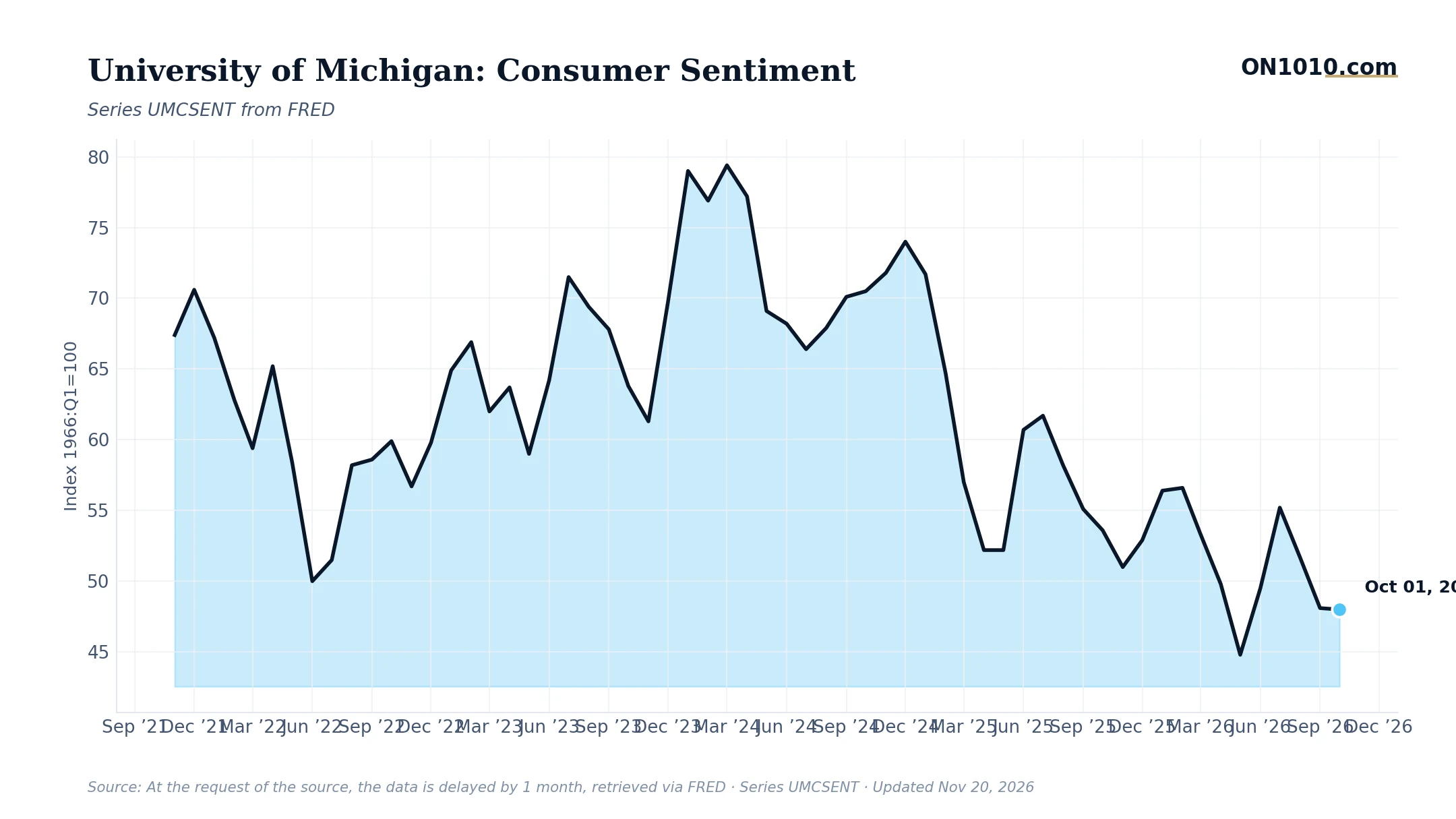
Consumer sentiment hit 48.0 in October, essentially unchanged from September’s 48.1, but that near-flat reading masks something worth paying attention to. The index has now spent five consecutive months below 52, nearly 9.3% below where it was a year ago, and sits near the very bottom of its long-run historical range. Americans are deeply pessimistic about the economy. Spending, so far, has held up better than the mood would predict.
That gap between how people feel and how they behave is the central tension right now. Consumer sentiment surveys capture fear and frustration. Actual spending captures what people do with their wallets. The two have diverged sharply at several points in the past few years, partly because the top 40% of earners, who drive a disproportionate share of consumer spending, have more financial cushion to spend through their own pessimism. What sentiment readings like this tend to capture first is a pullback in big discretionary purchases: cars, appliances, home improvements, things people can delay. The question is whether that softness stays contained or spreads.
The broader picture reinforces the caution. Inflation remains historically high, the real policy rate is restrictive, credit spreads are wide and rising, and the VIX is elevated, now sitting well above its recent average. Defensive sectors (staples, utilities, health care, real estate) have significantly outpaced the broader market over the past month. When money moves that decisively toward safety, it’s worth asking whether institutional investors are seeing something in forward margins and earnings that headline data hasn’t caught yet. Historically, restrictive monetary policy at this level has preceded a new recession within 12 months roughly 18% of the time. Base rate, not forecast.
In past cycles, prolonged sentiment readings at these depths, when they finally did give way, tended to precede a gradual recovery in confidence once either inflation cooled or the job market held firm. For businesses, the more immediate question is whether customers are pausing large purchases and what that means for order pipelines in Q1.
Bottom Line: Consumer sentiment is barely moving off a historic floor, and the financial conditions around it, tight credit, elevated volatility, cautious institutional positioning, suggest this isn’t just a mood. The disconnect between sentiment and spending is the economy’s load-bearing assumption right now. If that cracks, the read across to margins and hiring gets considerably more complicated.
Source: Federal Reserve Economic Data (FRED)
ON1010 Research is an independent publisher of economic education and is not a registered investment adviser, broker-dealer, or investment company. This content is for educational and informational purposes only and is not investment advice or a recommendation to buy, sell, or hold any security. Published under the publisher exemption recognized by Section 202(a)(11)(D) of the Investment Advisers Act of 1940 (Lowe v. SEC). Always consult a qualified financial professional before making any financial decision.
Free Research
The economy moves fast. We make sure you move faster.
Economic data, policy shifts, and market signals — delivered to your inbox.
Subscribe Free