
The Economy’s Secret Weapon Is Still Firing
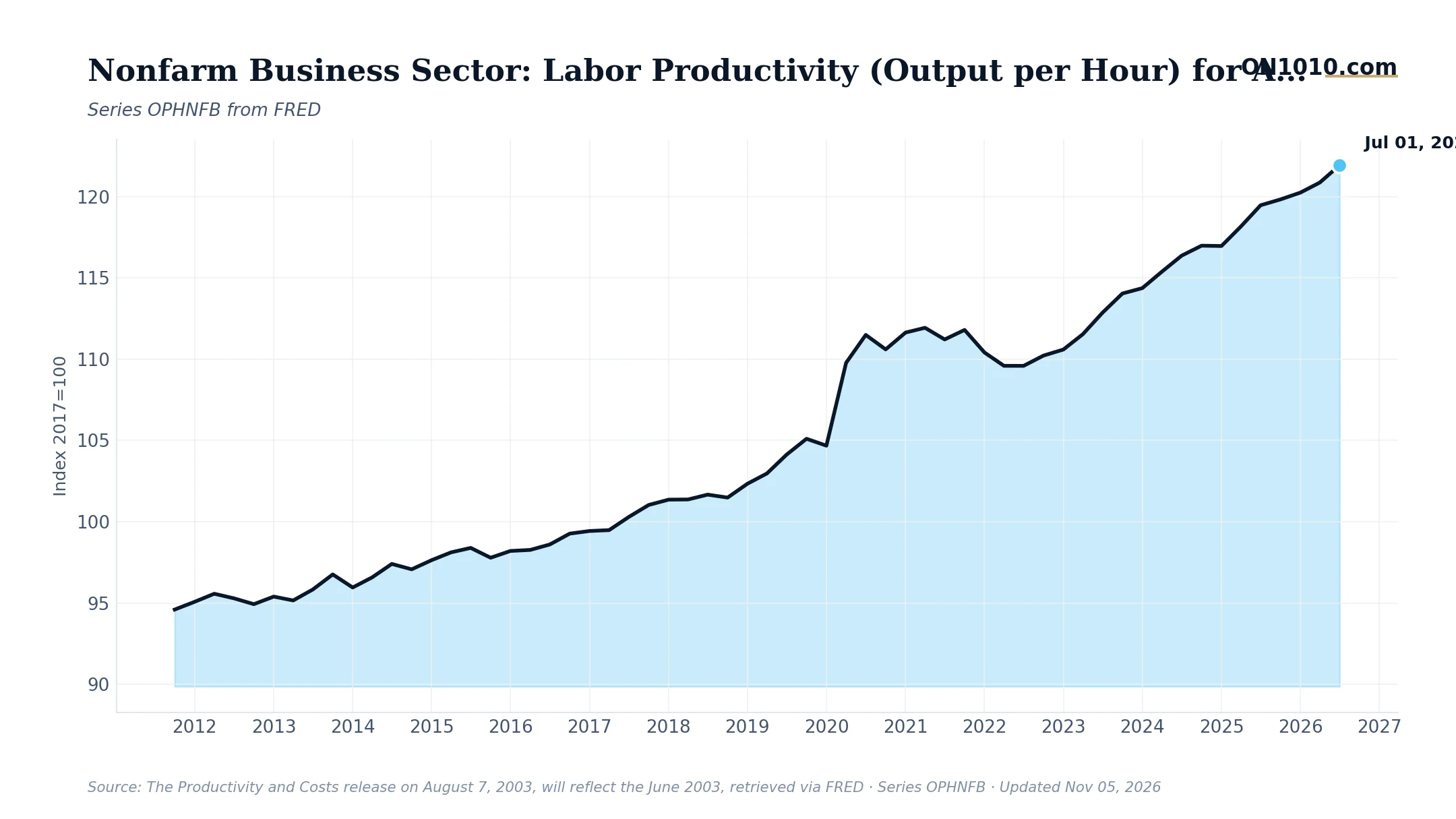
The number most Wall Street coverage glosses over just came in strong. Nonfarm business productivity rose 0.88% in the second quarter of 2026, pushing the year-over-year gain to 2.06%. In an economy wrestling with sticky inflation and restrictive interest rates, that is a quietly significant development.
Here is why it matters. Productivity growth around 2% per year means the economy can produce more output without hiring proportionally more workers or pushing up wages in ways that rekindle inflation. It is one of the few mechanisms that keeps growth and price stability on the same side of the ledger at once. The trend has been consistent: the index has climbed from 118.16 a year ago to 121.922 today, a steady upward march with no meaningful interruption.
The bigger picture is where this gets interesting. Inflation is running very high relative to its own history. The Fed’s real policy rate is restrictive. Credit spreads are wide. Consumer sentiment is near historical lows. Any one of those conditions would typically slow investment and squeeze margins. Yet productivity keeps rising, which suggests businesses have found ways to do more with the same inputs, whether through technology adoption, workflow changes, or the lingering effects of post-COVID restructuring. The AI productivity thesis, still unproven at the macro level, would look something like this if it were beginning to show up in the data.
Historically, sustained productivity growth in the 1.5% to 2.5% range has given the Fed more room to maneuver, because unit labor costs rise more slowly when workers are producing more per hour. In past cycles, periods of solid productivity growth have also supported profit margins even when top-line revenue growth slowed, which is the linkage business operators and capital allocators tend to watch most closely. Past performance does not predict future results, but the mechanism is worth understanding.
Bottom Line: Productivity is doing the heavy lifting right now, quietly offsetting some of the most restrictive financial conditions in decades. The question is whether this pace holds once businesses finish optimizing and have to invest fresh capital to keep improving.
Source: Federal Reserve Economic Data (FRED)
ON1010 Research is an independent publisher of economic education and is not a registered investment adviser, broker-dealer, or investment company. This content is for educational and informational purposes only and is not investment advice or a recommendation to buy, sell, or hold any security. Published under the publisher exemption recognized by Section 202(a)(11)(D) of the Investment Advisers Act of 1940 (Lowe v. SEC). Always consult a qualified financial professional before making any financial decision.
Free Research
The economy moves fast. We make sure you move faster.
Economic data, policy shifts, and market signals — delivered to your inbox.
Subscribe Free