
When the Guns Go Quiet, Follow the Oil Math
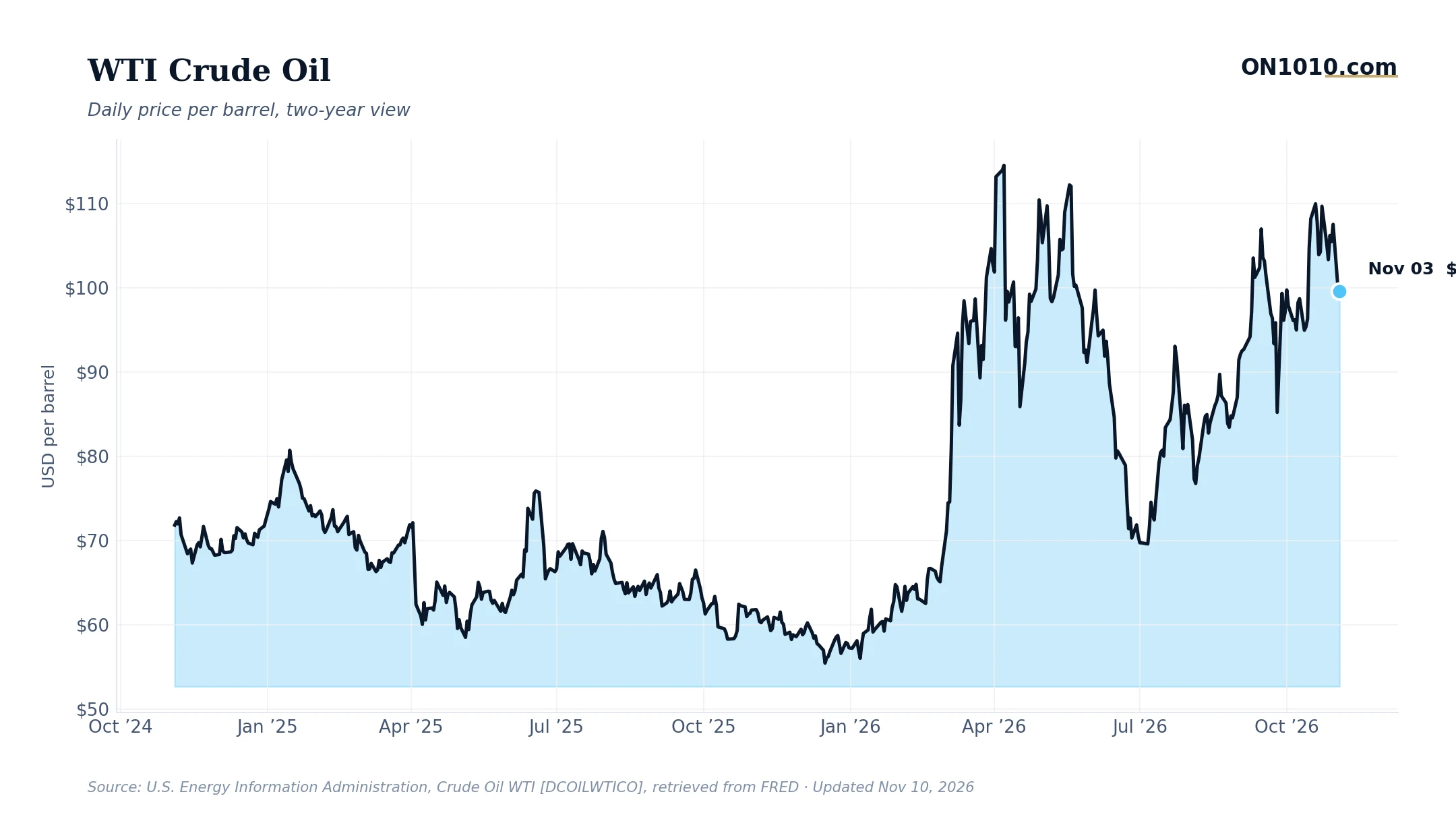
According to CNBC, President Trump declared that Iran “militarily is effectively over,” citing the destruction of its navy and what he described as runaway inflation gutting Tehran’s economy. He said the war would end “fairly soon” and played down the likelihood of further strikes. It’s a significant de-escalation signal from Washington, but the gap between a presidential statement and a durable peace agreement is wide enough to drive a tanker through.
The Strait of Hormuz is the chokepoint that handles roughly 20% of global oil trade. When military risk around that corridor rises, energy markets price in a disruption premium. When it falls, that premium can drain quickly. The question now is how much of a risk premium the market has already embedded in energy prices, and whether Trump’s comments represent a genuine path to resolution or a negotiating signal aimed at Tehran, Riyadh, and energy markets simultaneously. Those are very different things with very different market consequences.
What’s worth watching here is the broader macro backdrop. Core inflation is running near the top of its historical range. The Fed’s real policy rate is already restrictive. If geopolitical cooling actually delivers lower energy costs, that’s a disinflationary tailwind that could ease some pressure on the Fed, though one development in one region rarely moves the needle on a structural inflation problem. The bond market will be the tell. If long rates start drifting lower on reduced energy risk, that would signal the market believes the de-escalation is real.
Meanwhile, the broader market is sending the opposite signal from “calm returning.” Defensive sectors have been running well ahead of growth sectors. Consumer staples and health care are outperforming by double digits over the past month. Credit spreads remain wide. Consumer sentiment sits near historic lows. Historically, investors have treated geopolitical de-escalation as a reason to revisit beaten-down cyclical sectors, but that rotation tends to be durable only when the underlying economic fundamentals support it. Right now, those fundamentals are mixed at best.
Bottom Line: A ceasefire signal from Washington is worth noting, but the economic conditions that made this conflict so destabilizing, elevated inflation, tight credit, and weak consumer confidence, don’t disappear with a press conference.
Read more: CNBC Top News
ON1010 Research is an independent publisher of economic education and is not a registered investment adviser, broker-dealer, or investment company. This content is for educational and informational purposes only and is not investment advice or a recommendation to buy, sell, or hold any security. Published under the publisher exemption recognized by Section 202(a)(11)(D) of the Investment Advisers Act of 1940 (Lowe v. SEC). Always consult a qualified financial professional before making any financial decision.
Free Research
The economy moves fast. We make sure you move faster.
Economic data, policy shifts, and market signals — delivered to your inbox.
Subscribe Free