
Bond Markets Are Pricing Inflation Close to Target. The Rest of the Dashboard Tells a Different Story.
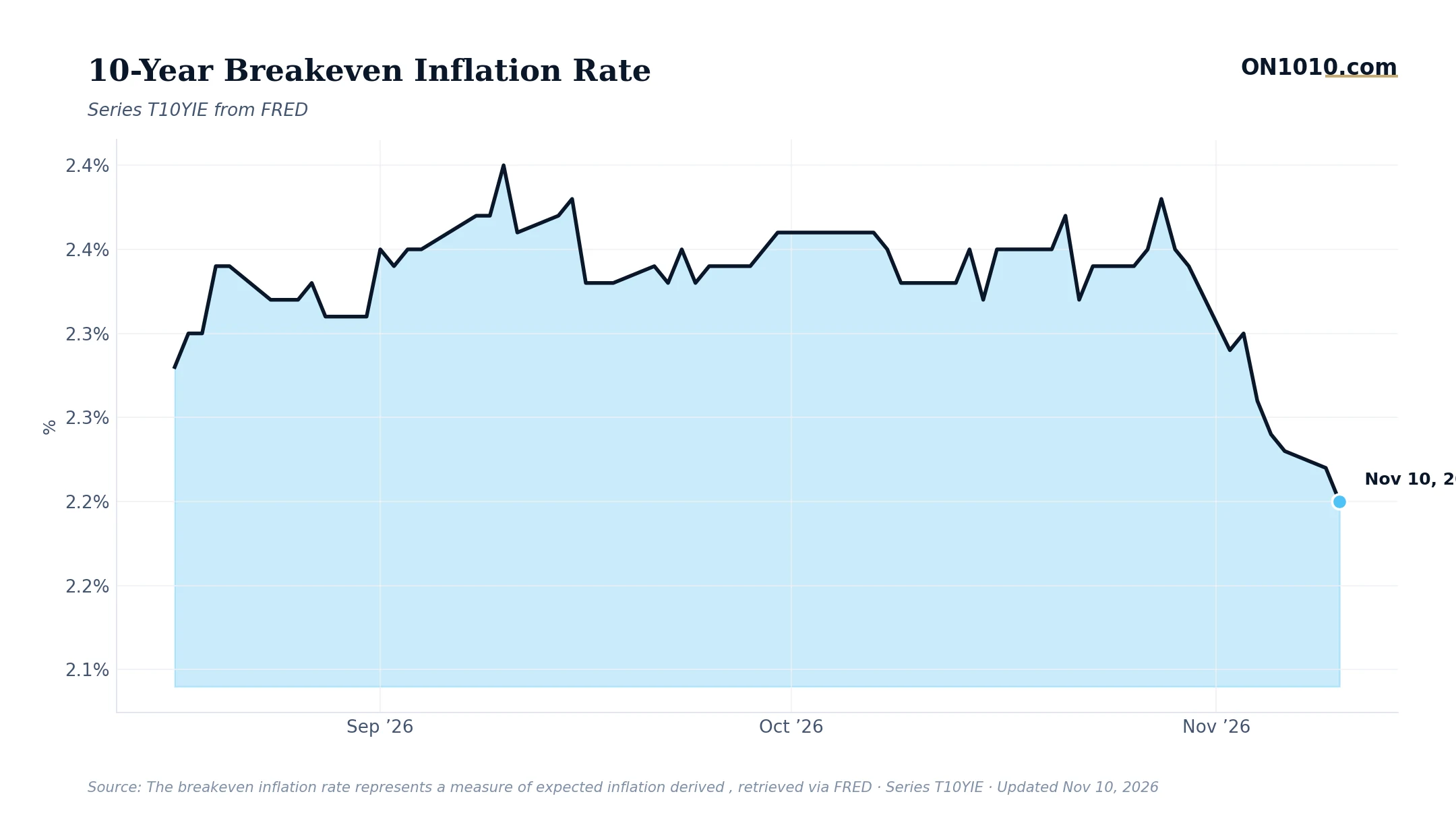
The 10-year breakeven inflation rate slipped to 2.2% on November 10, down from 2.3% just a week ago. That is a meaningful six-week drop, and on its surface, it looks like good news. Bond investors, it appears, are becoming more comfortable that inflation is heading back toward the Fed’s 2% target.
But comfortable and correct are two different things.
Here is the tension worth sitting up for. Core inflation is running historically hot, well above where it has been in nine out of every ten months on record. The Fed’s real policy rate is high by historical standards, meaning monetary policy is genuinely restrictive. And yet the bond market is essentially saying: relax, it’s almost over. That divergence deserves scrutiny. Either the bond market is pricing in a faster return to normal than the data supports, or the economic gauges are lagging a real turn in momentum. Both are possible. Neither is obvious.
The backdrop makes this harder to read, not easier. Credit spreads are wide, sitting near the upper end of their historical range. Consumer sentiment is near its lowest readings in decades. Sector rotation in equities shows a clear flight toward defensive names (consumer staples up 12.3% versus SPY, health care up 13.6% versus SPY) while technology has shed 10.7% relative to the broader market. When money moves that decisively toward safety, the market is expressing something the inflation breakeven alone does not capture.
Historically, breakevens near 2.2% have signaled that markets believe the Fed’s inflation fight is nearly won. In past cycles, that has sometimes been right and sometimes premature, particularly when inflation was structurally driven rather than cyclically driven. The post-2020 economy has more structural inflation pressure built into it than any cycle in the prior 30 years, which is a reason to treat the current breakeven with some skepticism. Past performance does not predict future results, and this environment has few clean historical analogs. For business leaders thinking about multi-year pricing strategy or capital commitments, the question the breakeven raises is straightforward: does the bond market know something the rest of the indicators do not, or is it underpricing the stickier parts of the inflation story?
Bottom Line: The 10-year breakeven is telling a calming story about inflation’s future. Wide credit spreads, elevated volatility, and a defensive rotation in equities are telling a more cautious one. When the signals split this sharply, the honest answer is that the market is genuinely uncertain, and that uncertainty itself is worth pricing into how you think about the next 12 to 18 months.
Source: Federal Reserve Economic Data (FRED)
ON1010 Research is an independent publisher of economic education and is not a registered investment adviser, broker-dealer, or investment company. This content is for educational and informational purposes only and is not investment advice or a recommendation to buy, sell, or hold any security. Published under the publisher exemption recognized by Section 202(a)(11)(D) of the Investment Advisers Act of 1940 (Lowe v. SEC). Always consult a qualified financial professional before making any financial decision.
Free Research
The economy moves fast. We make sure you move faster.
Economic data, policy shifts, and market signals — delivered to your inbox.
Subscribe Free